Switzerland runs its pensions like a precision timepiece while France debates retirement age reforms. For the 300,000+ French frontaliers (cross-border workers) commuting daily to Swiss jobs, understanding how their mandatory retirement savings get invested isn’t just curiosity, it’s financial survival. The public sector pension fund PKBS in Basel offers a rare window into a system that turns monthly contributions into projected half-million-franc nest eggs through institutional-grade diversification that would make a French asset manager weep with envy.
The Three-Pillar Reality Check
Switzerland’s retirement system rests on three pillars that function nothing like France’s repartition model. The first pillar (AVS/AI) covers basic needs through state solidarity, similar to France’s sécurité sociale (social security). The second pillar, where things get interesting, operates on pure capitalization. Each month, both employee and employer feed a personal pension pot that belongs to the worker, not the state. The third pillar mirrors France’s PER (retirement savings plan) with tax-deductible voluntary contributions.
A 30-year-old public sector worker in Basel chips in 315 CHF monthly from his gross salary. His employer adds 379.50 CHF. These aren’t taxes disappearing into a bureaucratic black hole, they’re investments compounding in his name. The fund projects 500,000 CHF by age 65, even using deliberately pessimistic scenarios. Try finding a French répartition (pay-as-you-go) scheme that gives you that level of individualized transparency.
The Asset Allocation That French Funds Won’t Touch
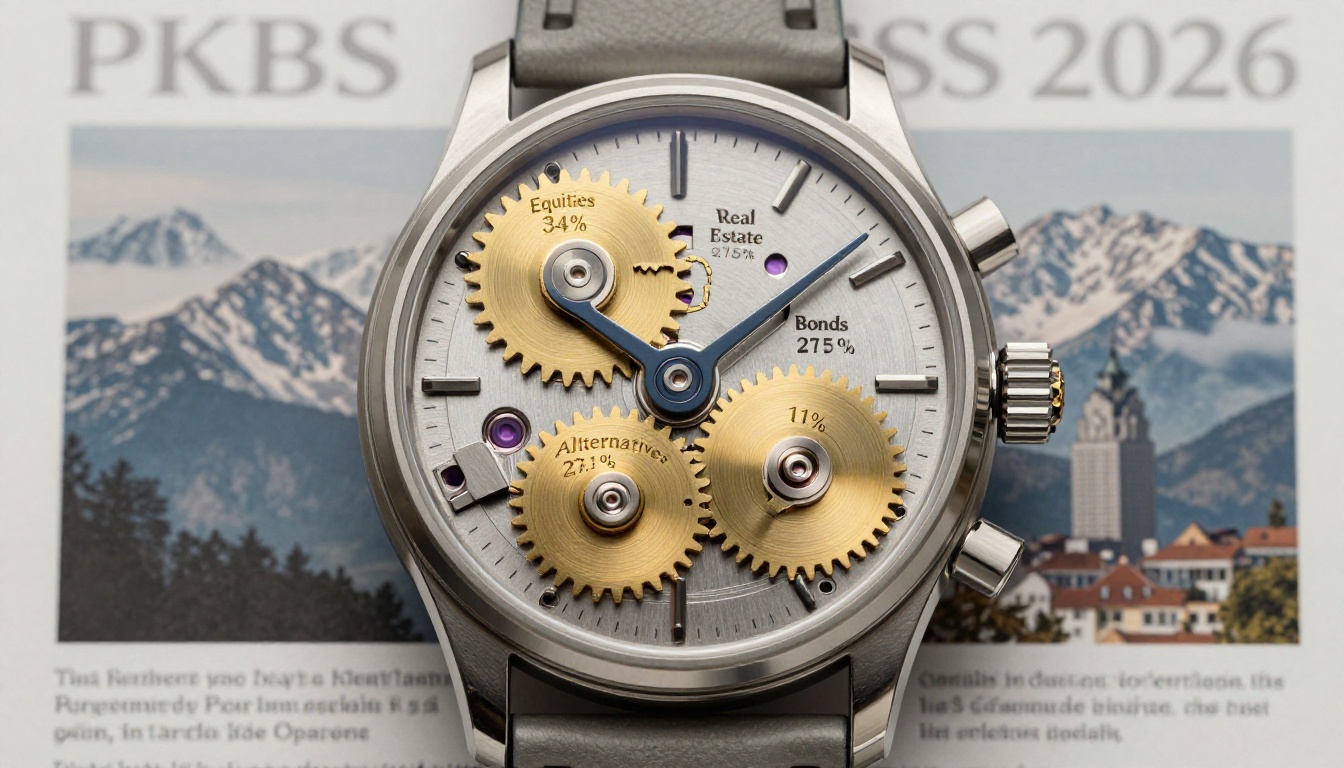
PKBS distributes contributions across asset classes that would trigger regulatory heartburn in Paris. The 2026 strategy shows institutional sophistication far beyond French euro-denominated fonds en euros (euro funds):
- Actions (equities) 34%: Split between 13.5% Swiss stocks and 20.5% international, heavily weighted toward US markets. No artificial home bias constraints.
- Immobilier (real estate) 27.5%: Primarily Swiss properties (24%), providing inflation-linked income and stability. French pension funds barely touch direct property.
- Obligations & Prêts (bonds & loans) 27.5%: Includes CHF-denominated bonds (11%), mortgages (5.5%), and direct loans (5%). The mortgage component is particularly clever, lending against Swiss real estate rather than just buying bonds.
- Alternatifs & Divers (alternatives) 11%: This is where PKBS gets spicy. Private equity and infrastructure (4%), convertible bonds (4%), and notably, or (gold) at 3% for inflation protection.

That gold allocation represents a philosophical difference: Swiss pension funds treat inflation as a real risk requiring tangible hedging, while French schemes pretend inflation doesn’t exist until it shows up in the deficit reports.
The Governance Model France Desperately Needs
Swiss pension law mandates a minimum return of 1% annually, even when markets tank. If performance exceeds this threshold, the surplus gets distributed strategically: funding current retiree pensions, building reserves for bad years, and paying above-minimum returns to active members. This creates a buffer system that French caisses de retraite (pension funds) lack entirely.
Performance varies dramatically between funds. Large public-sector funds like PKBS managing entire cantons keep fees minimal and achieve 4-5% average returns. Meanwhile, some commercial funds, AXA gets mentioned frequently, capture excess returns for themselves, delivering only the legal minimum. The transparency around these differences would be revolutionary in France’s opaque pension landscape.
Many international residents report waiting weeks for banking appointments in Paris, despite expectations of streamlined processes. In Switzerland, pension fund members access detailed investment breakdowns and performance data online. The contrast highlights how governance culture shapes outcomes.
Why French Frontaliers Should Pay Attention
For French workers crossing the border daily into Geneva, Basel, or Lausanne, the second pillar represents forced savings at institutional rates. A couple working in Switzerland with a combined 12,000 CHF net monthly income can live comfortably while building substantial retirement capital. The same couple earning equivalent euros in Lyon would struggle to replicate this through French PER products with their limited investment options.
The math is stark. A 30-year-old contributing 694.50 CHF monthly (employee + employer) for 35 years at 4% average return accumulates roughly 590,000 CHF. The same contribution into a French PER with typical 2% net returns (after high fees) yields barely 400,000 EUR. The 190,000 difference isn’t abstract, it’s a decade of additional retirement income.
Swiss health insurance costs, 450-600 CHF monthly for a 30-year-old in Geneva, often shock French workers accustomed to sécurité sociale contributions. But this individual model creates portability and transparency that France’s system lacks. When you change jobs, your second pillar capital moves with you, unlike French pension rights that get fragmented across multiple regimes.
The Hidden Mechanics Nobody Discusses
Management fees remain opaque even in Switzerland. The PKBS member admits uncertainty about exact costs, though managing an entire canton’s pensions suggests economies of scale. French residents considering Swiss employment should demand fee transparency before signing contracts, some funds charge hidden administrative costs that erode the headline advantage.
Performance projections use deliberately pessimistic scenarios, which explains why a 30-year-old with only three years of contributions sees 500,000 CHF projections. Veteran colleagues report annual increases on their statements as the fund recalculates. This conservative approach contrasts with French pension projections that often assume unrealistic growth to mask structural deficits.
The ability to redirect allocations, like shifting toward more equities, varies by fund. PKBS offers limited customization, treating members as pooled investors rather than individual portfolio managers. This institutional approach works for diversification but frustrates finance-savvy members who manage their own PEA (stock savings plan) with 100% S&P 500 exposure on the side.
The Salary Equation That Makes It Work
Living in Switzerland demands serious income. A single person needs 5,000-6,000 CHF net monthly in Zurich or Geneva to maintain comfort. Yet this high cost enables the system. Employers contribute substantially to pension funds because labor markets require it. The 379.50 CHF employer contribution represents a real employment cost that French companies avoid by relying on state repartition.
Cross-border workers face unique challenges. They pay Swiss social charges but often live in French border regions with lower costs. This arbitrage allows aggressive pension building while maintaining reasonable living expenses. However, tax complications arise, Swiss withholding taxes combined with French impôt sur le revenu (income tax) declarations create administrative burdens that require professional advice.
The housing market in Swiss cities runs 2,000-2,500 CHF for a one-bedroom apartment, pushing many workers to border towns. A two-bedroom in Annemasse costs half what you’d pay in Geneva, but the commute adds transportation costs and complexity. The trade-off between rent savings and commute time dominates daily life for frontaliers.
Bottom Line: What France Could Steal
Switzerland’s pension success isn’t cultural mystique, it’s structural design. Mandatory capitalization with transparent investment strategies, legal minimum returns, and individual ownership creates accountability. French reforms keep tinkering with retirement ages while avoiding the fundamental question: who owns the capital?
French workers can’t replicate the Swiss system individually, but they can pressure for change. The PER structure already exists, what’s missing is the mandate and investment freedom. Allowing French pension funds to allocate 3% to gold or invest directly in Swiss-style real estate would diversify risk beyond the current bond-heavy approach.
For the 300,000 French citizens already in the Swiss system, the strategy is simple: maximize second pillar contributions, understand your fund’s performance relative to peers, and treat the third pillar as serious tax optimization, not a savings afterthought. The projection of 500,000 CHF at retirement isn’t magic, it’s math, discipline, and a system designed to make the numbers work.
The real controversy isn’t that Swiss pensions outperform French ones. It’s that France knows exactly how to fix its system but chooses political expediency over structural reform. Every French frontalier’s pension statement serves as a monthly reminder that alternatives exist, and they compound nicely.