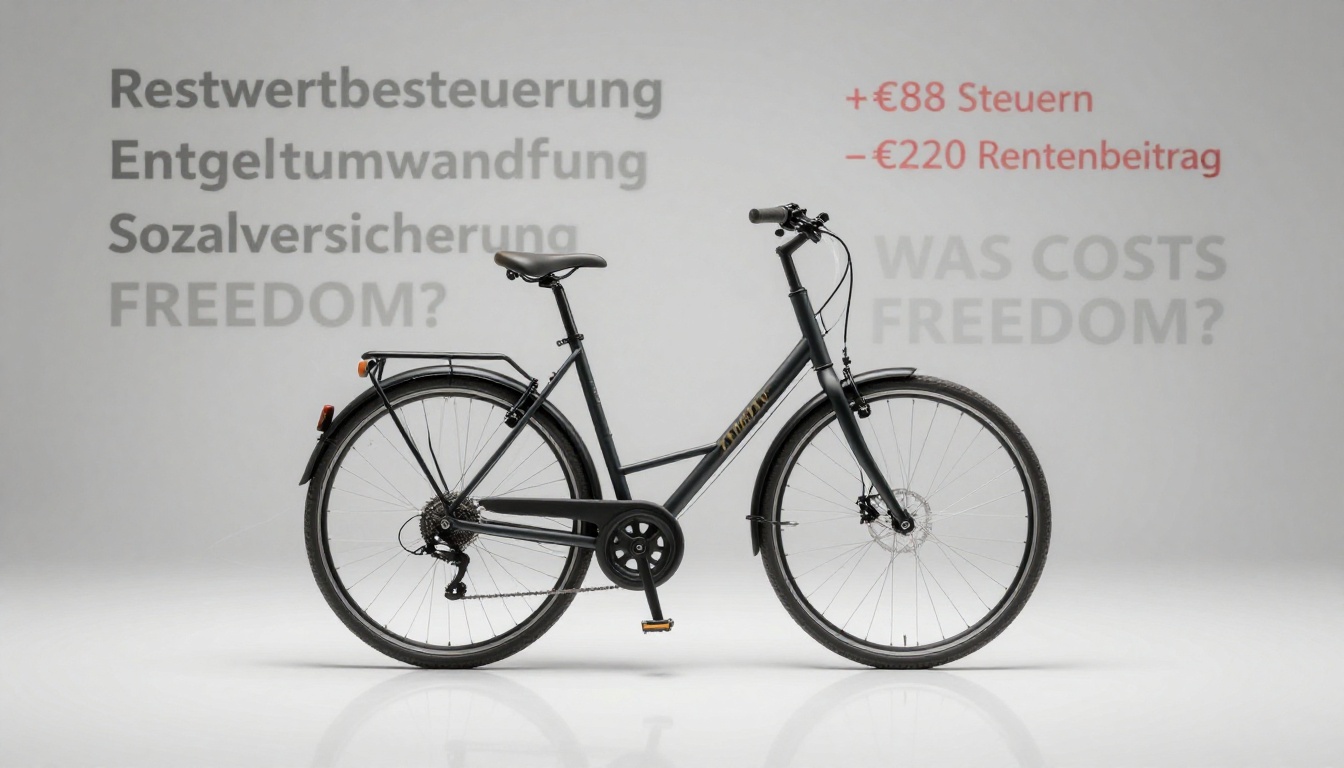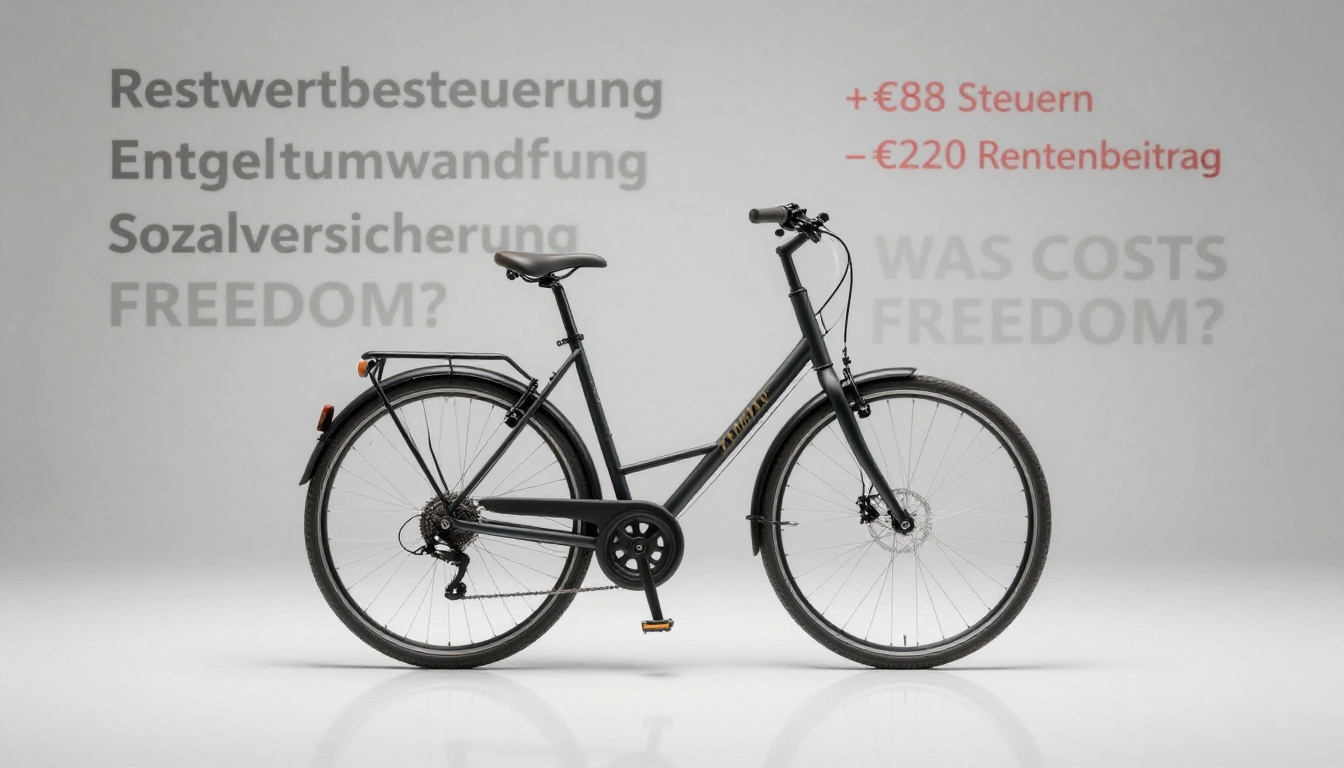
Your employer offers you a brand-new bike at a fraction of the cost. The brochure promises savings, sustainability, and health benefits. What could possibly go wrong? In Austria, plenty. Behind the glossy marketing of Jobrad and similar schemes lies a web of tax rules that can erase every cent of your supposed discount, and even leave you paying more than if you’d bought the bike outright.
The Leasing Mirage: How It Promises to Work
The pitch is simple: your employer leases a bike, you pay for it through your gross salary (Entgeltumwandlung – salary conversion), and everyone wins. You save on income tax and social security contributions because your taxable income drops. The employer gets a happy employee and a tax-deductible expense. The bike provider locks in a customer.
Take a typical scenario: a €1,200 bike over 24 months. You pay €702.72 in lease payments, with a residual value of €180. Total cost: €882.72. Since payments come from your gross salary, you might save 30-40% on taxes and social contributions. On paper, you’re getting a €1,200 bike for under €900. Except that’s not the full story.
The Residual Value Tax Trap: Where Savings Evaporate
Here’s where Austrian tax law delivers its first gut punch. The Restwert (residual value) in your contract, €180 in our example, often has little to do with the bike’s actual market value after two years of use. The Finanzamt (Tax Office) doesn’t care what your contract says. They care what the bike is actually worth.
If that €1,200 bike still commands €400 on the used market after 24 months, you must declare and tax the difference between the contractual residual value (€180) and the fair market value (€400). That’s €220 of additional taxable income. At a 40% marginal tax rate, you owe €88 in extra taxes. Suddenly your €882.72 bike costs €970.72, just €10 less than buying it new at full price.
Many international residents report shock when their Steuererklärung (tax return) reveals this hidden cost. The prevailing sentiment among those who’ve been through the process: the residual value clause makes the entire leasing benefit mathematically neutral at best, and a loss at worst.
The Pension Robbery You Don’t Notice
While you’re busy calculating tax on residual values, a more insidious cost quietly compounds: reduced pension contributions. Every euro diverted from your gross salary to bike leasing is a euro not contributing to your Rentenversicherung (pension insurance).
For someone earning €3,500 gross per month, leasing a €2,500 bike reduces monthly pension contributions by roughly €2. Over a 40-year career, that could mean €960 less in annual pension payments, every year for the rest of your life. The Bundesministerium für Arbeit und Soziales (Federal Ministry of Labour and Social Affairs) confirms that pension calculations depend directly on contribution amounts and duration.
The catch? If your income already exceeds the Sozialversicherung Höchstbemessungsgrundlage (social security maximum assessment threshold), this particular penalty disappears. But for most salaried workers under that limit, which sits at €5,850 per month in 2025, you’re slowly eroding your retirement income for a bike you’ll likely replace in three years.
This trade-off becomes even more painful when you consider other benefits. Lower gross income means reduced Krankengeld (sick pay), Arbeitslosengeld (unemployment benefits), and Elterngeld (parental leave benefits), since all are calculated based on your net earnings history. The Beamtenbund Thüringen (civil servants’ association) explicitly warns that the apparent savings are often illusory when long-term benefits are factored in.
The Ownership Illusion: Who Really Owns Your Bike?
Despite paying 70-80% of the bike’s value, you own precisely nothing until you pay the residual value at lease end. This creates a dangerous insurance gap. If your bike is stolen three months before the lease expires, the insurance payout goes to the leasing company, not you. You’ve paid nearly the full purchase price but receive zero compensation.
Many newcomers express frustration, discovering too late that mandatory service packages and insurance premiums often cost more than equivalent coverage bought independently. For a €1,200 bike, these add-ons can add €15-20 per month, effectively negating any tax benefit.
The 13th and 14th Salary Complication
Austrian employees receive two additional monthly salaries (13. Gehalt and 14. Gehalt – 13th and 14th salary), taxed at a preferential rate. Here’s the kicker: bike leasing payments typically reduce your base salary, which can push these special salary payments into a higher tax bracket.
One financial advisor noted: “Your 14th salary might get taxed at 35% instead of 20% because the leasing reduced your regular monthly income. The math gets ugly fast.” This effect varies by individual, but it’s rarely mentioned in leasing brochures.
When Does It Actually Make Sense?
After dissecting the traps, are there scenarios where bike leasing works? Yes, but they’re narrow:
- High earners above the social security threshold: You avoid the pension penalty entirely
- E-bikes over €2,500: The 0.25% monthly taxable benefit (€6.25 on a €2,500 bike) remains small relative to potential tax savings
- Employers covering insurance and service: Some companies absorb these costs, eliminating that penalty
- Certain purchase of the bike: If you know you’ll pay the residual value and keep the bike for 5+ years, the initial tax savings might justify the hassle
For a basic €1,200 commuter bike, however, the prevailing sentiment among Austrian financial planners is clear: buy it outright. The administrative overhead, tax uncertainty, and benefit erosion make leasing a solution in search of a problem.
The Bottom Line: Do the Math Three Times
Before signing any Jobrad agreement, calculate:
- Residual value tax: Research realistic used prices for your bike model after the lease term
- Pension impact: Use the Finanztip calculator to estimate reduced retirement income
- 13th/14th salary effect: Ask your HR department for a simulation of your specific tax bracket impact
- Insurance cost: Compare mandatory leasing insurance vs. independent policies
- Opportunity cost: Could you earn more by investing the price difference?
The new digital banking requirements have slashed paperwork, but introduced new compliance hurdles most expats overlook. Similarly, bike leasing promises simplicity while delivering complexity. For most Austrian employees, particularly those under the social security maximum threshold, the hidden costs of leasing in Austria turn a shiny benefit into a financial mirage.
Your best move? Open a dedicated savings account, automate monthly transfers equal to what your lease payment would be, and buy the bike outright in 18 months. You’ll own it from day one, face no tax surprises, and keep your pension contributions intact. In the world of Austrian employee benefits, sometimes the old-fashioned way is the only way that actually pays off.