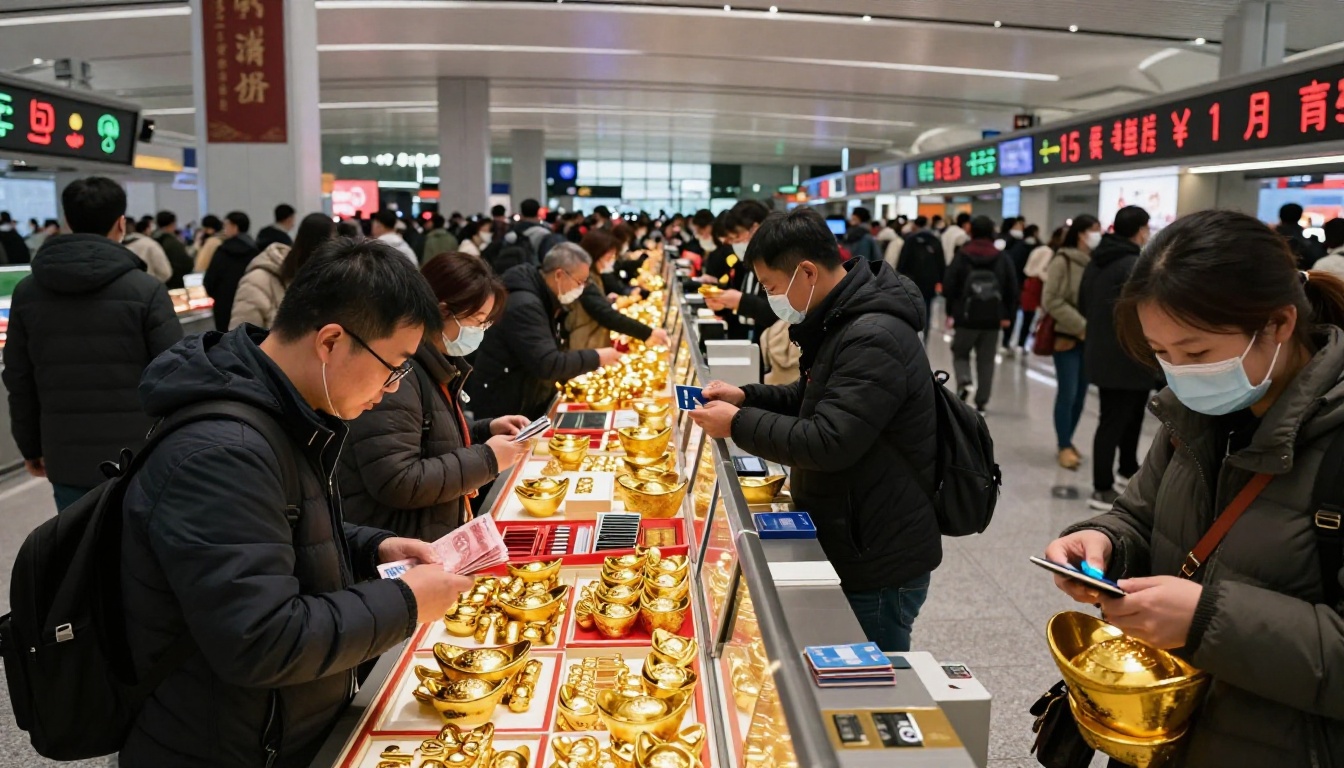
Fresh off a business trip to China, a traveler noticed something unusual at the airport: groups of people exchanging gold ingots, creating multiple bank cards, and counting stacks of cash. Gold shops were packed throughout the day, with customers buying jewelry, coins, and small bars. This wasn’t just holiday shopping.
The scene, observed in an airport departure hall, showed people creating numerous bank cards in sequence, a tactic often used to circumvent capital controls or spread assets across multiple accounts. The purchases didn’t appear ornamental. Something else was driving this behavior.
Cultural Tradition Meets Economic Anxiety
Chinese New Year traditions certainly play a role. Giving gold during the lunar new year symbolizes prosperity and good fortune. But the scale and intensity observed suggests more than tradition. Salaries in China are lower than in Europe, yet the gold buying was relentless. When tradition meets economic uncertainty, behavior shifts from symbolic to strategic.
Many Chinese households view physical gold as the ultimate safe haven. Unlike digital assets or bank deposits, gold cannot be frozen, devalued overnight, or subject to capital controls. In a financial system where property markets have stalled and stock markets remain volatile, gold offers something unique: complete ownership without counterparty risk.
Institutional Moves Mirror Individual Behavior
This isn’t just individual behavior. The People’s Bank of China has been systematically increasing its gold reserves while reducing exposure to US Treasury bonds. China’s gold holdings recently reached 74.1 million ounces, a record high, while foreign holdings of US debt have fallen to an 18-year low.
The movement reflects a broader shift toward tangible assets. Central banks across Asia and the Middle East are diversifying away from dollar-denominated debt, rewriting the rules of international reserves. This recomposition of global finance, while quiet on the surface, fundamentally alters the balance of monetary power.
For French investors, this institutional pivot creates ripple effects. As major economies reduce dollar dependence, currency volatility increases. The euro’s relationship with both the dollar and yuan becomes more unpredictable, affecting import prices, inflation, and investment returns in France.
Currency Volatility Hits French Portfolios
This isn’t theoretical. Currency volatility and its impact on investment behavior has already shown how American monetary policy creates immediate consequences for French bank accounts and portfolios. When central banks reposition themselves, exchange rates fluctuate, and the value of international investments shifts.
The Banque de France watches these developments closely. Large-scale gold accumulation by China represents a potential challenge to dollar dominance, which indirectly affects the euro’s role in global trade. For French residents with overseas assets or those working for multinational companies, these shifts can alter compensation, pension values, and investment performance.
The Macao Hotel That Sold Its Floor
This week, a Macao hotel announced it removed and sold 79 kilograms of gold ingots embedded in its lobby floor for nearly $13 million. Opened in 2006, the Grand Emperor Hotel had used gold bars as decorative flooring to project luxury. Citing renovation plans, management called the sale a “good opportunity” to monetize the asset amid record prices.

The transaction mirrors individual behavior: monetize gold when prices are high. But it also highlights a key difference between institutional and personal strategy. The hotel could afford to hold gold for nearly two decades. Individual investors often lack that patience or security.
French Tax Rules Complicate Gold Investment
For residents in France, buying physical gold involves navigating complex tax rules. The DGFiP (Direction Générale des Finances Publiques – French tax authority) treats gold differently depending on its form. Physical gold bars and coins face a flat 11.5% tax on capital gains, with an exemption after a 22-year holding period. Gold ETFs, by contrast, are taxed as financial assets under the PFU (Prélèvement Forfaitaire Unique – flat tax) at 30%.
Storage presents another challenge. While Chinese buyers can easily access gold shops, French investors must either store gold at home (risky) or pay for secure vaulting (expensive). The assurance-vie (life insurance wrapper) offers a tax-efficient way to hold gold ETFs, but not physical metal.
Silver: The Overlooked Alternative
While gold grabs headlines, other precious metals tell a similar story. Silver’s surge as an alternative precious metal investment suggests French investors might be overlooking opportunities closer to home. Silver has outperformed gold in recent months, yet receives far less attention in French investment circles.
The same economic anxieties driving Chinese gold purchases, currency devaluation fears, financial system instability, apply to silver. But silver’s lower price point and industrial applications create different risk-reward dynamics.
Practical Takeaways for French Residents
That old investment proverb, when your hairdresser starts talking about an asset, it’s time to sell, applies across cultures. The fact that gold has become mainstream conversation in China warrants caution, not panic buying.
For French residents considering precious metals, several principles apply:
First, understand your own financial system before chasing trends elsewhere. French tax rules, storage options, and investment vehicles differ fundamentally from China’s. What works in Shanghai may fail in Paris.
Second, consider allocation size. Most financial advisors suggest limiting gold to 5-10% of a portfolio. More concentrated bets require deep understanding of tax implications and storage logistics.
Third, explore alternatives. For those seeking inflation protection, French real estate (despite high entry costs), inflation-linked bonds, or diversified commodity funds may offer better risk-adjusted returns than physical gold.
Finally, monitor central bank policy. The Banque de France’s own gold reserves and the European Central Bank’s monetary policy affect gold prices more directly than Chinese consumer behavior. Yet the Chinese trend signals broader global anxiety that no investor can ignore.
The Chinese gold rush reflects genuine economic distrust and a cultural pivot toward tangible assets. It also reveals a world where financial systems feel increasingly fragile. For French investors, the lesson isn’t to copy Chinese behavior, but to recognize the underlying forces driving it, and ensure their own portfolios are prepared for a world where trust in paper assets continues to erode.