
A German investor walked into an Allianz branch a few years ago with €15,000 and walked out with a PrivateFinancePolice (PFP) contract, convinced they were diversifying their wealth. Several years later, that “investment” sits at €14,487.57, a 3% loss. During the same period, their self-managed ETF portfolio delivered 20% annual returns. The kicker? They’ll likely recover their loss within weeks by moving the money into market securities.
This isn’t an isolated horror story. It’s a textbook example of how Germany’s insurance industry continues to package expensive, inflexible products as prudent long-term investments while independent ETF investing runs circles around them.
The Product Behind the Pain
Allianz PrivateFinancePolice belongs to a category Germans call fondsgebundene Versicherungen (fund-linked insurance policies). These hybrid products wrap mutual funds inside an insurance contract, promising tax advantages and lifelong security. In reality, they combine the worst of both worlds: high insurance costs with mediocre fund performance.
The structure works like this: your contributions first feed a complex fee system, Abschlusskosten (acquisition costs), Verwaltungskosten (administrative fees), and Vertriebsprovisionen (distribution commissions). Only the remainder reaches the actual investment funds. The insurance wrapper adds layers of opacity that make true performance nearly impossible to track in real-time.
The Reddit user’s experience mirrors what financial regulators have documented for years: three-quarters of customers break these contracts early, forfeiting most benefits and locking in losses. The few who persist face another rude awakening at retirement: guaranteed annuity factors so low that you’d need to live past 85 just to break even compared to a direct payout.
The Fee Extraction Architecture
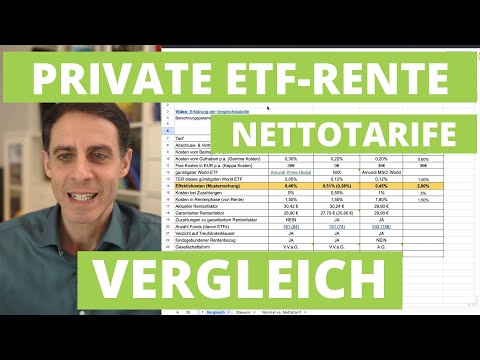
Let’s talk numbers. The Allianz InvestFlex product, the market leader in this space, carries effective costs of 1.30% annually. That doesn’t sound catastrophic until you compare it to a net tariff Nettotarif ETF pension insurance at 0.40% or, better yet, a plain ETF savings plan at 0.20-0.30%.
Over 25 years with €500 monthly contributions, that 0.90% difference balloons to €45,127 in lost capital. This aligns perfectly with our analysis of the hidden costs of German investment products eroding returns, where a €3,000 Union Investment fund shrank to €26 after a decade due to front-end loads and annual fees.
The German insurance industry perfected this model long before fintech arrived. They front-load costs, meaning your first years of contributions barely touch the investment portion. Cancel early? You forfeit most of your money. Stay? You pay premium fees for decades.
ETF-Sparplan: The Transparent Alternative
What makes the 20% annual ETF return even more striking is its simplicity. No opaque insurance mathematics. No Versicherungsmantel (insurance wrapper) obscuring performance. Just low-cost index funds tracking global markets.
The advantages compound over time:
– Kostentransparenz (cost transparency): TERs of 0.05-0.22% are published daily
– Flexibilität (flexibility): Pause contributions, change amounts, or withdraw without penalty
– Steuereinfachheit (tax simplicity): 26.375% Abgeltungssteuer (capital gains tax) applies only to 70% of gains for equity ETFs
– Real-time tracking: Your portfolio value updates by the minute, not quarterly in an insurer’s PDF
The tax “advantage” of insurance products? Overrated. Yes, the 12/62-Regelung (12/62 rule) taxes only 42.50% of gains after age 62 and 12 years of holding. But this requires locking your money for decades. ETFs offer superior net returns even after full taxation, and you maintain complete control.
Why Germany Still Falls for This
The persistence of underperforming insurance products reveals uncomfortable truths about German financial culture. Three structural factors keep this alive:
-
Distribution power: Insurance agents and bank advisors earn 2-4% commissions. They push these products aggressively, especially to customers seeking “sicher” (safe) investments.
-
Regulatory capture: The state actively subsidizes these products through tax deferral while failing to mandate transparent cost disclosure. As Prof. Dr. Hartmut Walz noted in his Finanzfluss criticism, even required Basisinformationsblätter (basic information sheets) sometimes vanish before contract signing.
-
Trust in institutions: Germans traditionally trust established brands like Allianz. The assumption that “they wouldn’t sell something bad” dies hard, even when performance data screams otherwise.
The Finanzfluss Parallel: When “Education” Sells Insurance
This controversy didn’t emerge in a vacuum. The same dynamics appeared when Germany’s largest financial YouTube channel, Finanzfluss, promoted ETF insurance products using a comparison calculator later exposed as systematically flawed. The calculator assumed complete portfolio rebalancing (unnecessary and tax-inefficient) and full liquidation at retirement (also unnecessary), making insurance products appear more competitive than reality.
When critics like Prof. Dr. Hartmut Walz called out these manipulations, Finanzfluss responded by quietly editing videos, shadow-banning critical comments, and disabling discussion entirely. The channel that built its reputation on “unbiased” education revealed itself as just another distribution arm for insurance partners.
This mirrors the broader lack of transparency in insurer-driven ’empowerment’ financial products. When Investforwomen GmbH faced lawsuits from the Verbraucherzentrale (Consumer Center), the pattern was identical: products marketed as empowering women financially turned out to be expensive insurance wrappers with minimal investment benefit.
The Math That Matters
Let’s run the actual numbers from our case study:
Allianz PFP (estimated structure):
– Initial: €15,000
– After fees and underperformance: €14,487.57
– Annualized return: approximately -0.5% (accounting for fee drag)
ETF Portfolio (actual performance):
– Same period: 20% annual returns
– If the €15,000 had gone here instead: €31,104 (after 4 years at 20% CAGR)
– Difference: €16,616 in missed gains
The investor plans to recover the loss “anticyclically” by buying market securities. Translation: they’ll make back years of insurance underperformance in weeks by switching to proper investments.
What Actually Works for German Investors
If you’re building long-term wealth in Germany, the path is clear:
- Open a Depot (brokerage account) with a low-cost provider
- Set up an ETF-Sparplan with 1-2 global equity ETFs
- Automate monthly contributions (€50 minimum)
- Ignore market noise for 15+ years
- Harvest tax losses annually to optimize Abgeltungssteuer
For those seeking insurance-like benefits, consider:
– Private Haftpflichtversicherung (private liability insurance) for protection
– Term life insurance if you have dependents
– Keep insurance and investment strictly separate
The new Altersvorsorgedepot (retirement savings account), launching January 2026, will offer state subsidies (20% on contributions up to certain limits) for pure ETF investments, finally acknowledging that insurance wrappers add no value.
Bottom Line: Stop Paying for Complexity
The Allianz PrivateFinancePolice case isn’t about one bad product. It’s about an entire category of financial instruments that survive on complexity, commissions, and consumer inertia. While Allianz shareholders enjoy 92% stock gains (partly funded by these products’ fees), customers get stuck with negative returns and 35-year lock-in periods.
Your €15,000 deserves better than a product where the provider’s stock outperforms the product itself by hundreds of percentage points. The solution isn’t diversification into insurance, it’s diversification into global equity markets at minimal cost.
The German financial system makes this harder than it should be, but not impossible. Your Finanzamt (tax office) won’t penalize you for choosing transparency. Your future self will thank you for avoiding the Versicherungsfalle (insurance trap).
Action steps:
- Audit your existing insurance-investment hybrids
- Calculate true effective costs using independent calculators
- Consider exiting if you’re in the first 5-10 years (before fees compound)
- Redirect contributions to a simple ETF-Sparplan
- For retirement-specific savings, wait for the new Altersvorsorgedepot details in 2026
The 20% ETF returns aren’t guaranteed forever. But the 3% loss on insurance products? That’s built into the design.