A German student working for his uncle’s moving company during semester break invested his €2,000 earnings into Counter-Strike: Global Offensive cases at €0.10 each. Less than a year later, he sold them for €0.70 per case. That initial paycheck transformed into €14,000. His next move? Dropping €3,000 on Koi Copenhagen 2024 Holo stickers when the team announced their CS retirement, then flipping them for €10,000 a few months later. This isn’t a meme stock story. This is the new face of German retail investing, and the Finanzamt (Tax Office) is barely aware it exists.
When Pixels Become Assets
The Counter-Strike skin market operates with the same efficiency as a Deutsche Bahn train, usually predictable, until Valve releases an unexpected update that derails everything. What started as cosmetic flair has evolved into a full-blown alternative asset class, complete with its own market cycles, arbitrage opportunities, and institutional-grade risk factors.
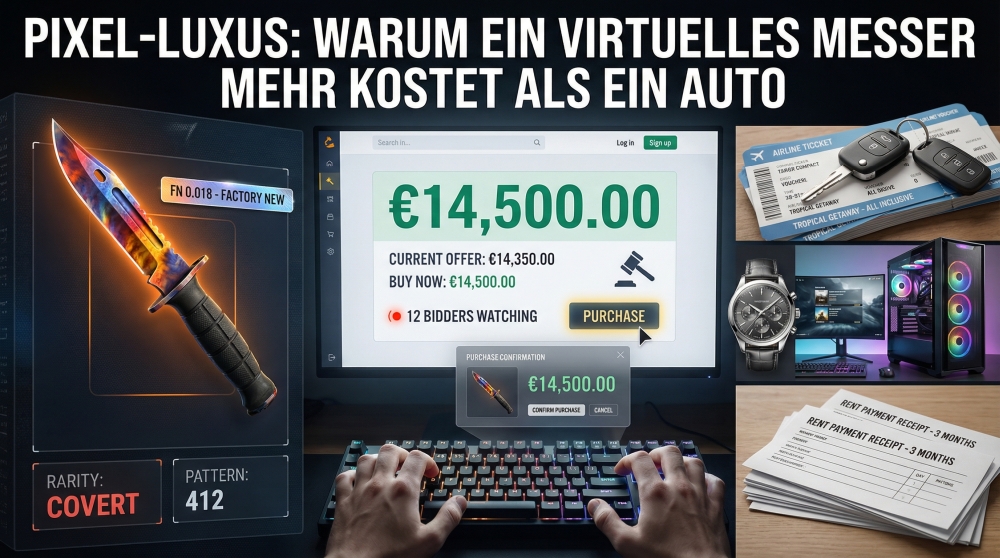
Virtual assets like CS skins derive value from pure scarcity and social signaling. A digital knife serves no practical function beyond making a satisfying sound when drawn, yet commands prices exceeding most Germans’ monthly rent. The psychology mirrors luxury watch collecting, status symbols whose worth depends entirely on what the next buyer is willing to pay. The difference? Your Rolex doesn’t become worthless because a single company in Washington state tweaks an algorithm.
The CS Economy: How German Traders Actually Make Money
The market structure splits between Valve’s walled garden and the wild west of third-party platforms. The Steam Community Markt (Steam Community Market) traps your profits as Steam Guthaben (Steam credit), useful for buying games, useless for paying your Munich apartment’s Kaltmiete (base rent). Serious traders migrate to external sites like csfloat.com where real money changes hands, minus Valve’s hefty transaction fees.
Success requires BWL-Autist (business administration nerd) levels of analysis. German investors scrutinize Float Values (wear levels), Pattern Templates (visual variations), and Sticker Placements (decal positioning) with the intensity their fathers reserve for comparing Bausparverträge (building savings contracts). A Case Hardened AK-47 might trade for €100 or €50,000 depending on blue pattern density, variations invisible to casual players but representing life-changing money for those who understand the metrics.
Real German Profit Patterns
The research reveals consistent strategies among successful German skin investors:
Why This Isn’t Just Gambling, Until It Is
Critics argue CS skins represent pure gambling, not investing. They’re not entirely wrong. Unlike stocks backed by company performance and dividends, skin values depend entirely on community sentiment and Valve’s unpredictable decisions. One update can crash entire market segments.
Yet the same arguments apply to many behavioral trends in volatile digital currency markets, a space where German investors famously pour cash into crashing crypto despite Buffett indicators flashing red. The skin market merely represents this speculation in its purest form: no fundamentals, no cash flows, just pure supply and demand dynamics.
The key difference? Diversifizierung (diversification) within the ecosystem mitigates some risk. Smart German traders don’t bet everything on one knife skin. They spread capital across cases, stickers, and weapon skins, much like a traditional portfolio. When Valve’s Trade-Up Update crashed knife prices, red skins spiked, proving that market-neutral positions exist even here.
The Tax Trap: What the Finanzamt Doesn’t Know
Here’s where German investors face potential disaster. The Finanzamt hasn’t issued clear guidance on virtual asset taxation. Are skins Spekulationsgeschäfte (speculative transactions) subject to 25% capital gains tax? Do they count as private Veräußerungsgeschäfte (private disposal transactions) with the €600 exemption? Or are they simply digital goods exempt from taxation?
Most German traders operate in a gray area, assuming small transactions fly under the radar. But with some inventories exceeding €50,000, the implications of capital income tax changes on digital holdings could be severe. If the SPD’s proposed capital income tax reforms target digital assets, many gamers might face surprise tax bills on profits they’ve already reinvested into their Steam libraries.
The safest approach? Treat skin trading like any other investment. Document purchases, track profits, and declare gains in your Steuererklärung (tax return). The Finanzamt might not understand what a “Factory New Dragon Lore” is, but they definitely understand undeclared income.
Scams, Sharks, and the Dark Side
Where money flows, predators follow. German skin traders face API-Scams where trades get hijacked at the last second, fake Valve employee schemes, and phishing sites mimicking Steam’s login page. The creativity of scammers rivals the complexity of German bureaucratic forms, but with more immediate financial pain.
One common trap: “Vote for my team” links that compromise your Steam account. Another: bulk sale offers that seem generous until you realize you’ve traded your €5,000 knife for worthless cases. The advice from experienced traders mirrors warnings about dangers of leveraging capital for yield arbitrage, if it looks too good to be true, it will probably destroy your portfolio.
The Psychological Parallel: From Hätte-Hätte to Digital Regret
German investors already struggle with patterns of retail investor regret and emotional bias in traditional markets. The skin market amplifies these tendencies. Every trader who sold Phoenix cases at €0.20 before they hit €5 experiences the same “Hätte, hätte, Fahrradkette” (would have, could have, bicycle chain) regret that haunts stock market participants.
The difference? Skin trading happens in gaming lobbies, Discord channels, and Reddit threads, environments where emotional decisions get reinforced by community hype. When a popular streamer showcases a specific skin, prices spike within hours. This creates fundamental differences between speculation and investing that many young German traders don’t recognize until they’ve lost their semester earnings.
Should You Allocate Your Sparplan to Skins?
Let’s be clear: CS skins shouldn’t replace your ETF-Sparplan (ETF savings plan). The market lacks regulation, trades 24/7 (exhausting), and depends entirely on a single company’s decisions. Valve could theoretically shut down trading tomorrow, making your €10,000 inventory worthless pixels.
Yet completely dismissing the market ignores its reality. Some German investors have built five-figure portfolios starting with pocket money. The key is treating skins as what they are: highly speculative alternative assets that belong in the “fun money” portion of your portfolio, the same bucket you might use for individual stock picks or crypto experiments.
Practical allocation guidelines for German investors:
- ✓ Maximum 5% of net worth in virtual assets
- ✓ Never invest money you need for fixed costs (Miete, Versicherungen)
- ✓ Document everything for the Finanzamt
- ✓ Use reputable third-party markets, not shady Discord trades
- ✓ Understand you’re competing with bots and teenagers who have more time
The Bottom Line
Counter-Strike skins represent both the future and past of speculation. Future because they demonstrate how digital scarcity creates real value. Past because they repeat every bubble pattern documented in financial history, from tulip mania to crypto winter.
German investors face a unique position: excellent internet infrastructure, high disposable income, and a cultural tendency toward thorough research (the BWL-Autist effect). But also strict tax laws, risk-averse financial education, and limitations of ‘safe’ conservative investing portfolios that make alternative assets tempting.
The student who turned €2,000 into €14,000 exists. So do hundreds who turned €2,000 into €200. The market rewards knowledge, timing, and emotional discipline, qualities that also drive success in traditional investing. Just don’t expect your Sparkasse advisor to understand when you ask about adding Dragon Lores to your portfolio.
The real question isn’t whether skins are legitimate investments. It’s whether German investors can apply their famous rationality to the most irrational market imaginable. Some clearly can. The rest are just gambling with extra steps, and the Finanzamt will eventually want its cut.