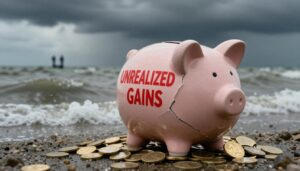
The Netherlands just dropped a tax bombshell that should make every German investor nervous. Starting in 2028, Dutch savers face a staggering 38% tax on unrealized capital gains, paper profits from stocks, ETFs, bonds, crypto, and even precious metals that exist only on a screen. You haven’t cashed out, you haven’t seen a cent, but the Finanzamt (Tax Office) wants its cut anyway.
This isn’t some fringe proposal. The Dutch government has secured parliamentary majority support for what amounts to one of Europe’s most aggressive wealth-building barriers. For German residents watching from across the border, the question isn’t whether this is fair, it’s whether our own politicians will find inspiration in this radical experiment.
The Box 3 Reform: Taxing Dreams Before They Materialize

The Dutch system, known as “Wet werkelijk rendement Box 3” (Actual Return Box 3 Act), fundamentally rewrites the rules of investment taxation. Under current Dutch law, the government assumed a flat return on wealth and taxed that. The new approach targets actual gains, both realized and unrealized.
Here’s the mechanism: Your assets get valued on January 1st and December 31st. If your portfolio grew from €100,000 to €150,000, you owe 38% on that €50,000 paper gain. That’s €19,000 in taxes, even if you never sold a single share. The government offers a paltry consolation: the exemption rises from €1,000 to €1,800. For anyone building serious wealth, this is meaningless.
The policy covers everything: stocks, ETFs, bonds, cryptocurrencies, precious metals, and even real estate (with some exceptions for primary residences). The only mercy is that losses can be carried forward to offset future gains, but good luck getting a refund if your gains evaporate after you’ve already paid tax on them.
The Liquidity Death Trap
The most dangerous aspect isn’t the rate, it’s the forced liquidity crisis. Many international residents report waiting weeks for banking appointments in major German cities, despite Germany’s reputation for efficiency. Now imagine needing to sell assets urgently to pay a tax bill on money you never received.
Consider this scenario: You invest your entire €100,000 savings in a promising Dutch tech stock. It doubles to €200,000 by year-end. You owe €38,000 in taxes. Before you can celebrate, the stock crashes back to €100,000 in January. You’ve lost your original investment and you’re still on the hook for €38,000 you don’t have. This isn’t theoretical, it’s exactly what the law allows.
Critics warn this could trigger mass capital flight. Dutch crypto analyst Michaël van de Poppe called the plan “insane”, predicting it will drive residents to leave. Many newcomers express frustration, finding the Berlin rental market nearly impossible to navigate without local contacts. Similar patterns could emerge in the Netherlands as investors flee to more sensible jurisdictions.
Constitutional Questions and Corporate Exemptions
German legal experts already see red flags. One constitutional argument holds that taxes cannot force asset sales or destroy wealth-building capacity. The Dutch plan does both. If your €100,000 portfolio grows to €200,000 and you lack €38,000 in cash, you must sell, potentially your entire position, to meet the tax obligation.
Interestingly, corporations and the ultra-wealthy seem exempt. Vermögensverwaltende GmbHs (asset-managing limited liability companies) and foundations aren’t targeted. The law aims squarely at private individuals building wealth through normal investment accounts. Many international residents report that German tax complexity ranks among the most confusing systems they’ve encountered, but the Dutch approach introduces a new level of aggression.
This selective targeting reveals the political calculus: hit the middle class hard enough to raise revenue, but not so hard that powerful lobbies fight back. It’s a pattern familiar to anyone following Germany’s debate on wealth taxation and intergenerational equity, where the SPD’s inheritance reform proposals similarly focus on individual savers while corporate structures remain untouched.
Could This Infect German Policy?
The Dutch government claims this addresses court rulings that invalidated the old “assumed return” system. Sound familiar? Germany’s own Finanzamt (Tax Office) has faced similar legal challenges, particularly around the Vorabpauschale (advance lump-sum tax) on investment funds. The German system already taxes assumed returns on funds, though at much lower rates and only on specific products.
The political winds in Germany show concerning parallels. Left-leaning parties like the SPD and Greens have historically argued that wealth concentration requires aggressive taxation. The Dutch plan offers a blueprint: frame it as “fairness”, target paper gains, and promise it only hits “the rich.” Never mind that €100,000 in investments isn’t wealthy, it’s a modest retirement nest egg.
State incentives and restrictions in private retirement savings already demonstrate how German policy can discourage wealth building. The Riester pension successor program offers up to €480 in annual subsidies but comes with strings that often leave childless savers worse off than simple ETF portfolios. Adding unrealized gains tax would be another layer of complexity that primarily benefits tax advisors.
The Behavioral Impact: From HODL to FORCED-SELL
Long-term investment strategies like “buy and hold” become economically irrational under this system. Why hold through volatility if you’ll pay tax on temporary peaks? The Dutch plan incentivizes selling winners early to lock in cash for future tax bills, and discourages risky but potentially rewarding investments.
This contradicts decades of financial wisdom. Poor returns and structural issues in traditional German investment products already push savers toward index funds. Adding annual tax friction makes long-term compounding nearly impossible. The math is brutal: a 38% annual drain on paper gains means you need returns above 61% just to break even after taxes and inflation.
German investors reconsidering global portfolio strategies amid policy uncertainty might view this as another reason to diversify internationally, but carefully. The Dutch example shows that even stable European democracies can implement destructive tax policy when public finances get tight.
Internal Link: Financial Literacy Crisis
Germany’s broader financial literacy challenges affect how such policies might be received. When a 17-year-old student suggesting diversification over gold gets called clueless by classmates, it reveals how poorly many Germans understand investment fundamentals. This knowledge gap makes it easier for politicians to sell destructive policies as “taxing the rich.”
Behavioral biases in German retail investing decisions already lead to suboptimal choices. The “Hätte, hätte, Fahrradkette” mentality (would have, could have, bicycle chain) dominates forums. Adding complex unrealized gains taxation would overwhelm many investors, pushing them toward simpler but poorer-performing products or discouraging investment altogether.
What German Investors Should Do Now
While no German politician has formally proposed this, vigilance is warranted. The Dutch reform passed because most voters don’t own stocks, dangerous speculation by the wealthy, they believe. Similar sentiment exists in Germany, where only about 17% of adults directly hold equities.
Practical steps:
1. Diversify jurisdictions: Don’t hold all assets in one country. Consider brokerages in Germany, Austria, or Switzerland.
2. Use tax-advantaged accounts: Max out your Sparerpauschbetrag (saver’s allowance) and use tax-free accounts where possible.
3. Monitor political developments: The Vorabpauschale debate shows German courts are already wrestling with taxing assumed returns. Real gains are a logical next step.
4. Consider corporate structures: While the Dutch exempted asset-managing companies, German laws differ. Research GmbH & Co. KG structures for larger portfolios.
Conclusion: A Warning, Not a Prophecy
The Dutch unrealized gains tax represents a fundamental shift, from taxing actual income to taxing potential wealth. For German investors, it’s a preview of what happens when governments prioritize short-term revenue over long-term wealth creation.
The policy’s flaws are obvious: it creates liquidity crises, punishes long-term investing, and exempts the truly wealthy while crushing middle-class savers. Yet it enjoys majority support because most voters don’t see themselves as investors.
German policy hasn’t reached this point, but the ideological foundation exists. The SPD’s inheritance tax proposals and the ongoing debate around state incentives and restrictions in private retirement savings show similar thinking.
The best defense is active participation in wealth building and vocal opposition to policies that would tax dreams before they become reality. As the Dutch example shows, once implemented, such taxes are nearly impossible to reverse. German investors should watch closely, and prepare accordingly.
Disclaimer: This analysis is for informational purposes only and does not constitute financial or tax advice. Consult a qualified Steuerberater (tax advisor) for personalized guidance on your situation.