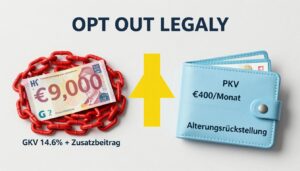
You earn a good salary in Germany, let’s say 80,000 euros gross annually. You play by the rules, pay your taxes, and budget carefully. Then your health insurance statement arrives: over 1,000 euros deducted each month for your GKV (statutory health insurance). You investigate switching to PKV (private health insurance), only to discover your chronic condition makes you uninsurable. This is the reality for thousands of German professionals who find themselves financially penalized for earning well while medically chained to a system they cannot leave.
The frustration runs deeper than money. Many report waiting six months for a dermatologist appointment or being turned away from specialists who no longer accept new patients. One software engineer in Munich described calling 15 HNO (ENT) doctors before finding one with availability, then waiting three months for the appointment. The math feels broken: you pay premium contributions but receive budget-tier service.
How Contributions Hit Four Figures
The GKV contribution system appears straightforward but contains a nasty surprise for high earners. The standard rate combines a 14.6% general contribution with a Zusatzbeitrag (supplementary contribution) that varies by insurer. In 2026, these Zusatzbeiträge range from 2.18% to 4.40%, creating a total bite between 16.78% and 19.00% of your income.
Here’s where the trap springs shut. The Beitragsbemessungsgrenze (contribution assessment ceiling) for 2025 caps at 66,150 euros annually. Earn above that threshold, and your contributions stop rising, unless you’re self-employed. For employees, the maximum employee contribution lands around 471 euros monthly, with your employer matching that amount. But self-employed professionals pay the full 14.6% plus the entire Zusatzbeitrag themselves, pushing their monthly burden past 1,000 euros when income exceeds 80,000 euros.
The calculation works as follows: take your monthly income, multiply by the total contribution rate, and watch the number climb. A freelancer earning 6,667 euros monthly with a 3.5% Zusatzbeitrag pays 19.1% total, 1,273 euros every month. That exceeds many mortgage payments, yet provides no guarantee of timely medical care.
The Medical Lockout from Private Insurance
PKV insurers operate with risk selection freedom that GKV legally cannot use. When you apply, they demand comprehensive health declarations. A chronic condition, anything from diabetes to a successfully treated thyroid issue, triggers either outright rejection or prohibitive risk surcharges.
One marketing manager discovered this after a minor autoimmune diagnosis requiring only annual check-ups. Three PKV applications resulted in three rejections. The irony: his condition costs the GKV system perhaps 200 euros yearly in routine bloodwork, yet it bars him from leaving a system costing him 12,000 euros annually.
The PKV industry’s logic remains coldly statistical. One insurer explained they don’t fear the known condition’s cost, they fear the unknown complications and associated risks. A person with a chronic condition might develop secondary issues, requiring expensive treatments. From their perspective, rejecting a 30-year-old who might cost 50,000 euros over a decade makes actuarial sense, even if it feels discriminatory to the applicant.
The Family Insurance Complication
The GKV offers one significant advantage that complicates the escape calculation: Familienversicherung (family insurance). A privately insured parent must pay separate premiums for each child, often 150-200 euros per child monthly. In the GKV, your 1,000-euro contribution covers your entire family.
This creates a perverse incentive structure. A father earning 90,000 euros might pay 1,100 euros for family GKV coverage. Switching to PKV could mean 600 euros for him plus 500 euros for his wife and two children, no savings, just more paperwork. Many international residents specifically cite this as their reason for staying in the GKV despite the costs.
The system essentially taxes you for being healthy and childless, then subsidizes you for having dependents. For dual-income couples without children, the math never works in their favor.
The Age Cost Bomb Waiting in Both Systems
Long-term cost projections reveal another trap. GKV advocates point to stable contributions in retirement, noting the KVdR (Krankenversicherung der Rentner, or pensioners’ health insurance) caps costs based on pension income rather than health status. A retiree with a 1,500-euro pension might pay 250 euros monthly.
PKV critics highlight horror stories: retirees facing 900-euro monthly premiums after decades of paying 400 euros, forcing them onto Grundsicherung (basic social security) to afford coverage. The PKV’s aging reserves, designed to smooth costs over a lifetime, prove insufficient when insurers close old tariffs to new members, leaving existing policyholders to fund their own demographic crisis.
One analysis suggests the GKV contribution rate could hit 20% by 2033, with total social security contributions reaching 50% of income by 2035. The financial gap in the GKV system threatens 12 billion euros by 2027, making future Zusatzbeiträge increases inevitable. Staying in GKV means betting the system remains solvent. Switching to PKV means betting you won’t outlive your savings.
The Illusion of Service Quality Differences
PKV marketing emphasizes separate waiting rooms, direct specialist access, and private hospital rooms. GKV defenders counter that most doctors treat all patients identically, and the real difference lies in billing complexity.
A self-employed architect who switched to PKV described the freedom of booking MRI appointments within days instead of months. Yet a GKV-insured teacher countered that her husband’s PKV required him to pay every bill upfront, then chase reimbursements, a part-time job in itself. She preferred the GKV’s direct billing, where doctors handle insurance paperwork.
The data reveals a geographic lottery. In Berlin or Munich, PKV advantages prove substantial, specialists have capacity for privately insured patients. In smaller cities, the same doctors treat everyone together, making the premium price difference harder to justify.
Strategies for the Trapped
If you’re stuck in high-cost GKV with no PKV exit, several imperfect strategies exist:
- Optimize within GKV: Not all insurers charge equal Zusatzbeiträge. The spread between cheapest and most expensive exceeds 2 percentage points, worth 100+ euros monthly at high incomes. Use comparison tools and switch during special termination periods when your insurer raises rates.
- Tax optimization: GKV contributions count as Vorsorgeaufwendungen (precautionary expenses), reducing taxable income. Self-employed individuals can deduct the full amount, softening the blow.
- Health cost budgeting: Accept that you’re funding the system’s solidarity principle. One finance professional reframeed it as “paying 1,000 euros to avoid insurance paperwork and guarantee family coverage.”
- Consider supplementary insurance: Private Zusatzversicherungen for dental care or hospital upgrades provide PKV-like benefits without medical underwriting, though they add to total costs.
- Plan for retirement: If you’re 50+ and healthy, the KVdR option becomes attractive. If you have chronic conditions, staying in GKV through retirement provides cost certainty. Younger professionals face a genuine dilemma.
The Systemic Failure
This situation exposes a fundamental design flaw. Germany’s dual system promises choice but delivers constraint. The GKV cannot refuse members or adjust prices for risk, so high earners subsidize others. The PKV can refuse risk, leaving those who most need alternatives trapped.
The result: a middle group of 30-50 year old professionals with good incomes but imperfect health who fund both systems without receiving optimal service from either. They pay GKV’s highest rates while being denied PKV’s benefits.
Policymakers have discussed Bürgerversicherung (citizens’ insurance) to merge the systems, but reforms stall. Meanwhile, the Beitragsbemessungsgrenze rises annually, pushing more middle-earners into the high-contribution bracket. The projected contribution increases will make this problem acute for millions, not just the current high-income cohort.
Making Your Decision
Evaluate three factors honestly:
- Health status: If you have any chronic condition, stop dreaming about PKV. Focus on optimizing GKV.
- Family planning: If children are likely, GKV’s family coverage becomes valuable. If you’re single or your partner has separate coverage, PKV becomes more attractive.
- Income stability: Self-employed with fluctuating income risk PKV premiums they cannot afford in bad years. GKV’s income-based contributions provide a safety net.
Request anonymized risk inquiries from PKV brokers before committing time to applications. Many offer preliminary assessments without formal applications that could haunt your insurance record.
Most importantly: accept that no perfect solution exists. The German healthcare system, for all its strengths, creates genuine losers in its current form. Understanding whether you’re among them, and why, represents the first step toward rational financial planning.
The 1,000-euro monthly contribution isn’t a bug in the system. For high earners with health issues, it’s a feature they cannot escape. Your best strategy isn’t fighting the trap, it’s optimizing your life within it.