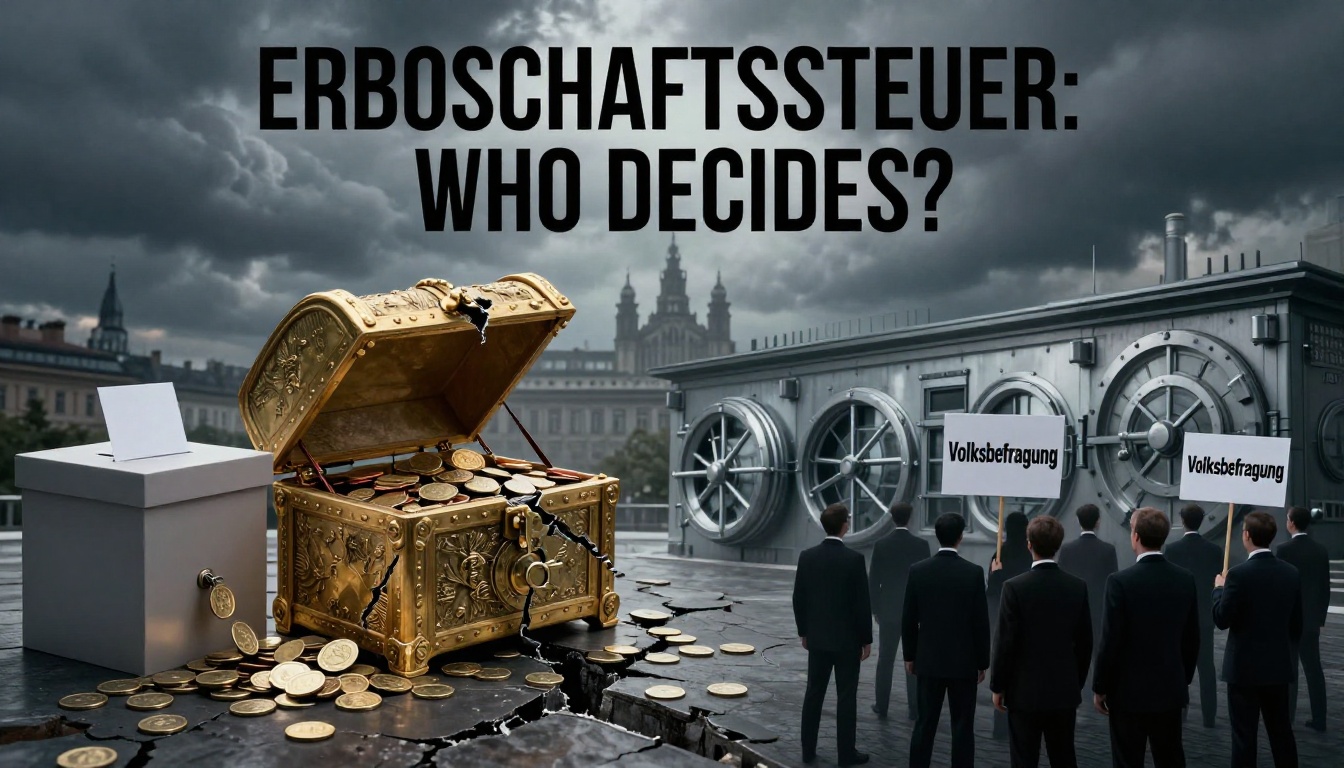
Austria’s political establishment is having a moment of rare public honesty about who really calls the shots on tax policy. When SPÖ-Staatsekretärin (State Secretary) Michaela Schmidt casually suggested that Austrians might want to weigh in on inheritance tax through a Volksbefragung (referendum), she triggered a response that revealed more about the country’s power structures than any campaign speech ever could.
The Spark: A Personal Opinion That Wasn’t So Personal
Schmidt’s comment came during a “Kurier” talk show, where she floated the idea of letting citizens vote on Erbschaftssteuer (inheritance tax). “I can personally imagine that we could also make inheritance tax a topic of a referendum”, she said, framing it as her own view. But in Austrian politics, when the Regierungskoordinatorin (government coordinator) for the SPÖ speaks, it’s never just personal.
Within hours, ÖVP-Finanzstaatssekretärin Barbara Eibinger-Miedl delivered the kind of clear, unambiguous rejection that Austrian bureaucrats usually reserve for requests to process paperwork on a Friday afternoon. “Inheritance and wealth taxes are not a topic for this legislative period”, she stated flatly. The message was unmistakable: the public might want a say, but the coalition agreement has already decided.
Coalition Math Trumps Democratic Voice
The immediate slap-down exposes a fundamental tension in Austria’s current political arrangement. The governing coalition of ÖVP, SPÖ, and NEOS agreed in their Regierungsprogramm (government program) that wealth and inheritance taxes were off the table. According to Vizekanzler (Vice-Chancellor) Andreas Babler, Schmidt’s proposal represents a “personal opinion”, not official SPÖ policy.
This distinction matters enormously. Under the coalition’s rules, any Volksbefragung requires unanimous approval from all three parties. The ÖVP has drawn a bright red line, and NEOS has backed them, calling new tax burdens “the wrong way” just as inflation shows signs of cooling. The SPÖ finds itself in the awkward position of having to publicly walk back its own minister’s suggestion.
What we’re witnessing is coalition politics in its purest form: an internal SPÖ debate spilling into public view, immediately corrected by the harsh arithmetic of maintaining a three-party government. The message to voters is clear, your desire for input on wealth redistribution is secondary to keeping the coalition intact.
The Economic Arguments: More Than Just “Tax the Rich”
Behind the political theater lies a substantive debate about how Austria should approach intergenerational wealth. The research reveals fascinating disconnects between public perception and economic reality.
The Double Taxation Dilemma
Opponents of inheritance tax hammer home a simple point: this money has already been taxed. As one analysis puts it, “Erbschaften bestehen fast immer aus Geld, das bereits mehrfach besteuert wurde: als Einkommen, als Unternehmensgewinn, als Kapitalertrag.” (Inheritances consist almost always of money that has already been taxed multiple times: as income, as corporate profit, as capital gains.)
This argument resonates with middle-class Austrians who’ve spent decades building modest wealth through already-taxed income. The fear isn’t necessarily about protecting billionaires, it’s about protecting family homes, small businesses, and savings that represent a lifetime of post-tax effort.

The Family Business Problem
The Industriellenvereinigung (Industrial Association) has been particularly vocal, warning that inheritance tax doesn’t hit abstract “wealth” but real, operating businesses. Their argument: when a family-owned manufacturing company passes to the next generation, the heirs inherit machinery, property, and business shares, not liquid cash.
Austria’s Grunderwerbsteuer (real estate transfer tax) already applies to inherited property, meaning the state already takes a cut when houses or land change hands through inheritance. Adding an additional Erbschaftssteuer could force heirs to sell business assets just to pay the tax bill, potentially destroying viable companies and the jobs they provide.
This isn’t theoretical. German research cited in Austrian debates shows inheritance taxes often trigger investment freezes, job cuts, or forced sales when businesses lack the liquidity to cover tax bills. The Steuerbelastung (tax burden) hits precisely where no cash exists, tied up in operational assets.
Public Opinion vs. Political Will: The Numbers Game
Here’s where the story gets interesting. Despite the coalition’s firm stance, public opinion data suggests Austrians might actually support some form of inheritance tax, if the question were framed correctly.
Research indicates that around 59% of Austrians support inheritance taxes, at least in principle. The SPÖ’s 2024 election proposal, taxing inheritances only above €1 million, which would exempt 98% of cases, polls even better. The party calculated that setting the threshold high enough would protect ordinary families while targeting genuine wealth concentration.
Yet the same surveys reveal confusion about what “inheritance tax” actually means. Many Austrians with assets under €500k oppose the concept, convinced it would apply to them. This gap between perception and reality creates political space for opponents to mobilize middle-class voters against their own economic interests.
The Industriellenvereinigung understands this dynamic perfectly. Their statement frames the debate not as “should billionaires pay more” but as “do you want to endanger Austrian jobs and competitiveness?” They warn: “Wer mitten in einer Phase schwacher Konjunktur… ständig neue Steuerfantasien in die Diskussion einbringt, schürt Unsicherheit, gefährdet Investitionen, Arbeitsplätze und die Wettbewerbsfähigkeit des Landes.” (Anyone who constantly introduces new tax fantasies in the middle of a weak economic phase… fuels uncertainty, endangering investments, jobs, and the country’s competitiveness.)
The Real Issue: What Problem Are We Solving?
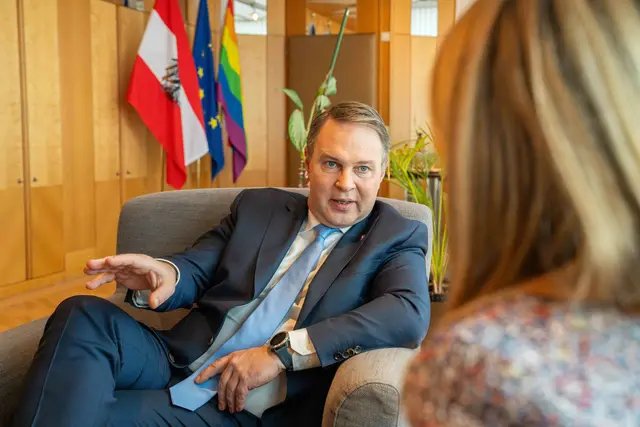
Finanzminister Markus Marterbauer has called inheritance tax the “grundvernünftigste Steuer” (most fundamentally reasonable tax), arguing it addresses wealth inequality without burdening work. But critics question whether the solution matches the scale of Austria’s actual problems.
Budget experts point out that even optimistic inheritance tax models would generate only a few hundred million euros, marginal in a federal budget measured in tens of billions. The administrative costs, valuation disputes, and legal complexity could eat up much of that revenue.
More importantly, Austria faces what Finanzstaatssekretärin Eibinger-Miedl calls an “Ausgabenproblem, kein Einnahmenproblem” (spending problem, not a revenue problem). With deficits projected to hit 7.4% of GDP, the structural issue is expenditure growth, not insufficient taxation of wealth transfers.
This frames the inheritance tax debate as symbolic rather than fiscal. For the SPÖ, it’s about signaling concern for wealth inequality. For the ÖVP and NEOS, rejecting it signals commitment to business confidence and investment. The actual revenue impact is secondary to the political messaging.
What This Means for Your Financial Planning
For internationally mobile professionals in Austria, this debate offers crucial insights into the country’s political risk landscape:
1. Policy Stability is Artificially High: The coalition agreement acts as a straitjacket, preventing even popular reforms from reaching a vote. This creates predictability, inheritance tax won’t happen this term, but also democratic frustration.
2. Wealth Planning Still Matters: While no Erbschaftssteuer looms immediately, the underlying pressure for wealth redistribution isn’t disappearing. If you’re building significant assets in Austria, cross-border structuring remains prudent.
3. Real Estate is Already Taxed: Remember that Grunderwerbsteuer applies to inherited property. For families where property represents the main asset, the state already takes 3.5% of market value at transfer, plus notary fees and court costs.
4. The Coalition’s Red Lines are Real: The unanimous consent requirement for Volksbefragungen means any controversial fiscal policy needs all three parties to agree. With NEOS firmly in the “no new taxes” camp and ÖVP representing business interests, major wealth taxes face a near-impossible hurdle.
The Bigger Picture: Democracy by Appointment Only
The inheritance tax saga reveals Austria’s approach to direct democracy: it’s a tool for safe topics, not controversial ones. Chancellor Stocker can propose a Volksbefragung on Wehrdienst (military service) because it’s in the Regierungsprogramm and coalition partners will likely agree. But on wealth taxes, where the coalition is fundamentally divided, direct democracy is declared inappropriate.
This creates a hierarchy of issues: some questions are “worthy” of public consultation, others must be decided by the “experts” in government. The justification, that politicians are elected to make tough calls, rings hollow when the same government selectively delegates decisions based on whether they might upset the coalition balance.
For residents navigating Austrian finance, the takeaway is clear: understand that stability comes at the cost of democratic input on the most contentious fiscal questions. The Erbschaftssteuer debate isn’t really about tax policy, it’s about who gets to decide, and under what rules.
And in today’s Austria, the coalition agreement trumps the Volksbefragung every time. Even when 59% of the public might vote “yes”, the answer from the government remains a firm “kein Thema.”
The real inheritance being passed down isn’t just wealth, it’s a political system where consensus among three parties matters more than the will of the electorate. That’s the Austrian fiscal reality, whether you’re inheriting a million-euro portfolio or just trying to understand how your taxes get decided.
For more on how Austrian property and wealth transfer works in practice, see our analysis of intergenerational wealth and property ownership in Austria.