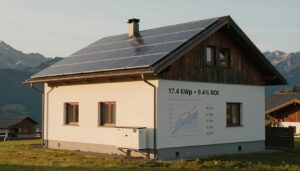
A high earner in Tirol recently discovered that renting out his paid-off apartment leaves him with just €250 monthly after taxes. The property could sell for €200,000 tax-free within the next three years, yet he hesitates. This scenario captures a widespread dilemma among Austrian professionals: when your income pushes you into higher tax brackets, traditional real estate wisdom crumbles. The numbers reveal a stark reality that many property owners overlook until the Finanzamt (Tax Office) sends its first unpleasant surprise.
The Brutal Math of Renting as a High Earner
The Tirol example exposes a calculation error that plagues many Austrian landlords. At €690 monthly rent (including utilities), the gross annual income appears respectable at €8,280. However, this income gets added to the landlord’s €90,000 salary, pushing it into Austria’s 48% marginal tax bracket. After income tax, the take-home shrinks dramatically.
But the real damage appears in the fine print. Property owners can deduct certain costs: maintenance, administrative fees, and the AfA (Absetzung für Abnutzung – depreciation allowance) of 1.5% annually on the building portion. For a €200,000 apartment where typically 60-80% represents building value, that’s €1,800-€2,400 in annual depreciation deductions. These deductions reduce taxable rental income, yet they create a hidden tax bomb.
Many landlords assume depreciation is purely beneficial. They discover the catch only when selling. The Austrian ImmoESt (Immobilienertragsteuer – real estate profit tax) calculates profit using a reduced purchase price basis. If you owned the property for five years, the tax authority subtracts five years of AfA from your original purchase price before calculating your gain. A property bought for €200,000 and sold for €200,000 after five years of renting could generate a €9,000 taxable profit, triggering €2,700 in ImmoESt at 30%.

Property decisions require careful calculation of long-term tax consequences
The Single-Property Risk Concentration
Financial advisors consistently warn against the Klumpenrisiko (concentration risk) of a single rental property. Unlike a diversified ETF portfolio, one apartment represents a single point of failure. A burst pipe, problematic tenant, or local market downturn can wipe out years of modest gains.
The Tirol landlord’s situation exemplifies this: his entire €200,000 capital remains locked in one asset while generating minimal cash flow. If the tenant defaults, he faces months of legal proceedings under Austria’s tenant-friendly Mietrechtsgesetz (Tenancy Law). The potential €250 monthly profit quickly transforms into a €690 monthly burden plus legal fees.
Moreover, Austrian rental yields rarely justify the risk for small landlords. At €600 monthly rent on a €200,000 property, the gross yield stands at 3.6%. After accounting for vacancy periods, maintenance reserves, and insurance, the net yield drops below 2%, far less than what broad market ETFs historically deliver.
ETF Alternatives: Liquidity and Tax Efficiency
Selling tax-free and investing in ETFs presents compelling advantages for high earners. Austrian tax treatment of investment funds offers significant benefits. The Kest (Kapitalertragssteuer – capital gains tax) stands at 27.5%, lower than the 30% ImmoESt rate. Additionally, ETFs provide instant diversification across global markets, eliminating the single-property risk.
The liquidity factor proves crucial. Unlike real estate, ETF shares can be sold partially to fund life changes without triggering massive tax events. The Tirol landlord could sell €50,000 worth of shares for a down payment on another property, while keeping the remainder invested. Try doing that with half a bathroom.
For someone earning €90,000 annually, the opportunity cost becomes stark. The €200,000 tied up in the apartment could generate, assuming a conservative 6% annual return, €12,000 yearly. Even after Kest, that’s €8,700 net, far exceeding the €3,000 annual rental profit.
The Relationship Insurance Argument
One Reddit commenter raised a point that resonates with many Austrian property owners: keeping the apartment as a Beziehungsversicherung (relationship insurance). If the relationship with his girlfriend ends, having a paid-off apartment eliminates the stress of finding new housing.
This emotional argument carries weight in Austria’s tight rental markets, particularly in desirable areas like Tirol. However, it demands honest cost-benefit analysis. The €200,000 insurance policy costs approximately €5,000 annually in foregone investment returns, plus ongoing maintenance and administrative burden.
A compromise exists: sell the apartment, invest the proceeds, and keep a smaller emergency fund specifically for potential housing transitions. Alternatively, consider a smaller property in a less expensive area as a true backup plan, rather than maintaining a suboptimal investment.
Austrian Market Realities: Tirol’s Outlook
Tirol’s real estate market presents unique considerations. The region’s strong tourism economy, limited building land, and strict zoning laws historically supported price appreciation. However, recent data suggests cooling growth. The Austrian National Bank’s financial stability report indicates that alpine property markets face pressure from demographic shifts and changing vacation preferences.
Selling within the three-year speculation tax exemption window becomes critical. After three years of rental activity, any profit becomes fully taxable under ImmoESt. The AfA deductions during rental years further inflate the taxable gain, creating a worst-of-both-worlds scenario: minimal rental income during ownership, maximum tax burden upon sale.
Careful document review is essential when calculating long-term tax implications
The Professional Landlord vs. Amateur Distinction
The Reddit discussion highlighted a crucial distinction: professional landlords with multiple properties benefit from economies of scale and portfolio effects. A single property owner lacks these advantages while facing identical regulatory burdens.
Austrian law treats all landlords equally regarding the MRG (Mietrechtsgesetz – Tenancy Act) and Bestellerprinzip (ordering principle for broker fees). The amateur landlord pays the same 2-3 months’ rent in Maklerprovision (broker commission) as a large corporation, but absorbs it as a much larger percentage of total returns.
Professional investors also leverage Fremdkapital (debt financing) to amplify returns. The Tirol landlord owns his property outright, eliminating the interest deduction benefit that makes many professional rental operations viable. His situation represents the least efficient form of property investment.
Concrete Decision Framework for Austrian Property Owners
Evaluate your situation through these lenses:
Sell if:
– Your marginal tax rate exceeds 42%
– The property represents over 30% of your net worth
– You can sell within the three-year speculation tax exemption period
– The net rental yield after all costs falls below 3%
– You lack time or expertise for property management
Keep if:
– The property is in a high-growth area with strong fundamentals
– You have specific personal use plans within 5 years
– You can leverage the property to acquire additional units
– The net yield exceeds 5% after all costs and taxes
For the Tirol case, selling appears optimal. The 1.5% net yield, combined with high tax exposure and concentration risk, makes the property a poor investment. The three-year tax-free window creates urgency. Investing in a diversified ETF portfolio while maintaining liquid reserves for emergencies offers superior risk-adjusted returns.
The Execution: Maximizing Tax-Free Sale Value
If selling, Austrian sellers should:
1. Obtain three independent valuations to establish market price
2. Consider cosmetic improvements that yield high returns (fresh paint, modern fixtures)
3. Time the sale for spring when buyer activity peaks in alpine regions
4. Market the property as “unvermietet” (unrented) to attract owner-occupiers who pay premiums
5. Budget for the Käuferprovision (buyer’s broker fee) under the Bestellerprinzip
The tax-free status requires proper documentation. Keep all purchase records, improvement invoices, and rental agreements. The Finanzamt may request proof that you met the three-year personal use requirement before rental.
Final Calculation: The True Cost of Keeping
Let’s model the Tirol landlord’s actual position over five years:
Keep and Rent:
– Rental income: €41,400 (gross over 5 years)
– After income tax (48% marginal): €21,528
– After maintenance reserves (20%): €13,248
– After insurance and fees: €11,748
– Net cash flow: €2,350 annually or €196 monthly
Sell and Invest in ETFs:
– Invest €200,000
– Assume 6% annual return: €67,500 gain over 5 years
– After Kest (27.5%): €48,938 net gain
– Annual equivalent: €9,788 or €816 monthly
The difference amounts to €620 monthly, enough to cover a decent rental apartment as backup, with money left over. This calculation excludes the ImmoESt time bomb that activates if he sells after the exemption period expires.
Financial decisions impact not just wealth, but life flexibility and relationship security
Austrian property owners must recognize when sentimentality masks poor financial logic. The security of a paid-off apartment feels tangible, but diversified, liquid investments provide genuine financial flexibility. For high earners, the tax system actively discourages small-scale landlording while rewarding diversified investing. The three-year window isn’t just a tax rule, it’s a decision deadline that separates smart wealth building from comfortable inertia.
The Tirol landlord’s final edit revealed his choice: keep the property as backup. His reasoning reflects human nature, but the numbers tell a different story. In Austria’s current tax and regulatory environment, the math rarely favors the amateur landlord with a paid-off property and high income.