The brochures promised energy independence and spectacular returns. Your neighbor insists it’s the best investment they’ve ever made. But what’s the actual return on a home solar system in Austria after one year of real-world operation? The numbers might challenge everything you thought you knew about Photovoltaik (photovoltaic) investments.
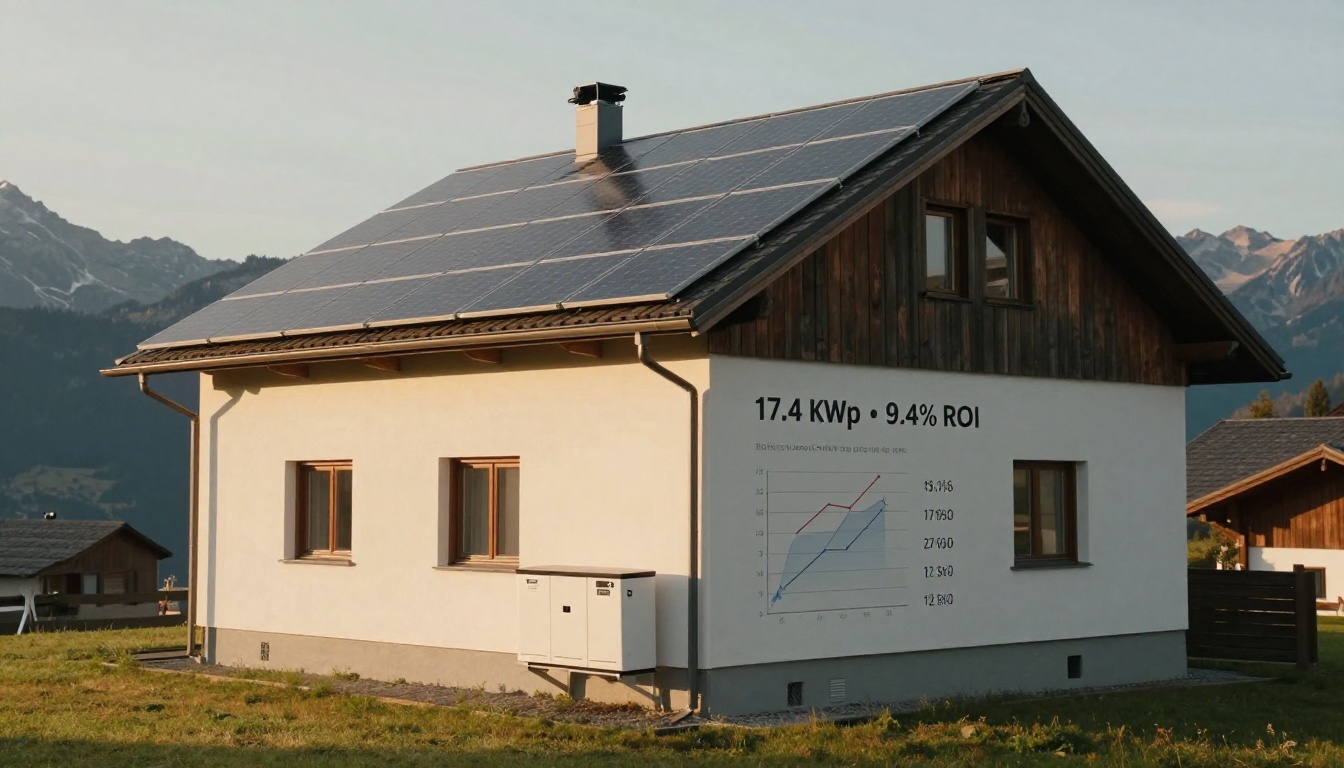
A detailed case study from a homeowner in Tirol reveals the unvarnished truth: €23,500 invested in a 17.4 kWp system with 19.3 kWh battery storage produced €2,207 in combined savings and earnings over 12 months. That’s a 9.4% raw return, decent, but not the financial revolution many expect. The devil lives in the details most installers won’t mention.
The Real Numbers: A Tirol Case Study
The system, installed in March 2025, powers a household with a Wärmepumpe (heat pump) for floor heating and hot water. Total electricity consumption reached 11,595 kWh over the year, typical for a modern Austrian home with electric heating.
Here’s the breakdown that matters:
– Self-consumption: 6,670 kWh from solar production
– Grid purchases: 5,289 kWh during low-production periods
– Feed-in to OEMAG (Austrian electricity market operator): 11,820 kWh at market rates
At a net electricity price of €0.22924 per kWh, the homeowner saved €1,529 on their bill. The Einspeisevergütung (feed-in tariff) added another €678. Combined: €2,207.
What the installer probably didn’t explain: that 11,820 kWh fed into the grid represents overproduction during summer months when the house couldn’t consume what the panels generated. In Austria’s current system, that excess gets compensated at rates far below retail electricity prices.
The ETF Comparison: Solar vs. Traditional Investing
The homeowner ran a parallel calculation: what if they’d invested the €23,500 in an ETF at 7% annual return instead?
The results expose solar’s fundamental limitation as a wealth-building tool. After 10 years, the ETF reaches €43,203 while the solar-plus-reinvested-savings approach hits only €29,898. It takes 20 years for the solar strategy to overtake pure financial investment, and that’s ignoring critical factors.
The calculation intentionally excludes:
– Inverter replacement (~€2,000 every 12 years)
– Battery degradation (likely replacement after 15 years)
– Insurance and maintenance costs
– Panel cleaning and potential repairs
– The system’s residual value declining toward zero
Industry professionals confirm these blind spots. One experienced installer notes that while panels themselves often last 30+ years with minimal degradation, Wechselrichter (inverters) rarely survive that long. Batteries face similar limitations. Ignoring these realities inflates solar’s apparent returns by 15-20% over a 20-year horizon.
Austrian Regulatory Changes: The Hidden Tax on Solar Owners
2026 brings new rules that quietly erode profitability. The Smart Meter requirement, while sold as “modernization”, functions as a compliance tax. Without one, your Einspeiseleistung (feed-in capacity) gets artificially limited to 60% of installed capacity, meaning up to 40% of potential earnings vanish.
Even with a Smart Meter, the system creates new costs:
– ZEREZ-Pflicht (Central Register for Unit and Component Certificates) registration fees
– Potential Direktvermarktungspflicht (direct marketing obligation) for systems over 25 kWp
– Network operator fees of €0.23 per kWh, halved with Smart Meter installation
The current Einspeisevergütung for new Austrian systems ranges from 7.78 to 12.35 cents per kWh depending on system size and feed-in model, significantly less than the 22.9 cents saved through self-consumption. This gap reveals solar’s true value proposition: it’s not about earning money, but about avoiding future electricity price increases.
The Self-Consumption Trap
The homeowner’s 57% self-consumption rate sounds impressive, but reveals a structural challenge. During November through February, the system achieves near 100% self-consumption yet still requires grid purchases because production plummets. In summer, production exceeds demand by 300-400%, forcing cheap feed-in sales.
This seasonal mismatch explains why adding a Batteriespeicher (battery storage) changes the math. A properly sized battery could shift 2,000-3,000 kWh from summer excess to winter deficit, boosting self-consumption toward 70% and reducing expensive grid purchases during dark months.
But batteries add €8,000-12,000 to initial costs, pushing payback periods beyond 12-14 years even with optimal configuration. For Austrian households planning to stay put for decades, this makes sense. For those moving within 10 years, the investment rarely breaks even on resale.
The Austrian Context: Why Location Matters
The Tirol installation benefits from high altitude and clear skies, conditions not universal across Austria. A similar system in Vienna’s Donaustadt or Salzburg’s flatter regions produces 10-15% less annually. Regional Strompreise (electricity prices) also vary significantly, with Vorarlberg and Tyrol paying among Austria’s highest rates, making solar more attractive there.
The homeowner’s mention of the Tiroler Raumordnungsgesetz (Tyrol Spatial Planning Act) reveals another Austrian peculiarity: expanding your system later requires navigating regional building codes that can cap additional capacity at 180 m². Planning ahead becomes essential, installing maximum capacity initially avoids costly retrofit applications.
Maintenance Reality Check
The 30-year ROI projections floating online assume zero maintenance costs. Real Austrian systems face:
– Annual inverter checks: €100-150
– Professional cleaning every 2-3 years: €200-300
– Insurance premium increases: €50-100 annually
– Potential tree growth from neighboring properties reducing output
Over 20 years, these “minor” expenses total €4,000-6,000, enough to shift ROI calculations by 0.5-0.8 percentage points annually.
The Wealth Tax Factor
Here’s where Austrian financial planning gets complicated. Unlike ETF investments that grow tax-free until realization, your solar system faces annual wealth taxation under Austria’s Vermögensteuer (wealth tax) rules, even as it depreciates. While the system reduces your electricity bills (and thus your taxable income), the asset itself adds to your Vermögenswert (wealth value) for tax calculations.
This creates a perverse incentive: the more you save on electricity, the more wealth tax you might pay on the system’s residual value. For households approaching Austria’s wealth tax thresholds, this can erode 0.3-0.5% of annual returns, a factor rarely mentioned in installer brochures.
When considering whether wealth taxation impacts your investment decisions, solar’s illiquid nature becomes a liability compared to financial assets you can quickly restructure.
The Break-Even Timeline: A Sobering Reality
With €2,207 annual savings on a €23,500 investment, simple payback occurs in 10.6 years. But factor in:
– 7% opportunity cost of capital
– €5,000 maintenance over 20 years
– Battery replacement at year 15 (€10,000)
– Wealth tax impact
The true economic break-even stretches to 14-16 years. This assumes:
– No major component failures
– Stable electricity prices
– You remain in the home
– Feed-in tariffs don’t collapse further
Practical Austrian Takeaways
Solar makes sense if:
– You own your home and plan to stay 15+ years
– Your household consumes 10,000+ kWh annually (heat pump, electric vehicle)
– You can maximize self-consumption above 60%
– You install before potential 2027 Einspeisevergütung reforms
Solar fails if:
– You might relocate within 10 years
– Your roof faces north or suffers shading
– You lack capital for proper system sizing
– You’re optimizing purely for financial return
The Austrian government’s push toward Smart Meters and ZEREZ registration suggests future support will favor systems integrated into the smart grid, not isolated rooftop generators. This favors larger, professionally managed installations over piecemeal homeowner projects.
The Final Verdict
After 12 months, this Austrian homeowner’s 9.4% return beats savings accounts but lags behind diversified ETFs. The real value isn’t in the numbers, it’s in price certainty. That €2,207 represents insulation from electricity price shocks that have doubled Austrian household Stromkosten (electricity costs) since 2020.
For those treating solar as a hedge rather than an investment, the math works. For those seeking maximum wealth creation, traditional asset accumulation strategies remain superior.
The controversial truth? Austrian solar sales pitches rely on emotional appeals to energy independence while glossing over the 15-year commitment required for genuine returns. As with any major financial decision, treat installer promises with the same skepticism you’d apply to any cost-benefit analysis of subsidized purchases.
Before signing, demand a 20-year cash flow projection that includes maintenance, component replacement, and wealth tax impacts. If they can’t provide it, you’ve found your answer.
Action Steps for Austrian Homeowners:
1. Request three quotes from certified installers registered with the WKO (Wirtschaftskammer Österreich, Austrian Economic Chamber)
2. Calculate your actual self-consumption potential using your last 12 months of electricity bills
3. Model scenarios with and without battery storage
4. Consult a Steuerberater (tax advisor) about wealth tax implications
5. Check regional Förderungen (subsidies) via the OeMAG website before committing
The sun shines on Austria’s roofs, but the financial forecast remains partly cloudy with a chance of unexpected costs.