The Austrian Wealth Paradox: Why Farmers Top the Rich List While Doctors Just Get By
If you ask the average Viennese university student which profession builds real wealth in Austria, you’ll hear the usual suspects: doctors, lawyers, consultants, maybe a software architect at Zühlke or Erste Bank. The Oesterreichische Nationalbank has news for you, and it’s going to hurt. According to the freshly released HFCS 2023 data, the wealthiest professional group in Austria isn’t wearing a suit to the opera or billing €400 an hour. They’re wearing rubber boots and worrying about the price of corn.

The Data That Flips Everything Upside Down
The Household Finance and Consumption Survey, conducted every few years by the OeNB, is the most comprehensive look at Austrian wealth behind closed doors. The 2023 wave shows something that economic logic struggles to explain: when you split inheritances by profession, farmers (Landwirte) routinely transfer more than one million euros to the next generation. That’s not a typo. While the average Austrian inheritance sits at a respectable €315,000, agricultural families are playing in a different league entirely.
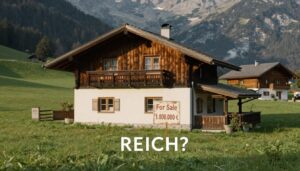
This isn’t just about having a nice farmhouse in the Wachau. We’re talking about multiple hectares of land, each worth a small fortune, a fully equipped Hof complete with stalls, machinery sheds, and a Fuhrpark that would make a logistics company jealous. The median Austrian household wealth is €125,000. A typical farmer’s land holdings alone can dwarf that by an order of magnitude.
The Million-Euro Illusion: Why Farmers Don’t Feel Rich
Here’s where the story gets Austrian-specific in its complexity. Many international residents look at these numbers and think, “Great, I’ll become a farmer and get rich.” Not so fast. The prevailing sentiment among those who understand rural Austria is that this wealth exists auf dem Papier, on paper only.
A 40-year-old tractor often has a higher resale value than what the average under-40 Austrian has saved. But that tractor also needs €8,000 in repairs this season. The land might be worth €15,000 per hectare, but you can’t sell it without triggering family drama that makes a Viennese housing association meeting look like a tea party. These assets have been in Familienbesitz for 300 years, and the moment someone starts selling off parcels to actually fund their retirement, the entire economic foundation crumbles. The next generation inherits cash instead of productive land, and the family enterprise evaporates.
The OeNB data captures this beautifully: farmers dominate wealth statistics because their assets are tangible, illiquid, and multi-generational. But try explaining to your bank manager that you’d like a mortgage based on your agricultural land holdings when you need cash flow. The Austrian banking system operates with the same efficiency as a Viennese coffee house, until you try to leverage illiquid agricultural assets.
Where the High Earners Actually Stand
Let’s talk about the professions everyone thinks should be at the top. According to recent salary data, professors lead Austria’s income charts at around €85,400 annually. Doctors aren’t far behind, with specialists in Vienna pulling in similar figures. Software architects at Austrian tech firms can hit €80,000 or more. These are excellent incomes by any standard.
But income isn’t wealth. The HFCS data shows a stark disconnect: while 45% of mortgage borrowers belong to the top income quintile, their net worth often lags behind their monthly earnings. A 35-year-old consultant in Innere Stadt might earn €6,000 net per month and live in a €4,000/month Altbau apartment, saving perhaps €1,500 monthly. That’s €18,000 per year, impressive, but it would take 55 years to match the million-euro inheritance of a farmer’s child.
The wealthiest 5% of Austrian households own over €1.2 million, but contrary to popular belief, this group isn’t dominated by high-salary professionals. It’s weighted heavily toward business owners, real estate investors, and yes, those land-owning families who’ve been accumulating assets since the Habsburgs were relevant.
The Inheritance Engine: Austria’s Real Wealth Builder
Here’s the spicy truth that makes Austrian wealth-building different from the American dream: 41% of Austrian households have received an inheritance or substantial gift, up from 35% in 2010. The average transfer of €315,000 represents more than just parental generosity, it’s the primary mechanism for wealth mobility in Austria.

This inheritance culture creates a professional wealth hierarchy that looks nothing like the income ladder. Landowners pass down both assets and the infrastructure to maintain them. A doctor passes down, what, exactly? A well-read medical library and a nice car? The OeNB data makes it clear: professions that facilitate asset accumulation beat professions that generate high income, at least across generations.
The controversial implication? If you’re a high-earning professional without family assets, you’re essentially running on a treadmill. You might out-consume a farmer in terms of lifestyle, better restaurants, nicer holidays, a newer Golf GTI, but you’re not building the kind of multi-generational wealth that defines Austria’s upper echelons.
What the Data Means for Your Career Choices
Before you quit your job at Raiffeisen to buy a struggling orchard in Burgenland, understand the nuance. The OeNB’s Vizegouverneurin Edeltraud Stiftinger points out that wealth inequality has remained stable, not because the system is fair, but because Austria’s robust social safety nets and pension systems compensate for lower private wealth among non-asset-holding classes.
In other words, that high-salary job does matter, it funds your KV (Krankenversicherung), builds your pension claims, and lets you live comfortably. The Finanzamt will take their cut regardless of whether your wealth comes from land or labor, but only one of these generates wealth that appears in the statistics.
For international residents, this data reveals a harsh reality: building substantial wealth in Austria without inheritance is exponentially harder than in countries where equity compensation and startup culture create new millionaires. The HFCS doesn’t even track billionaires, they’re statistically irrelevant in a country where old money defines the top tier.
The Takeaway: Austrian Wealth Has a Password
The password is Boden (land) and Zeit (time). Wealth in Austria isn’t built through aggressive income growth or clever Finanzonline optimization. It’s built through holding appreciating assets across decades, preferably centuries, and passing them down through a tax-efficient inheritance structure.

If you’re choosing a profession based on wealth potential alone, the data suggests you’d be better off managing your family’s rural properties than pursuing an academic career at the Universität Wien. But if you don’t have those properties to manage? The second-best strategy is the boring one: buy a smaller Wohnung than you can afford, invest in the boring Austrian stock index, and hope your kids can benefit from the only wealth-transfer mechanism that actually matters in this country: your persistence.
The real controversy in these numbers isn’t that farmers are wealthy. It’s that Austria’s wealth-building game is rigged toward asset holders, and the professions that generate the most economic value for society don’t necessarily generate the most wealth for the individuals pursuing them. That’s not a bug in the Austrian system, it’s a feature as old as the Grundbuch itself.