The question pops up regularly in French investment circles: if China is the world’s second-largest economy, why does it still languish in the same MSCI category as Brazil and India? The implications aren’t academic, this classification determines whether billions in passive investment flow into Chinese equities through your ETF (exchange-traded fund) or bypass them entirely.
MSCI’s framework splits global markets into two primary buckets: developed and emerging. The MSCI World index tracks 23 developed economies, while the MSCI Emerging Markets index covers 24 developing ones. China dominates the latter, representing roughly 25-30% of the emerging markets index. But here’s where it gets interesting for anyone holding a Plan d’Épargne en Actions (PEA) (stock savings plan) in France: the day China gets reclassified, your portfolio’s geographic exposure would shift dramatically.
The Classification System Isn’t About GDP
Many investors misunderstand MSCI’s methodology. As one astute commenter noted in recent discussions, MSCI doesn’t determine whether countries are developed, it determines whether their stock markets are developed. This distinction matters enormously.
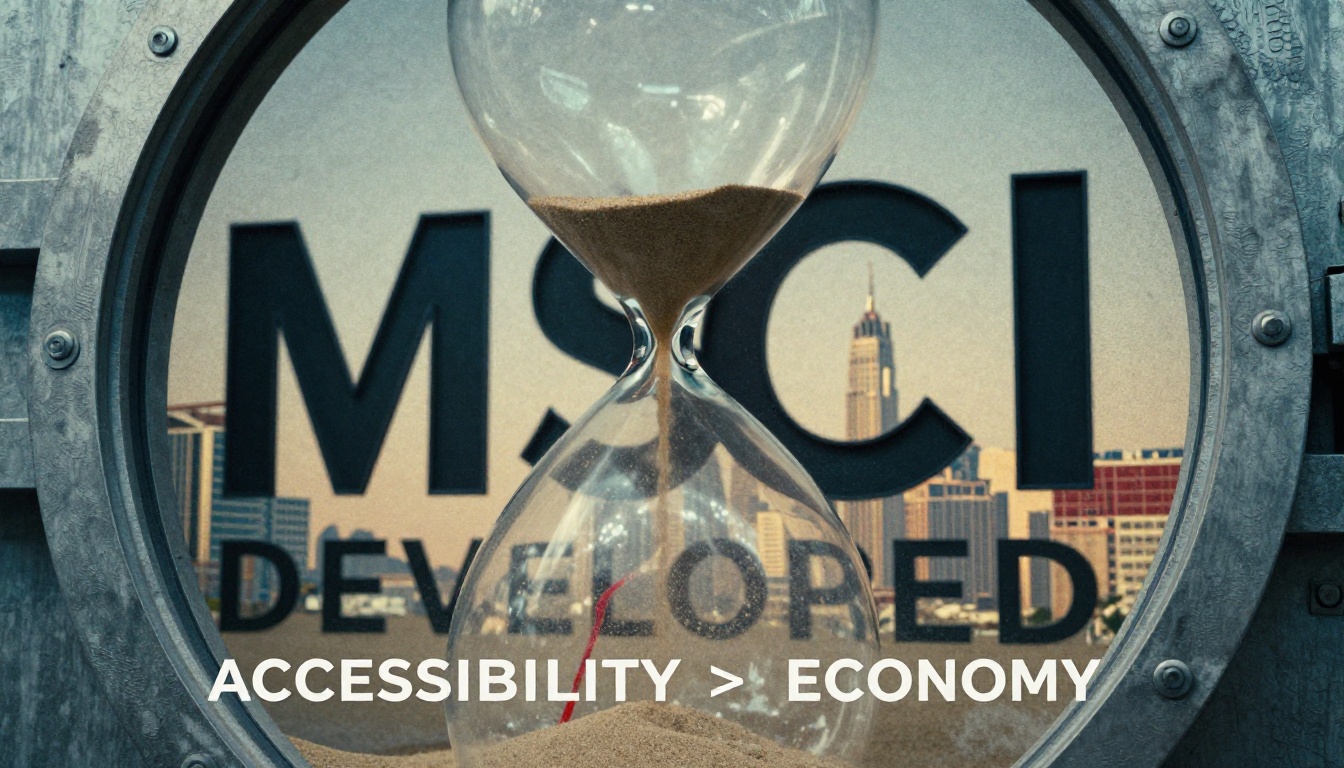
A developed market classification requires meeting stringent criteria across three dimensions: economic development, size and liquidity, and market accessibility. China stumbles primarily on the last point. Foreign investors face severe restrictions on capital repatriation, limited trading hours for currency conversion, and complex registration requirements through programs like Stock Connect and QFII (Qualified Foreign Institutional Investors).
The political system creates additional friction. Capital controls remain tight, and regulatory changes can happen overnight without consultation. For French investors accustomed to the transparency of Euronext Paris and the protections of European securities law, China’s market structure feels like navigating a maze blindfolded.
South Korea’s Decades-Long Quest Shows How Hard This Is
If you think China’s size alone should guarantee promotion, consider South Korea’s predicament. The country has been trying to achieve developed market status for years, meeting most economic criteria comfortably. Yet MSCI continues to reject the upgrade due to what it calls “accessibility issues.”
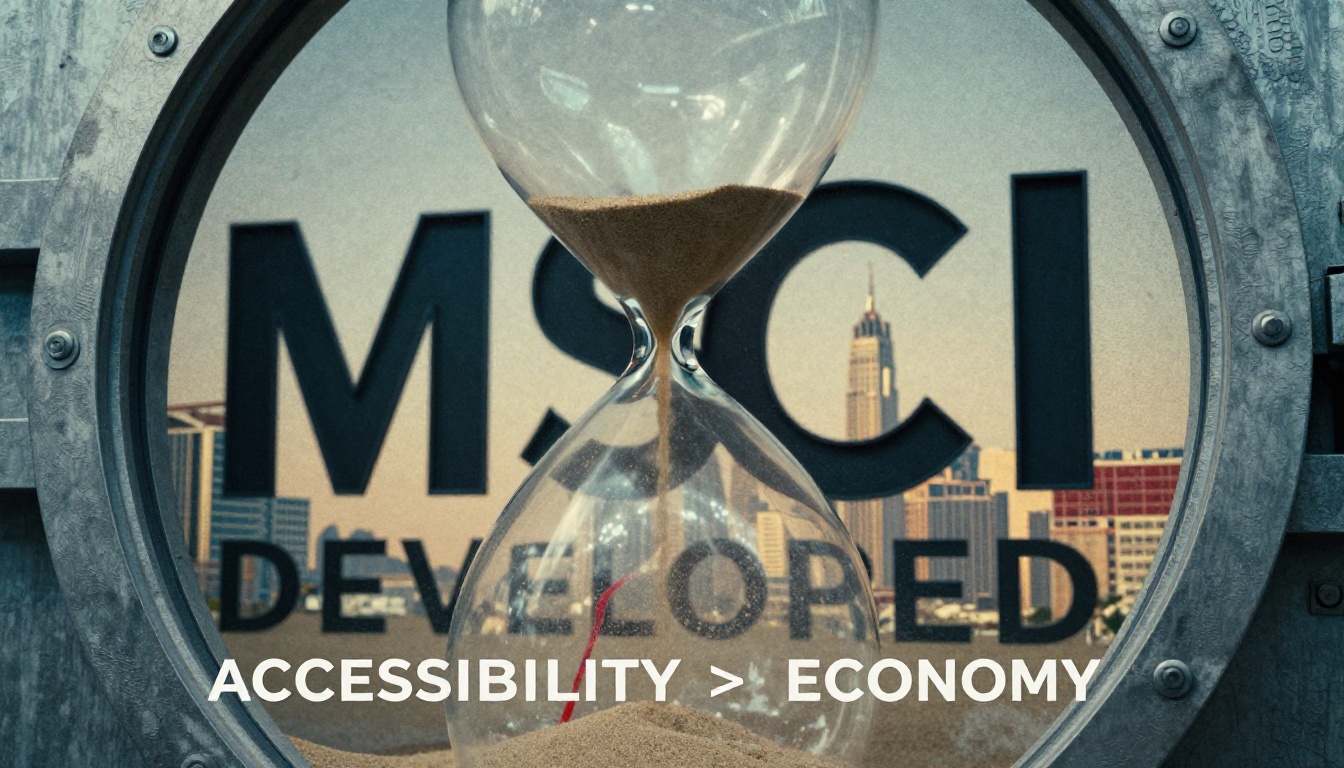
Specifically, South Korea imposes restrictions on trading the won outside Korean business hours and prohibits omnibus accounts that would allow asset managers to aggregate client holdings. These technical limitations create tracking errors for index funds and complicate portfolio management. If a sophisticated economy like South Korea can’t clear the bar after a decade of lobbying, China’s path looks even steeper.
The Greek example cuts both ways. Greece was demoted from developed to emerging status in 2013 during its debt crisis, proving that classifications aren’t permanent. But the bar for promotion remains exceptionally high, higher than many realize.
What Reclassification Would Mean for Your Portfolio
Should China somehow clear these hurdles, the impact would be immediate and massive. Index funds tracking the MSCI World would need to buy approximately $400-500 billion in Chinese equities to match the new weighting. This forced buying would likely drive up prices in the short term, benefiting current emerging markets investors.
But French investors holding ETF PEA (stock savings plan eligible ETFs) would face a different reality. Most emerging markets ETFs available in France are synthetic or swap-based to maintain PEA eligibility. A reclassification would require these products to restructure or lose their tax-advantaged status. The fiscalité (tax treatment) advantages you’ve been counting on, zero capital gains tax after five years, could evaporate for China-heavy positions.
The geographic concentration risk would also shift. Currently, the MSCI World is already dangerously overweight US equities, with American companies representing over 70% of the index. Adding China would reduce this US dominance slightly but introduce new concentration risks in a market with different regulatory risks and accounting standards.
The Accessibility Trap That Keeps China Emerging
Recent reports highlight why China’s market remains a “piège pour l’investisseur étranger” (trap for foreign investors). The contrôles de capitaux (capital controls) system means money can enter relatively easily but faces Byzantine procedures to exit. This asymmetry violates a core principle of developed market status: free capital mobility.
The situation at Chinese airports, where informal gold trading systems operate parallel to official banking channels, illustrates the gap between China’s economic might and its financial integration. When citizens resort to physical gold to move wealth across borders, it signals deep distrust in official conversion mechanisms.
China’s aggressive gold accumulation further complicates matters. The central bank’s purchases suggest preparation for potential financial decoupling, not deeper integration. This behavior hardly reassures index providers weighing accessibility criteria.
French Investors Face a Strategic Dilemma
Many French investors hold both MSCI World and MSCI Emerging Markets ETFs to achieve global diversification. The emerging markets component typically represents 10-12% of a combined portfolio, with China as the largest single country exposure. This allocation has underperformed developed markets for years, testing investor patience.
The debate among French investors mirrors global uncertainty: should you anticipate China’s eventual promotion or accept current market structures? Some argue that investing in emerging markets means betting on graduation, capturing growth before reclassification drives up valuations. Others contend that China’s unique political economy makes traditional development pathways irrelevant.
The performance data offers little clarity. Over the past decade, the MSCI World has slightly outperformed the MSCI ACWI (All Country World Index, which includes emerging markets), largely because emerging markets’ drag offset any early-stage growth benefits. The volatility premium hasn’t compensated for lower returns.
Practical Implications for Your PEA
For French investors, the PEA eligibility question looms large. Most pure emerging markets ETFs aren’t PEA-eligible due to their synthetic structure. Instead, investors use assurance-vie (life insurance) contracts or CTO (ordinary securities accounts) for this exposure. A China reclassification would theoretically make Chinese equities PEA-eligible, but only if the underlying securities become French-regulated or EU-listed, a distant prospect.
More likely, Chinese companies would need to issue ADR (American Depositary Receipts) or GDR (Global Depositary Receipts) in European markets to gain PEA access. Some already do, but the majority trade only on mainland exchanges under restrictive rules.
The tax implications matter enormously. Gains on Chinese stocks held through a CTO face the flat tax (PFU) of 30%, including social charges. The same gains in a PEA would be tax-free after five years. This 30 percentage-point difference is why classification matters beyond simple portfolio weighting.
The Political Roadblock
Ultimately, the most significant barrier isn’t economic but political. MSCI’s criteria include market predictability and regulatory stability, areas where China’s system diverges fundamentally from Western norms. The autorités chinoises (Chinese authorities) can halt trading in specific stocks, restrict sectors overnight, or change foreign investment rules without consultation.
Recent crackdowns on technology companies, education firms, and offshore listings demonstrate this risk vividly. When Beijing can effectively erase billions in market value with a single policy announcement, index providers rightfully question whether the market is “developed” in any meaningful sense.
The geopolitical dimension adds another layer. As US-China tensions escalate, Western index providers face pressure to limit exposure to Chinese assets. Some European pension funds already face divestment pressures regarding human rights concerns. MSCI can’t ignore these political realities, even if they fall outside formal criteria.
What Should French Investors Do?
First, understand that China’s emerging market status reflects genuine investment risks, not just bureaucratic foot-dragging. The accessibility issues, capital controls, and regulatory opacity are real constraints that affect returns and risk profiles.
Second, don’t base your strategy on anticipated reclassification. The timeline is measured in decades, not years, and the path is far from certain. If you want China exposure, accept it as part of a broader emerging markets allocation with eyes wide open to the risks.
Third, optimize your tax structure. For most French investors, the best approach remains holding MSCI World ETFs in a PEA for developed market exposure, and using assurance-vie or CTO for complementary emerging markets positions. This minimizes fees and taxes while maintaining flexibility.
Finally, monitor South Korea’s progress. If Seoul succeeds in removing its accessibility barriers and gains promotion, it would establish a roadmap for China, though Beijing would need to make far more extensive changes. Until then, China’s graduation remains a theoretical possibility rather than an imminent reality.
The MSCI reclassification debate matters not because change is coming soon, but because it forces investors to confront uncomfortable truths about risk, accessibility, and what “developed” really means in global finance. For French investors navigating PEA rules and tax optimization, these distinctions aren’t academic, they directly impact returns and portfolio construction.