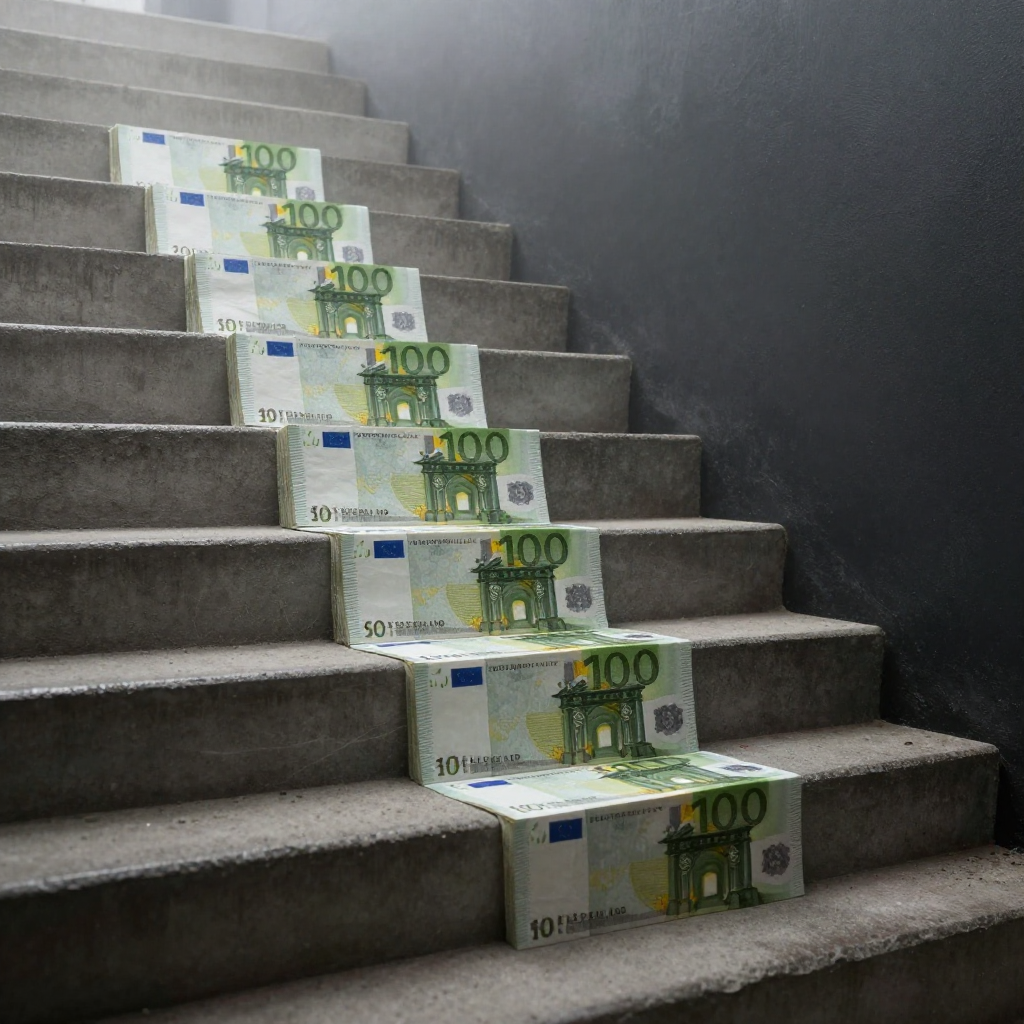
You finally hit your targets. The late nights, the impossible clients, the weekends sacrificed to PowerPoint presentations. Your boss slides that annual performance bonus across the table: €10,000 gross, a respectable sum that should change something. A better vacation, maybe. A dent in the mortgage. Then February’s busta paga (pay slip) arrives.
Your base salary is back to €1,600 per month. After the bonus pushed your RAL (Retribuzione Annua Lorda – Annual Gross Salary) to €45,000, you take home roughly €2,000 monthly on 14 payments. Had you refused the bonus and stayed at €35,000 RAL, you would have earned about €1,840. For that extra €10,000 in gross performance pay, you are rewarded with approximately €160 more per month. Before the bonus, you were an account manager burning out for €1,840. Now you are an account manager burning out for €2,000.
The math feels like a practical joke, but it is the harsh reality of Italy’s progressive tax system operating exactly as designed.
The Fiscal Trap of the Second Scaglione (Tax Bracket)
Italy’s IRPEF (Imposta sul Reddito delle Persone Fisiche – Personal Income Tax) operates on a progressive bracket system that, in theory, ensures those with higher incomes pay proportionally more. The 2026 brackets stand at 23% up to €28,000, 33% from €28,001 to €50,000, and 43% above €50,000. The cruelty lies not in the percentages alone, but in how they interact with INPS contributions and the phase-out of tax deductions.
When you earn €35,000 annually, you sit comfortably in the upper-middle of the second bracket. Your detrazioni (tax deductions) for dependent work are still substantial, roughly €1,300 annually, softening the blow of the 33% rate on income above €28,000. But push into €45,000 territory, and those deductions evaporate rapidly, falling to roughly €434. You lose nearly €900 in deductions alone while paying 33% IRPEF plus 9.19% INPS contributions on every euro of that bonus.

The result is a marginal tax rate that approaches 50% when you factor in regional and municipal addizionali (surtaxes). That €10,000 bonus effectively costs you €5,000 to €6,000 in taxes and lost benefits, leaving you with a net gain that barely covers a monthly grocery run for a family of four. As one worker noted in a viral discussion, permanent contracts in the €35,000 to €40,000 range are structurally punishing, the net salary rises so slowly it sometimes feels like it is falling.
The 2026 “Relief” That Changes Nothing
The 2026 Budget Law (Legge di Bilancio 2026) trumpeted a reduction in the second bracket from 35% to 33%, promising relief for the ceto medio (middle class). The maximum theoretical benefit? €440 annually, or roughly €37 per month, for those earning exactly €50,000. For our €45,000 earner, the savings hover around €240 per year, less than €1 per working day.
This microscopic adjustment does nothing to solve the incentive problem. When accepting a €10,000 bonus results in a net gain of €2,000 to €2,500 after all deductions and lost benefits, the rational response is to stop trying. Many Italian workers have already reached this conclusion, refusing overtime or declining promotions that push them into higher tax brackets without commensurate lifestyle improvements. Household affordability calculations including bonuses reveal that for families with children, the marginal utility of that extra income often vanishes entirely when weighed against childcare costs and the loss of income-tested benefits.
The system creates a bizarre paradox: you must work harder to maintain your standard of living due to inflation, but working harder triggers tax mechanisms that prevent you from actually improving it.
The Overtime Loophole and the Union Advantage
Ironically, 2026 introduces a separate tax break for overtime and night shifts, a flat 15% tax rate on up to €1,500 of additional income for workers earning under €40,000. This means your Saturday afternoon emergency shift is taxed at 15%, while your €10,000 annual performance bonus is taxed at nearly 50%. The message is clear: Italy prefers sporadic exhaustion over sustained excellence.
There is, however, a narrow escape route for the savvy. Accordi di secondo livello (second-level union agreements) can reclassify production bonuses as premi di risultato (performance prizes), subject to a flat 10% substitute tax rather than the progressive IRPEF scale. Companies with strong union presence can offer €3,000 in bonuses that cost the employee only €300 in taxes, versus €1,000 or more under standard taxation. Without these agreements, you are effectively donating half your bonus to the state.
For those without union leverage, welfare aziendale (company welfare) offers another path. Converting cash bonuses into tax-exempt benefits, up to €1,000 annually (€2,000 if you have children), allows you to receive the full value in services or vouchers rather than the gutted cash equivalent. Smart negotiation means demanding these structures upfront rather than accepting raw cash that will be devoured by the Agenzia delle Entrate (Revenue Agency).
The Ultimate Exit Strategy
When the math becomes indefensible, the only rational calculation is emigration. The Reddit user who sparked this discussion put it bluntly: for an extra €150 per month, they might as well return to being a paper-pushing clerk while studying for the C1 English exam to move to Ireland, where their position pays €80,000 to €110,000 gross annually. Italian tax incentives impact on real take-home pay schemes like the Rientro dei Cervelli (Brain Return) attempt to lure high-skilled workers back with partial tax exemptions, but these programs often fail to offset the structural disadvantages of the Italian salary scale for middle managers.
The brain drain is not driven by a lack of patriotism, it is driven by arithmetic. When a €10,000 bonus nets you €2,000 while your landlord raises rent by €200 monthly, the equation solves itself. You either optimize your tax strategy through union deals and welfare benefits, or you optimize your life by changing jurisdictions.