
Zero-Fee ETF Portfolios: The Under-30 Strategy Italian Banks Won’t Advertise

The average Italian bank would prefer you remain blissfully unaware that you can invest in global stock markets for less than the cost of a single espresso per month. While traditional institutions continue pushing actively managed funds with expense ratios that quietly devour 1.5% to 2% of your wealth annually, a growing cohort of young professionals is exploiting a regulatory loophole that reduces investment costs to zero. The weapon of choice? Zero-fee ETF portfolios built through strategic use of the Piano di Accumulo (Capital Accumulation Plan) at Italian brokers like Directa and Fineco.
This isn’t about day trading or crypto speculation. It’s about recognizing that why holding cash exposes savers to invisible value loss over time while simultaneously avoiding the fee structures that have enriched Italian financial advisors for decades. When your bank’s “consulente finanziario” (financial advisor) recommends a product charging 1.89% annually, they’re not technically lying to you, they’re simply operating in a parallel universe where low-cost index funds don’t exist. The risks of high-cost advisor-recommended funds versus low-cost ETFs become apparent once you calculate the compound damage over a 30-year horizon.
The Directa Zero-Fee Loophole
Directa SIM, the Turin-based broker that pioneered online trading in Italy back in 1995, currently offers the most aggressive entry point for young investors. Unlike traditional banks that treat ETF purchases as revenue events, Directa provides PAC (Piano di Accumulo) plans on over 700 ETFs with zero execution fees. This means you can automatically invest €100 monthly into a global equity ETF and pay exactly €0 in commissions.

The mathematics are brutal for traditional competitors. A typical Italian bank might charge €19 per ETF purchase. If you’re investing €200 monthly, that’s an immediate 9.5% loss before markets even open. Directa’s zero-fee structure eliminates this friction entirely, making it feasible to start with amounts as modest as €50 per month without watching fees consume your returns.
However, Directa isn’t a bank. It’s a SIM (Società di Intermediazione Mobiliare – Securities Intermediation Company), meaning you won’t get a conto corrente (current account) or debit card. Your money sits in segregated accounts at partner banks, protected under the Fondo Nazionale di Garanzia (National Guarantee Fund) up to €20,000, significantly less than the €100,000 deposit guarantee at full banks like Fineco. For many under-30 investors, this trade-off is acceptable, the separation of banking and brokerage actually enforces better financial discipline.
Fineco’s Under-30 Secret Weapon
FinecoBank, Italy’s largest online bank with over 1.8 million clients, takes a different approach. While their standard PAC (Piano di Accumulo) costs €2.95 to €13.95 per month depending on how many ETFs you include, they offer a killer feature for young investors: if you’re under 30, your PAC is completely free on any ETF.
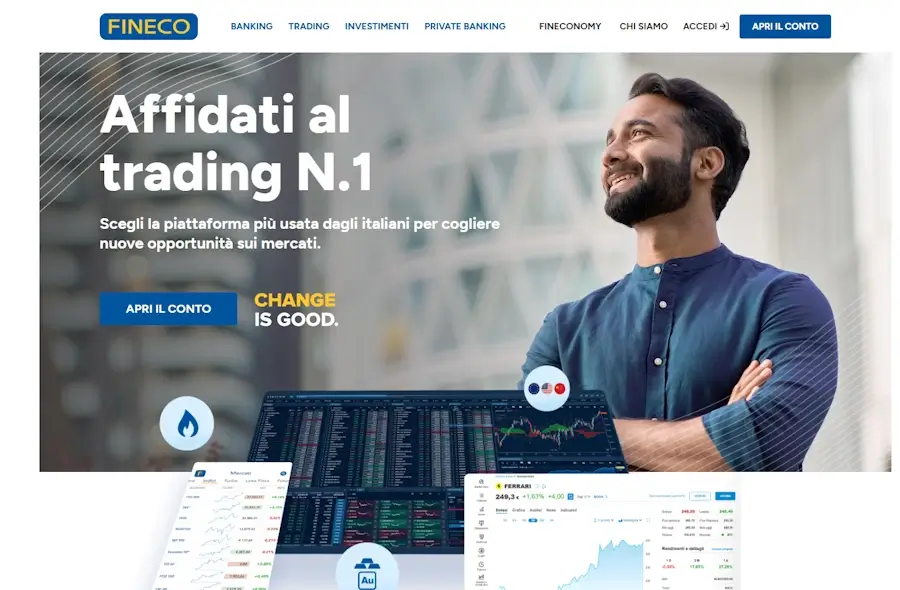
This creates a fascinating arbitrage opportunity. Fineco operates as a full-service bank, offering conto corrente (current account), debit cards, and integrated banking services that Directa cannot provide. Their platform, FinecoX, offers more sophisticated tools than Directa’s simpler interfaces. Yet for investors aged 30 and above, Fineco’s PAC costs can exceed Directa’s zero-fee structure, creating a demographic divide in optimal broker selection.
The catch? Fineco’s standard trading fees for non-PAC transactions remain higher than Directa’s variable rates, especially for smaller amounts. If you’re planning to comparing fee structures and execution methods for Italian brokerages, understanding when to use PAC versus lump-sum investments becomes crucial for optimizing costs.
SWDA vs VWCE: The Global Diversification Debate
Once you’ve selected your zero-fee platform, you face the asset allocation question. Italian investors increasingly gravitate toward two specific ETFs: SWDA (iShares Core MSCI World UCITS ETF) and VWCE (Vanguard FTSE All-World UCITS ETF).
SWDA
Tracks developed markets across 23 countries, excluding emerging markets like China, India, and Brazil. It charges a 0.20% expense ratio and holds roughly 1,500 stocks.
VWCE
Includes emerging markets, tracks nearly 3,700 stocks, and charges 0.22%. The difference seems minimal, 0.02% annually, but the emerging markets exposure creates significantly higher volatility.
For a 26-year-old with a permanent contract (“indeterminato”) and low risk aversion, the choice between these funds reveals your philosophical stance on global growth. SWDA offers pure developed market stability, while VWCE bets that emerging economies will drive the next decades of global returns. Many Italian investors split the difference, allocating 80% to SWDA for stability and 20% to emerging market ETFs for growth, though this complicates the simplicity that makes zero-fee PACs attractive in the first place.
The “Finto PAC” Execution Strategy
Here’s where Italian financial engineering gets interesting. While Directa offers zero-fee PACs, they limit you to specific ETFs in their promotional list. If you want to purchase ETFs outside this list, or if you’re using Fineco and want to optimize fees, you can employ a “Finto PAC” (Fake PAC) strategy.
Instead of setting up an official Piano di Accumulo, you manually execute purchases on the same dates each month, creating your own systematic investment plan while maintaining flexibility to change amounts or skip months. This approach requires discipline but allows you to comparing fee structures and execution methods for Italian brokerages by exploiting Directa’s variable commission structure (0.19% with a €1.50 minimum) for single purchases rather than being locked into Fineco’s fixed PAC costs.
For amounts under €789, Directa’s variable rate actually beats their own zero-fee PAC structure when considering the flexibility benefits. Above €2,632, Directa’s “Semplice” fixed €5 rate becomes optimal. Understanding these breakpoints separates sophisticated investors from those blindly following bank recommendations.
Building Your Four-Pillar Foundation
Zero-fee ETF investing doesn’t exist in a vacuum. To maintain consistent contributions during market downturns, you need structuring personal budgets to fund consistent investment contributions. The volatility of VWCE or SWDA will test your resolve when markets drop 20%, as they inevitably will, and having automated your savings rate through disciplined budgeting prevents the panic-selling that destroys long-term returns.
The typical recommendation for young Italians follows this hierarchy: first, build an emergency fund covering 3-6 months of expenses in a conto deposito (deposit account). Second, maximize any employer pension matching (though this is rare in Italy compared to other European countries). Third, establish your zero-fee PAC with Directa or Fineco, starting with amounts you won’t miss, perhaps €200 monthly, and increasing it by 10% annually as your salary grows.
The Tax Advantage Nobody Mentions
Both Directa and Fineco operate under the Regime Amministrato (Administrative Tax Regime), meaning they handle all tax reporting automatically. This isn’t controversial, but it reveals how Italian bureaucracy actually favors small ETF investors over active traders. Capital gains on ETFs held longer than one year face reduced taxation, and the 26% “imposta sostitutiva” (substitute tax) on profits is automatically calculated and paid by the broker.
Compare this to the nightmare of declaring individual stock trades on your Modello Redditi (Income Tax Return), and the appeal of buy-and-hold ETF strategies becomes obvious. You’re not just saving on fees, you’re purchasing sanity during tax season.
When Zero-Fee Isn’t Zero
The zero-fee PAC structure has limitations. Directa’s promotion applies only to specific ETFs, primarily those from iShares, Vanguard, and major providers. If you want niche exposure to specific sectors or thematic ETFs, you’ll pay standard commissions. Additionally, both brokers charge currency conversion fees (typically 0.33% at Fineco) if you purchase US-listed ETFs, though most Italian investors stick to Euro-denominated ETFs on Borsa Italiana (Italian Stock Exchange) or Xetra to avoid this drag.
There’s also the psychological cost. Zero fees encourage over-trading and portfolio tinkering. The discipline of a PAC works because it’s boring, you set it and forget it. Young investors sometimes sabotage themselves by treating zero-fee accounts as invitations to market-time or chase performance, negating the mathematical advantage of low costs through behavioral errors.
The Bottom Line for Under-30s
If you’re under 30 and haven’t started investing because you thought you needed €10,000 to make it worthwhile, the zero-fee PAC structure removes that excuse entirely. You can begin with €50 monthly, pay zero commissions, and gain exposure to thousands of global companies through a single ETF like SWDA or VWCE.
The banks won’t tell you this because they’d rather sell you their actively managed funds charging 1.5% annually. Over 40 years, that fee difference compounds to hundreds of thousands of euros in lost returns. Your move.