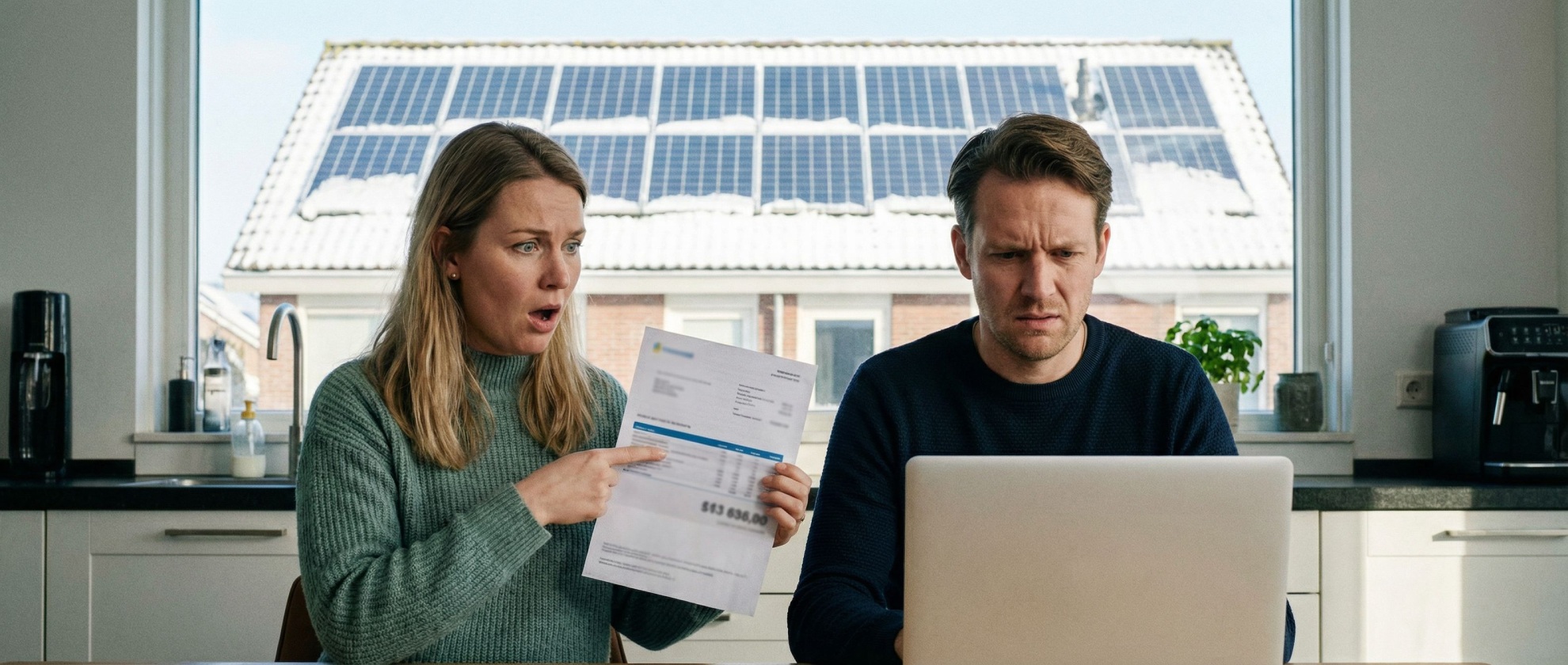
The Dutch government is pulling the plug on the salderingsregeling (net metering policy) come January 1, 2027, and if you own solar panels, your financial calculus is about to get messy. For years, the math was simple: more panels meant more savings, period. That equation is now broken. A detailed scenario analysis reveals that simply adding more panels without storage is financial negligence, while even the most optimistic battery setups leave you grid-dependent. The installation market is already collapsing, registrations dropped 48% in the first three quarters of 2025, and consumer organizations are in open revolt, demanding the government reinvest its newfound tax windfall into keeping solar attractive.
The Three-Scenario Reality Check
Let’s cut through the commercial sales pitches. A household with 6 panels (2.4 kWp) and annual consumption of 10,600 kWh (typical for a heat pump + electric car setup) ran the numbers on three paths forward. The results should trigger a serious rethink of your solar strategy.
Scenario 1: Do Nothing
With current 6 panels producing 2,124 kWh annually, only 927 kWh is used directly. The rest gets fed back to the grid for a measly €22 compensation. But here’s the kicker: 612 kWh, nearly 30% of production, will soon be worth exactly €0. Self-sufficiency sits at a pathetic 9%, with annual energy costs still hitting €1,893.
Scenario 2: Double the Panels
Adding 6 more panels boosts production to 4,249 kWh. Logic says this should help, right? Wrong. Self-sufficiency crawls to just 13%. You’re now wasting 1,426 kWh, over one-third of your production. The annual savings versus doing nothing? A laughable €75. At that rate, you’ll never recoup the installation costs.
Scenario 3: Panels Plus 11kWh Battery
Now we’re talking. The battery captures 1,991 kWh that would otherwise be wasted, pushing self-sufficiency to 28%. Wasted energy drops to 440 kWh. Annual savings jump to €479 compared to the baseline. With a €6,000 battery, that’s a 12-13 year payback period. Not great, but at least it’s a functioning system.
The brutal lesson: without a battery, expanding your solar array after 2027 is nearly pointless. You’re just producing more electricity to give away for free.
The Battery Efficiency Fiction
Manufacturers advertise 94% round-trip efficiency for home batteries. The real world is harsher. When you factor in conversion losses from DC (solar panels) to AC (grid) and back to DC (battery) and AC again (home use), actual efficiency drops to 75-80%. That 11kWh battery? You need to pump in 2,200 kWh to get 1,991 kWh back out. And that’s before accounting for the fact that most Dutch solar production happens between April and September, while your biggest consumption months are November through February.
Many international residents report that even with a 20kWh battery and electric vehicle, winter self-sufficiency remains a fantasy. As one analysis noted: “From March to September you’re nearly self-sufficient, then everything collapses.” The idea of “becoming independent from the grid” is a myth unless you’re installing 20+ panels with multiple batteries.
Dynamic Contracts: The Double-Edged Sword
Your choice of energiecontract (energy contract) matters more than ever. Fixed contracts let you net meter 1-to-1 through 2026. Dynamic contracts, where prices change hourly, already break that parity, compensating feed-in at spot prices while charging consumption at different rates. This creates a hidden cost that many solar owners miss.
Post-2027, the landscape shifts dramatically:
– Terugleververgoeding (feed-in compensation) drops to as low as 50% of the base electricity rate (minimum required by law)
– Terugleverkosten (feed-in costs) can exceed the compensation, meaning you pay to give electricity away
– Energy tax applies to all grid consumption, not just the net amount
Vattenfall and Budget Energie currently offer the most favorable fixed contracts for solar owners, with relatively low feed-in costs and high switching bonuses. Zonneplan’s dynamic contract stands out for having zero feed-in costs and a 10% solar bonus on every kWh fed back. But the math only works if you can shift consumption to sunny hours, which most households can’t.
The Policy Chaos and Market Collapse
Six major organizations, Aedes, Vereniging Eigen Huis, Consumentenbond, Woonbond, Milieudefensie, and Natuur & Milieu, have demanded the incoming cabinet protect consumers from negative feed-in tariffs. Their letter to informateur Rianne Letschert highlights a critical point: the government will collect significantly more energy tax revenue after saldering ends, since solar owners will pay tax on all grid consumption. They want this money reinvested into solar subsidies.
The market is already in freefall. Net managers registered 48% fewer new installations in the first three quarters of 2025 compared to 2024. Installers are laying off workers. The sudden cliff-edge termination, rather than a gradual phase-out, has created a crisis. As one energy researcher put it: “People have gotten used to cheap electricity through saldering and see it as an acquired right. Now they’ll have to work for it.”
What Actually Works: A Tactical Guide
Based on the data, here’s what solar owners should actually do:
If you already have panels:
– Switch to a contract with the lowest possible feed-in costs before 2027
– Install a home battery if your payback period is under 15 years and you can use at least 30% of stored energy
– Use the “zero export” mode on your inverter to avoid paying feed-in costs (but this wastes free energy)
– Shift consumption: run dishwasher, washing machine, and EV charging during peak sun hours (11am-3pm)
If you’re considering new panels:
– Don’t oversize. Install only what you can realistically consume during production hours
– Face panels east-west instead of south to spread generation across morning and evening
– Factor in a battery from day one, without it, your payback period could exceed 25 years
– Check if your roof can support vertical panels, which produce more in morning/evening when demand is higher
The rental problem: For huurders (renters) with solar panels, the situation is worse. You’re paying panel rent on top of energy costs, and you typically lack the EV, heat pump, or smart appliances needed to boost self-consumption. Some renters report their panels will cost more than they save after 2027.
The Hard Truth
The Dutch energy transition is hitting a wall. Solar made sense when the grid was your free battery. That era ends in 11 months. The most cost-effective “battery” for most households remains the grid, but now you’ll pay luxury prices for it.
A 28% self-sufficiency rate with €479 annual savings is the realistic ceiling for a typical Dutch home with a €6,000 battery. That’s not the revolution we were promised. It’s an expensive, complicated optimization problem where the house usually wins.
If you’re waiting for better technology, note that battery prices are falling and efficiency is improving. But waiting has its own cost: the 0% VAT on solar installations ends when the policy changes, and who knows if subsidies will actually materialize.
The smartest move? Run your own numbers. Use the simulation tools that factor in your actual consumption profile, not the optimistic scenarios from installers who need to sell panels. The Dutch government created this mess by turning a temporary incentive into an entitlement. Now solar owners have to do the hard math themselves.
Action Items:
– Compare your current contract’s feed-in costs vs. Vattenfall/Budget Energie
– Calculate your true self-consumption percentage (it’s probably under 30%)
– Model battery payback using 80% efficiency, not 94%
– Consider waiting until 2027 to see if battery prices crash or subsidies appear
– If you have a heat pump and EV, dynamic contracts with battery storage might work
– If you’re a renter, demand transparency from your corporation about post-2027 costs