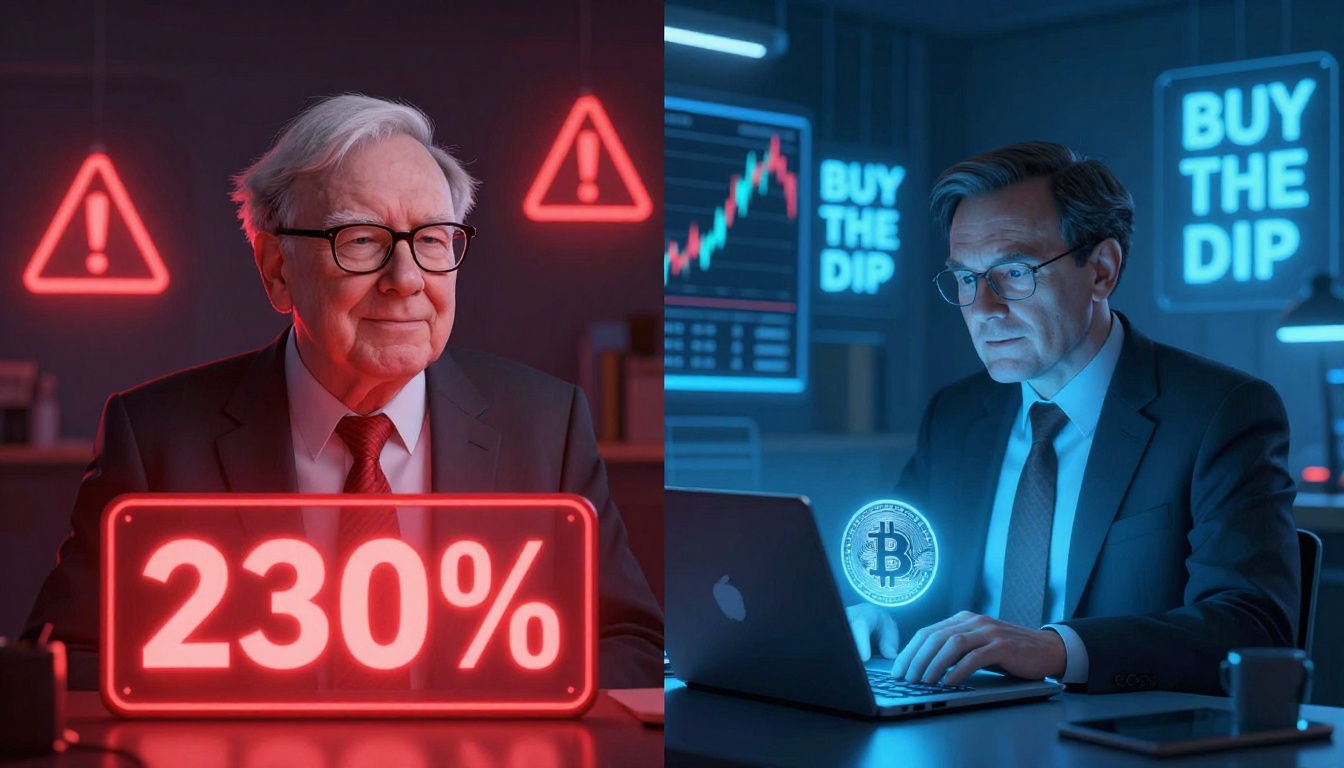
The Buffett Indicator just flashed a warning signal that’s only appeared four times in sixty years. Meanwhile, a crypto trader publicly announced he’s dumping another €9,200 into altcoins after watching his portfolio crater 80%. Welcome to the schizophrenic world of 2026 investing, where Warren Buffett’s favorite valuation tool suggests markets are more overvalued than during the dot-com bubble, yet the same fearlessness that drove German investors into the DAX is now fueling a very different kind of patience.
The 230% Siren Warren Buffett Doesn’t Want You to Ignore
The Buffett Indicator, calculated by dividing total US market capitalization by GDP, currently sits around 230%. To put that in perspective, that’s 76.6% above its historical trend line, or 2.4 standard deviations into nosebleed territory. This is only the fourth time in six decades that markets have reached such extreme levels.
Warren Buffett described this ratio as “the single best measure for the overall stock market valuation level at a given time.” When it exceeds 120%, markets are overvalued. At 230%, it’s practically screaming.
Historical precedent isn’t gentle. The previous three peaks:
– 1968: Followed by a 35% S&P 500 drop (1970 tech crash)
– 2000: Dot-com bubble burst, 49% collapse
– 2021: Inflation-triggered sell-off, 25% decline

Yet here’s where it gets uncomfortable for German investors: the indicator isn’t perfect. It doesn’t account for multinational companies generating massive international revenues while GDP remains domestic. The S&P 500’s current composition, with megacap tech firms dominating, creates a structural shift that Buffett’s 2001 formula couldn’t foresee.
Crypto’s 80% Abyss: When “Buying the Dip” Becomes a Lifestyle
While traditional markets flash red, crypto investors operate in a parallel universe where 80% losses aren’t a stop-loss trigger but a Dollar-Cost-Averaging (DCA) invitation. One trader recently documented his strategy: despite his altcoin portfolio bleeding down to just 20-25% of its original value, he injected another $10,000 across four positions, Optimism (OP), Bittensor (TAO), Sei (SEI), and Wormhole (W).
His reasoning? A confluence of technical capitulation signals, oversold RSI readings, and a macro environment he believes has bottomed. This isn’t blind hope, it’s a calculated strategy that how emotional self-deception impacts investing decisions during market volatility frequently masks.
The psychological mechanics are fascinating. German investors, conditioned by decades of Sparkasse (savings bank) conservatism and Angst (anxiety) about capital preservation, now face an asset class where volatility isn’t a bug, it’s the entire operating system. The same cultural traits that made long-term wealth building through disciplined ETF investing despite market swings so powerful are being stress-tested by 24/7 crypto markets.
The German Investor’s Dilemma: Patience vs. Panic
German financial culture has always prized patience. The concept of Sparquote (savings rate) and Vorsorge (provision/provision for the future) runs deep. But there’s a critical difference between patience with a DAX ETF backed by industrial giants and patience with a token that might be tomorrow’s wertloser Müll (worthless trash).
Many international residents in Germany report confusion about this dichotomy. On one hand, the Finanzamt (Tax Office) treats crypto as a speculative asset, taxing gains at your personal income tax rate if held under one year. On the other, German regulators have created relatively clear crypto custody rules that institutional investors now use.
The tension reveals itself in portfolio construction. While some Germans stick to real-world performance of a globally diversified ETF portfolio during recent market cycles, others are drawn to the same speculative instincts that fueled Neuer Markt (German tech stock index) mania in 1999, just with more sophisticated vocabulary.
Dollar-Cost-Averaging: The Mathematics of Hope
The trader’s DCA strategy follows a simple principle: invest fixed amounts at regular intervals regardless of price. When applied to productive assets like stocks (companies that generate earnings), DCA smooths volatility and leverages time. When applied to speculative assets, it’s more controversial.
His specific allocation:
– Optimism (OP): $2,500 at $0.2085
– Bittensor (TAO): $2,500 at $180
– Sei (SEI): $2,500 at $0.08
– Wormhole (W): $2,500 at $0.0215
This isn’t random. He’s doubling down on existing positions to lower his average entry price. The portfolio shows his largest holdings: TAO (23.3%), OP (21.5%), SEI (19.1%), a concentrated bet on infrastructure plays.
The math works if any of these survive and thrive. If they go to zero, it’s just more capital evaporated. This is where the importance of financial literacy when distinguishing speculation from long-term investing becomes critical. A 17-year-old German student recently faced ridicule for suggesting diversification over gold, his understanding of risk-adjusted returns may be more sophisticated than many crypto maximalists.
Taxes and Reality: The German Tax Office (Finanzamt) Doesn’t Care About Your Losses
Here’s where German bureaucratic reality collides with crypto dreams. While you’re down 80%, the Finanzamt only taxes realized gains. Your losses only matter when you sell, and they can offset gains, but not indefinitely. The Verlustverrechnung (loss offset) rules cap crypto losses at €20,000 per year against other income.
More concerning: tax risks on paper gains that could affect investor behavior in downturns are no longer theoretical. The Netherlands is implementing a 38% tax on unrealized gains starting 2028. While Germany hasn’t followed suit, the European harmonization pressure is real. Imagine paying taxes on your crypto portfolio’s 2021 peak value while it’s down 80% in 2026.
This tax asymmetry makes DCA during downturns a double-edged sword. You’re lowering your average cost, but each new purchase resets the one-year holding period for preferential tax treatment. The Spekulationsfrist (speculation period) matters.
The Retirement Factor: Riester, Rürup, and Crypto Dreams
Long-term German investors face a stark choice: continue with traditional Altersvorsorge (retirement provision) through regulated products like the reformed long-term retirement planning resilience amid uncertain market conditions, or allocate a speculative portion to crypto.
The new Altersvorsorgedepot (retirement provision depot) offers more flexibility than the old Riester-Rente, but it’s still fundamentally tied to regulated assets. You can’t hold your TAO tokens there.
This creates a bifurcated strategy: max out your tax-advantaged retirement accounts with boring ETFs, then use disposable income for high-risk speculation. It’s sensible, until the speculative portion becomes an emotional obsession that distracts from the core strategy.
What Actually Separates Wheat from Chaff
The original Reddit post claimed “In solchen Phasen trennt sich die Spreu vom Weizen” (in such phases, the wheat is separated from the chaff). But what does that actually mean?
For productive assets like stocks, separation means distinguishing between companies with real cash flows and those riding narrative waves. For crypto, it’s murkier. The most compelling argument for blockchain’s relevance isn’t speculation, it’s offener Zugang zu Finanzinfrastruktur (open access to financial infrastructure) in regions where banks fail.
A German commenter noted: “Wir reden in Deutschland über Krypto aus einer recht privilegierten Ausgangslage heraus. Banken, Versicherungen und grundlegende Finanzdienstleistungen funktionieren hier selbstverständlich.” (We talk about crypto in Germany from a fairly privileged position. Banks, insurance, and basic financial services work here as a matter of course.)
This is the uncomfortable truth: for German investors, crypto is largely optional speculation, not essential infrastructure. The Use Case (use case) remains elusive for most. Tracking tickets for public transport or enabling cross-border remittances are valid but niche applications.
The Actionable German Investor’s Playbook
So what should you actually do when the Buffett Indicator flashes 230% and crypto is down 80%?
For your ETF portfolio:
– Stay the course if you’re in accumulating ETFs. Market timing fails 94% of the time.
– If you have fresh capital, DCA over 6-12 months. The indicator suggests lower future returns, not immediate collapse.
– Review your Asset Allocation (asset allocation). Consider shaving 5-10% from equities if you’re overweight.
For crypto (if you must):
– Limit exposure to 1-5% of net worth, money you can afford to lose completely.
– DCA only with disposable income after all tax-advantaged accounts are maxed.
– Document everything for the Finanzamt. Use a proper Krypto-Steuer-Tool (crypto tax tool).
– Understand that DCA into a dying asset just means losing money more slowly.
For your psyche:
– Keep an Investmenttagebuch (investment journal). The most dangerous lies are the ones you tell yourself about “knowing” what the market will do.
– Celebrate the psychological milestone of early investing success in volatile markets, but don’t let it breed overconfidence.
The Verdict: Two Different Games
The Buffett Indicator’s 230% warning and the crypto trader’s 80% loss DCA represent two fundamentally different investment philosophies. One measures market cap against economic output, a relationship that, while stretched, still reflects underlying business reality. The other measures conviction against volatility, a relationship where conviction can be either heroic or delusional.
German investors have the luxury of a stable Währung (currency), functional Regulierung (regulation), and access to the world’s most boring, effective wealth-building tools. Squandering that advantage on speculation requires extraordinary justification.
The wheat isn’t separated from the chash by who buys the dip, but by who survives long enough to harvest, whether that’s at age 65 with a funded retirement or after the next crypto cycle. The Buffett Indicator doesn’t tell you when to sell, but it does suggest that future returns will be lower. In that environment, preserving capital becomes more valuable than swinging for the fences.
Your move depends on which game you’re actually playing. Just don’t confuse them.