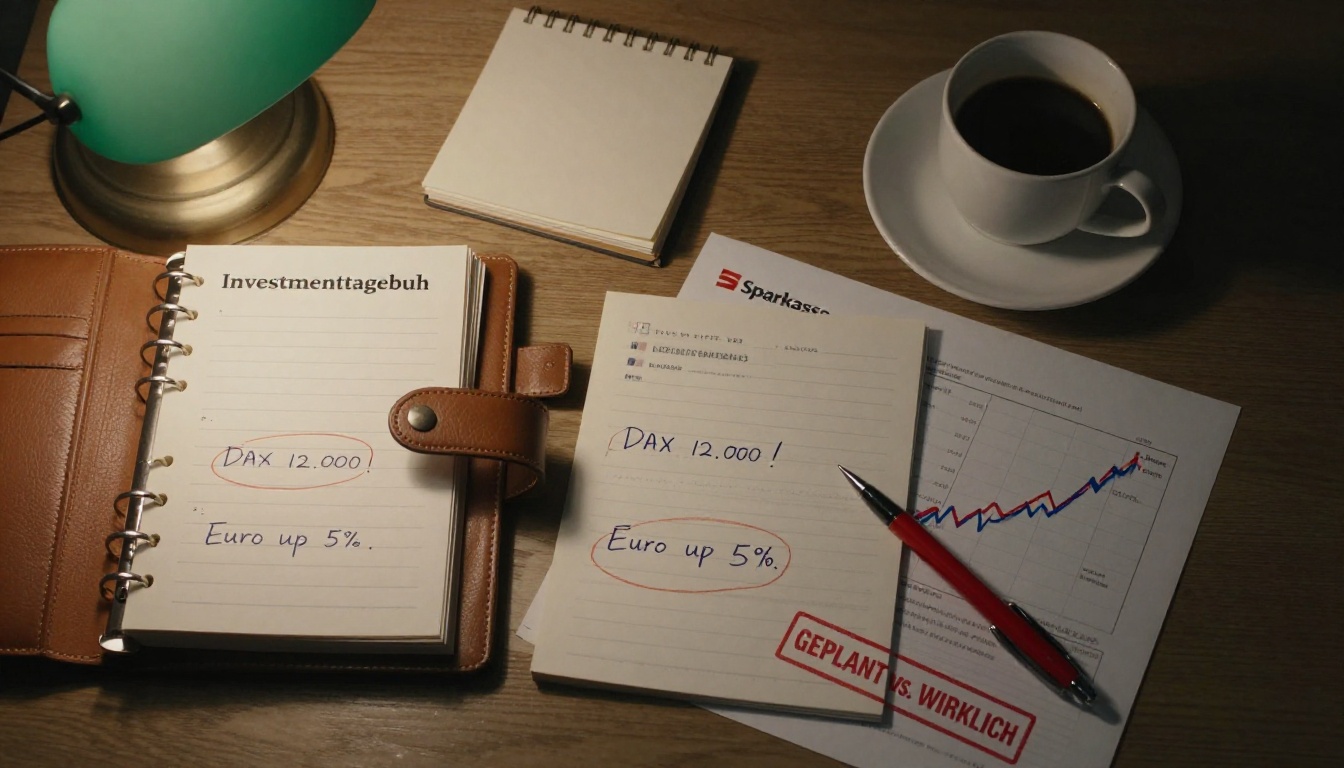
The most dangerous lies in German finance aren’t told by crash prophets or fraudulent brokers, they’re the ones you tell yourself. Every time you claim “I knew the DAX would drop” or “I always expected Tesla to surge”, your memory rewrites history to make you look smarter. Financial researcher Hanno Beck has a simple weapon against this self-deception: the Investmenttagebuch (investment journal), a written record of your expectations before you invest.
Why Germans Need Written Accountability
Germany’s financial culture relies heavily on institutional trust. You visit your Sparkasse (savings bank) advisor, nod along to their Anlageempfehlungen (investment recommendations), and assume their expertise shields you from poor decisions. This trust becomes dangerous when markets turn volatile. Without documented reasoning, you fall prey to Rückschaufehler (hindsight bias), convincing yourself you predicted outcomes you never actually foresaw.
Beck’s research reveals a pattern: investors who write down expectations before buying, “I expect the Euro to strengthen 5% this year” or “I believe AI stocks will rise 30%”, discover six months later that most predictions failed. This documented failure becomes the most valuable lesson in your financial education.
The Crash Prophet Paradox
German media regularly features Crashpropheten (crash prophets) predicting market collapses. These figures attract attention because they exploit a psychological loophole: humans remember correct predictions while forgetting the dozens of failed forecasts. An Investmenttagebuch (investment journal) closes this loophole.
When you document your own market timing attempts, selling before an expected crash, buying before an anticipated rally, you create an unimpeachable record of your actual predictive ability. Most investors discover their “gut feelings” underperform simple buy-and-hold strategies. This realization hurts, but it prevents future losses.
How Emotional Investing Thrives in German Bureaucracy
Germany’s love of documentation ironically creates a blind spot for personal finance. You meticulously file your Steuererklärung (tax return) and keep every Quittung (receipt), yet your investment decisions remain based on emotional reactions to headlines. This disconnect leaves you vulnerable to how family pressure and trust in traditional institutions can lead to emotional, poorly reasoned investments.
Your Sparkasse advisor won’t suggest an Investmenttagebuch (investment journal) because it undermines their authority. If you discover your own predictions outperform their recommendations, you might question the value of their Beratungsgebühren (advisory fees). The journal transforms you from a passive recipient of advice into an active evaluator of financial expertise.
Practical Implementation for German Investors
Creating an effective Investmenttagebuch (investment journal) requires more than noting purchase dates. For every investment, document:
- Specific expectations: “I expect this ETF-Sparplan (ETF savings plan) to return 7% annually because…”
- Time horizon: “I will hold this position for at least five years unless…”
- Emotional state: “I’m buying because I’m anxious about missing out on tech gains”
- Alternative options considered: “I rejected a global bond fund because…”
This process reveals patterns. Many German investors discover their Anlageentscheidungen (investment decisions) correlate with Baufinanzierung (mortgage) stress or job insecurity, emotions unrelated to market fundamentals.
The Demographic Prediction Trap
Germans particularly struggle with long-term predictions. Demographic forecasts showing Germany’s population shrinking by 20 million by 2070 convince many to delay property purchases, waiting for a crash that may never materialize. This mirrors how demographic predictions can lead to flawed investment decisions in German real estate.
Your Investmenttagebuch (investment journal) would expose this flaw. Reviewing entries from five years ago might show you expected a housing crash in 2020 that never arrived, while property prices in Munich and Berlin continued climbing. The documented gap between expectation and reality becomes harder to ignore than vague memories.
Psychological Traps in the German Market
The Investmenttagebuch (investment journal) combats several cognitive biases prevalent among German investors:
1. Authority Bias: Trusting Finanzberater (financial advisors) from established banks without questioning their logic
2. Consensus Effect: Assuming “everyone” is buying Bausparverträge (building savings contracts) so it must be wise
3. Loss Aversion: Selling winners too early while holding losers, documented in your Verlustbuchungen (loss entries)
When you write down “I’m buying this because my advisor recommended it and they work for Deutsche Bank”, you create a paper trail of your reasoning. Six months later, when the investment underperforms, you can’t rewrite history. The entry forces you to confront whether “trusted institution” equals “good investment.”
Real-World Example: The Tech Stock FOMO
Imagine documenting this entry in March 2024: “Buying NVIDIA stock at €820. AI is the future, and every expert says this is a generational opportunity. I feel excited but also pressured because my colleague already made 40% on his position.”
Six months later, NVIDIA trades at €720. Your Investmenttagebuch (investment journal) entry prevents you from claiming “I always knew it was overvalued.” Instead, you face the uncomfortable truth: you bought based on hype and social pressure, not analysis. This documented failure teaches more than any Finanzbildungskurs (financial literacy course).
The Luxury Poverty Connection
German investors often confuse consumption with investment. You justify a new iPhone because it “helps you trade stocks”, but your Investmenttagebuch (investment journal) reveals the truth: you spent €1,200 on a device while your Depot (brokerage account) holds €800. This pattern appears in the psychological disconnect between consumption habits and long-term investment goals in Germany.
Documenting the rationale for every purchase, “I’m buying this stock because I understand the business” versus “I’m buying because I want to feel like an investor”, exposes the difference between real investing and financial cosplay.
Scam Vulnerability and Documentation
Investmenttagebuch (investment journal) discipline also protects against fraud. Fraudsters thrive on emotional decisions made without written records. When you document every investment thesis, you create friction that slows impulsive choices.
This matters because how emotional vulnerability and overconfidence can make investors susceptible to sophisticated financial scams shows that German fraud victims often acted on “exclusive opportunities” they never properly analyzed. A journal entry reading “I’m investing €50,000 in this crypto platform because the advisor promised 15% returns and said spots are limited” would raise red flags before money transfers, not after.
Implementation: Digital or Analog?
German data protection concerns make some investors prefer paper journals. However, digital tools offer advantages:
- Encrypted notes apps with date stamps prevent tampering
- Spreadsheets allow filtering by performance or emotional state
- Brokerage export functions provide transaction data for honest review
The key isn’t format, it’s brutal honesty. A beautiful leather Notizbuch (notebook) filled with flattering lies serves no purpose. An ugly spreadsheet documenting painful mistakes builds wealth.
The Six-Month Review Ritual
Beck recommends reviewing entries every six months. This timeline works well with German Steuerjahres (tax years) and quarterly Unternehmensberichte (company reports). During review, categorize outcomes:
- Prediction correct: Analyze why you were right, skill or luck?
- Partially correct: Did the investment work for reasons you identified?
- Completely wrong: What blind spot caused the error?
Over time, patterns emerge. Many German investors discover their “conservative” Rentenfonds (pension funds) underperform because they overweight domestic stocks due to Heimatbias (home bias), not risk tolerance.
Conclusion: Becoming Your Own Toughest Critic
The Investmenttagebuch (investment journal) works because it removes your ability to lie to yourself. In a financial culture that values expert opinions and institutional trust, documenting your own reasoning feels radical. Yet this simple practice transforms you from a passive consumer of financial advice into an active, learning investor.
Start today. Before your next Wertpapierkauf (securities purchase), write down your complete thesis. Six months from now, the gap between expectation and reality will teach you more than any Sparkasse seminar ever could. Your future self, richer and wiser, will thank you for the uncomfortable honesty.
The German financial system rewards those who think for themselves. An Investmenttagebuch (investment journal) is the first step toward earning that reward.