The math seems seductively simple: Germany’s population is shrinking by up to 20 million people by 2070, baby boomers are retiring en masse, and eventually, millions of properties will flood the market as this generation passes on. So why not wait a decade or two and scoop up prime real estate at fire-sale prices? This demographic determinism has become the favored rationalization for delaying Germany’s most consequential financial decision. But the numbers tell a far more complicated, and expensive, story.
The Demographic Reality Check
Let’s start with the stark data from the Statistisches Bundesamt. By 2035, one in four Germans will be 67 or older, up from one in five today. The working-age population is projected to shrink from 51.2 million to as low as 37.1 million by 2070. The old-age dependency ratio could worsen from 33 retirees per 100 workers to a staggering 61:100. These aren’t abstract projections, they’re demographic freight trains already barreling down the track.
But here’s where the housing crash theory derails: population decline doesn’t equal uniform demand destruction. The Federal Statistical Office’s scenarios show Germany’s population in 2070 could range from 63.9 to 86.5 million, a 22-million-person spread that reveals more about uncertainty than certainty. The moderate scenario pegs the population at 74.7 million, but even this masks brutal regional disparities that will define real estate values.
The “Inheritance Wave” Is a Mirage
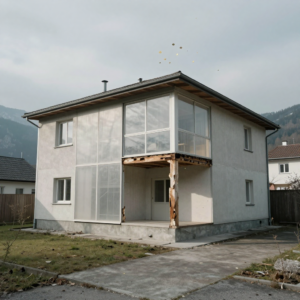
Many prospective buyers imagine a tidal wave of boomer-owned properties hitting the market around 2040. The reality? A trickle of often undesirable inventory. As one analysis of demographic trends notes, the properties becoming available will be technologically obsolete and require substantial renovation. A 40-year-old house isn’t vintage, it’s potentially a money pit of outdated heating systems, insufficient insulation, and asbestos surprises.
The generation currently in their 60s and 70s owns a disproportionate share of German real estate, but their properties cluster in two categories: desirable urban locations and dying rural villages. The latter will see entire neighborhoods become unsellable at any price, a phenomenon already visible in parts of eastern Germany and Italy’s abandoned hill towns. The former? Those properties will be fought over by international capital, institutional investors, and the minority of young Germans who can afford them.
Location Tiers Determine Everything
The demographic impact fractures cleanly along the A-, B-, and C-location divide. In Munich, Frankfurt, and Berlin, the housing shortage will persist regardless of national population trends. These cities function as nodes in the global economy, insulated from domestic demographic headwinds by immigration and capital inflows. The Statistisches Bundesamt explicitly states that only Berlin, Hamburg, and Bremen can expect growth even under pessimistic scenarios, if immigration remains high.
In contrast, C-locations, rural districts in Saxony-Anhalt, Thuringia, and the Saarland, face a death spiral. Some communities will offer houses for symbolic prices, yet find no takers. The problem isn’t price but utility: no jobs, collapsing infrastructure, and schools merging into regional hubs. Buying “cheap” here means catching a falling knife that will keep falling for decades.
B-locations present the murkiest picture. Mid-sized cities like Stuttgart face existential questions. If the automotive industry doesn’t successfully transition, Stuttgart could follow Detroit’s path, wealthy residents fleeing, tax base eroding, and “cheap” housing that keeps getting cheaper. The demographic dividend becomes a demographic curse when tied to a single industry’s decline.
The Supply-Side Catastrophe
While demographics grab headlines, Germany’s real housing crisis is construction collapse. According to Finanzen100, 2025 and 2026 will see “significantly fewer” apartments built than the country needs, creating a gap that widens monthly. Material costs, interest rates, and regulatory complexity have made building economically unviable.
This shortage means that even as demand softens in aggregate, supply constraints will support prices in desirable areas. The demographic death spiral in rural regions doesn’t help young families searching in Berlin or Munich. You’re not competing with ghosts in Saxony for a Kreuzberg apartment.
The Senior Supply Blockage
Perhaps the most underappreciated factor: retirees aren’t downsizing. Nearly half of Germans over 65 would move to smaller apartments, but the market prevents it. As housing analyst Reiner Braun explains, “Altmietverträge are nothing but securities in Germany”, protected by tenant laws that make them far cheaper than current market rates.
A widow paying €8 per square meter for her 120m² family apartment faces €15-20 per square meter for a 60m² new rental. Even if she wanted to downsize, the math punishes her. Transaction costs, renovation expenses, and emotional barriers, “You don’t transplant an old tree”, as Braun puts it, create a gridlock where millions of square meters remain theoretically available but practically locked.
Cities have responded with Wohnungstausch platforms, but the ratio reveals the problem: for every senior offering a large apartment, four families seek one. Munich’s exchange program facilitated just 15 swaps in its first year. The scale is laughable compared to the need.
The Renovation Trap
Even when boomer properties do enter the market, they’ll carry hidden costs. Germany’s skilled trades crisis means fewer craftsmen and rising wages. By 2040, renovating a 40-year-old house could cost as much as the purchase price itself. Add new heating system requirements under the Gebäudeenergiegesetz, insulation mandates, and potential asbestos remediation, and that “bargain” becomes a financial sinkhole.
The properties that will be genuinely cheap will be cheap for a reason: they’re in locations with no economic future or require six-figure investments to become habitable by modern standards.
The Math of Waiting
Let’s quantify the cost of waiting. Imagine a €500,000 apartment in Leipzig today, with 2% annual appreciation (conservative for a B-location). In 15 years, it costs €673,000. Your €50,000 down payment, if invested at 5% annually instead, grows to €104,000. You’ve gained €54,000 in investment returns but need an additional €173,000 to buy the same property, net loss of €119,000 in purchasing power.
And that’s assuming prices stay flat or decline, which demographic models suggest is unlikely in Leipzig and impossible in Munich. The opportunity cost compounds brutally: every year you wait, you’re building someone else’s equity instead of your own.
The Immigration Wild Card
The demographic projections that paint the bleakest pictures assume immigration declines. But Germany’s economic model depends on precisely the opposite. The Federal Statistical Office admits that even high immigration can’t fully offset the native population decline, but it can maintain demand in growth regions.
The properties most affected by demographic decline, rural houses in eastern Germany, aren’t on immigrants’ radar. They cluster in cities, sustaining demand exactly where you want to buy. Your demographic bet is actually a bet against Germany’s ability to attract skilled workers, a dangerous wager given labor shortages.
What Actually Works
Instead of timing the demographic shift, focus on factors you can control:
For urban buyers: Stop waiting. Berlin, Munich, and Hamburg face supply constraints that demographics won’t fix. The “crash” will happen in villages you’ve never heard of, not neighborhoods where you want to live. Every year of renting costs you wealth accumulation and exposes you to rental market volatility.
For suburban families: Target B-locations with diversified economies and good infrastructure. Cities like Leipzig, Dresden, or Freiburg offer growth potential without Munich prices. Demographic trends here are neutral to positive, and you’ll build equity while others wait for a crash that won’t come.
For contrarians: If you want to bet on demographic decline, buy rental properties in stable university towns. Student populations insulate you from local decline, and you’ll serve a perpetual rental market as ownership becomes unattainable for younger generations.
The Bottom Line
Germany’s demographic transition will create a bifurcated market: worthless properties in abandoned regions and increasingly expensive housing in functional cities. The cheap real estate you’re hoping for will come with conditions that make it worthless to you: location in a dying community, massive renovation needs, or arrival timed for your retirement, not your family-building years.
The generation that profits from demographic decline won’t be yours, it’ll be the one buying your property at a discount when you’re ready to downsize in 2050. By then, you’ll have paid €300,000 in rent while building zero equity. The demographic time bomb doesn’t explode where you think, it detonates in your personal wealth statement.
Stop waiting for millions of Germans to die so you can afford a home. Start building wealth now, where people will actually want to live when you’re ready to sell.