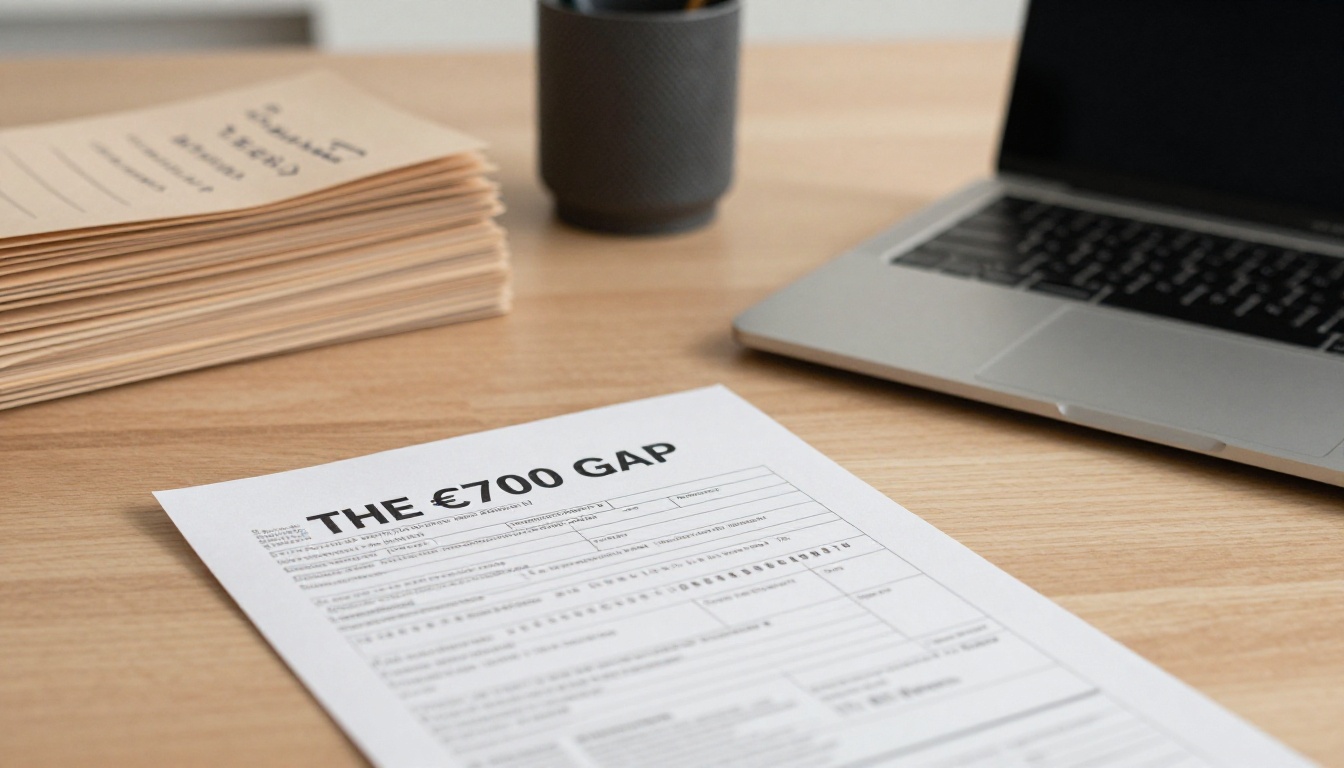
Your colleague just bragged about their €1,200 tax refund. You got €320. Same job, same office, same coffee machine. What gives? The German tax system operates with the same precision as a Deutsche Bahn timetable, until you realize there are express routes you never knew existed. That €700+ gap isn’t about cheating the system, it’s about understanding the deductions hiding in plain sight.
The Refund Disparity Isn’t Random
Let’s address the elephant in the room. When tax software companies advertise “average refunds of €1,000”, they’re not lying, they’re just averaging the €3,000 refund of someone who deducted a home office and five-figure training costs with the €0 refund of someone who filed only their commuter allowance. The math works, but it doesn’t tell your story.
The Reddit thread that sparked this discussion reveals a common pattern: full-time employees who commute 30 kilometers by car and claim only the Pendlerpauschale (commuter allowance) typically land between €200-400. Meanwhile, those who treat their tax return like a financial audit of their work life regularly hit four-figure refunds.
The truth? Your refund size directly correlates with how thoroughly you document your work-related spending. Not your salary, not your job title, your paperwork.
Beyond the Commuter Allowance: The Deductions You Miss
The Pendlerpauschale of €0.38 per kilometer adds up, but it’s just the appetizer. The real money sits in categories most international residents never explore.
Professional Equipment: Your Laptop Isn’t Just a Laptop
That MacBook you bought for €1,500? If you use it at least 10% for work, it’s deductible. The German tax law (§ 9 EStG) allows you to claim income-related expenses (Werbungskosten) for equipment that serves your professional activity.
Here’s what this means practically:
– Laptops, monitors, phones: Deductible proportionally to work use (50/50 split accepted without proof, >90% work use allows 100% deduction)
– Peripherals: Printers, keyboards, webcams, docking stations
– Software: Professional subscriptions, antivirus, cloud storage
– Home office furniture: Desk, ergonomic chair, lighting
Since 2021, self-employed workers can write off laptops immediately regardless of price. Employees claim these in Anlage N (income tax return supplement N), but only if total Werbungskosten exceed the €1,230 Pauschale (lump sum) that everyone gets automatically. This is why many employees skip these deductions, individually they seem small, but combined they break that threshold fast.

The Secondary Residence Rule: Your Biggest Hidden Lever
One commenter mentioned deducting up to €1,000 monthly for a Zweitwohnung (secondary residence). This isn’t a typo. If your job requires you to maintain a second home near your workplace (and your primary residence is too far for reasonable commuting), you can deduct:
– Rent (up to €1,000/month)
– Utilities and Nebenkosten (ancillary costs)
– Travel costs between residences
– Moving costs to establish the secondary residence
The key is the “beruflich veranlasst” (work-related) requirement. A project manager assigned to a client site three hours from their family home qualifies. Someone who simply prefers city life does not.
Insurance: Not All Policies Are Created Equal
Many international residents miss insurance deductions because they assume none qualify. The reality is nuanced. While private Haftpflichtversicherung (liability insurance) is generally not deductible, beruflich bedingte (work-related) insurance absolutely is:
- Professional liability (D&O, cyber risk, electronics insurance)
- Work-related car insurance (portion of Kfz-Versicherung)
- Legal insurance if it covers professional disputes
Health and care insurance contributions go in Anlage Sonderausgaben (special expenses supplement), while work-related liability insurance belongs in Anlage N. Mix these up and you delay processing or lose the deduction entirely.
Education and Training: The Five-Figure Game Changer
That “five-figure Werbungskosten” comment from the research? It often comes from a single intensive training program. A €3,000 masterclass plus:
– Flight: €800
– Hotel (10 nights): €1,500
– Meals: €500
– Course fees: €3,000
– Lost work time: Potentially deductible if self-employed
Total: €8,800+ in one trip. Add annual professional journal subscriptions, association memberships, and certification renewals, and you understand how €10,000+ happens.
Critical detail: The training must maintain or improve skills for your current profession. Switching careers doesn’t count.
The Tax Class Trap: Why Withholding Masks the Real Story
Your Steuerklasse (tax class) doesn’t change your final tax liability, but it dramatically affects your monthly withholding and therefore your refund perception.
- Steuerklasse 1 (single): Neutral baseline, often results in small refunds
- Steuerklasse 3/5 (married, main/secondary earner): Main earner underpays monthly, secondary earner overpays heavily, creates large refund potential but also mandatory filing
- Steuerklasse 4 with factor: More balanced, but still requires filing
The planned abolition of the 3/5 combination will simplify this, but for now, many couples in 3/5 see refunds of €2,000+ simply because the secondary earner had excessive withholdings. It’s not extra money, it’s a return of an interest-free loan to the Finanzamt (tax office).
This is why comparing refunds across tax classes is meaningless. A €1,500 refund in Steuerklasse 5 might equal a €200 refund in Steuerklasse 1 after true liability is calculated.
Documentation: The €700 Difference Maker
The gap between €300 and €1,000 refunds rarely comes from one massive deduction. It’s the accumulation of €50 here, €120 there, each requiring proof.
What separates high-refund filers:
1. Digital receipt collection: Apps that scan and categorize receipts in real-time
2. Mileage logs: For every work trip, not just commute
3. Usage journals: For laptops, phones, home office, documenting work vs. private use
4. Annual insurance statements: Requesting Jahresbescheinigungen (annual certificates) from providers
5. Bank statement annotations: Flagging work-related transactions immediately
The €300 filer estimates. The €1,000 filer evidences.
Capital Gains and Foreign Investments: The Advanced Play
One commenter mentioned “significant capital gains in countries with high withholding tax.” This is where refunds jump to €5,000+ for some investors.
If you hold US stocks through a German broker, you likely pay 15% Quellensteuer (withholding tax) in the US plus 25% Abgeltungssteuer (capital gains tax) in Germany. The Quellensteuer gets credited against your German liability, but only if you file and claim it. Many investors skip this, losing 15% of their gains unnecessarily.
For substantial portfolios, this alone can create four-figure refunds. This connects directly to capital gains and inheritance tax implications when you’re dealing with inherited assets or large investment positions.
Common Mistakes That Keep You at €300
- Accepting the Pauschale: The €1,230 Werbungskostenpauschale (income-related expenses lump sum) is automatic. Many stop there, ignoring actual expenses that exceed it.
- Mixing up forms: Putting health insurance in Anlage N instead of Anlage Sonderausgaben causes rejections.
- No receipts: “I paid cash” means no deduction. German tax law requires Belege (receipts) for everything above €250, practically, auditors ask for everything.
- Wrong tax class assumptions: Staying in 3/5 because “we get a bigger refund” ignores that it’s your money returning, not a bonus.
- Ignoring timing: Buying a €2,000 laptop in December vs. January affects which year’s return benefits. Strategic timing can push you over the Pauschale threshold.
The Action Plan: From €300 to €1,000 Next Year
Immediate steps for your 2025 return (due July 31, 2026):
1. Audit your bank statements: Flag every work-related expense from 2025. Even €5 parking fees for client visits add up.
2. Request insurance certificates: Call providers for Jahresbescheinigungen showing exact premiums paid.
3. Document home office days: The home office Pauschale of €6 per day (max €1,260/year) requires minimal proof, a calendar entry suffices.
4. Check your tax class: If you’re in 3/5, understand you’re forced to file. Make it count by claiming everything.
5. Use software intelligently: Programs like WISO Steuer guide you, but they only know what you input. The magic is in the data collection, not the software.
For 2026 planning:
– Start a digital receipt system today. The Ordio article on how average earners can optimize tax refunds despite lower visibility shows that systematic documentation matters more than income level.
– If your employer offers a Dienstwagen (company car), understand the 0.5% rule and its tax implications, hybrid vehicles have stricter CO₂ limits since 2025.
– For families, the Kinderbetreuungskosten (child care cost) deduction increased to 80% (max €4,800) in 2025, substantially more generous than previous years.
The Bigger Picture: Tax Optimization vs. Tax Evasion
That commenter who said, “Nervt aber trotzdem, weil es im Endeffekt einfach nur Geld ist, das man dem Staat vorerst ausgelegt hat” (It’s annoying because it’s just money you temporarily lent the state) is both right and wrong. Yes, large refunds mean you overpaid during the year. But the alternative, underpaying and facing a Nachzahlung (additional payment) with potential interest, is worse.
True optimization isn’t about maximizing refunds, it’s about minimizing total tax liability while staying liquid. This might mean filing for a Lohnsteuerermäßigung (wage tax reduction) mid-year to lower withholdings if you have consistent high deductions, rather than waiting for a refund.
Final Reality Check
The €1,000 refund club isn’t exclusive. It’s just better organized. They track expenses in real-time, understand that the Anlage N is their friend, and aren’t afraid to claim a Zweitwohnung when justified. They also know when to consult a Steuerberater (tax advisor), not for simple returns, but for complex situations like foreign income or business expenses.
Your €300 refund suggests you’re playing by the basic rules. That’s fine, but it’s not optimal. The system rewards those who document their professional life comprehensively. Start with one category, say, all work-related technology purchases, and build from there. Next year, that €300 could easily be €900.
And remember: that colleague with the €1,200 refund might have spent €3,000 on deductible expenses to get it. The net gain is what matters, not the gross refund. Track your spending, document religiously, and claim what’s yours. The Finanzamt won’t volunteer the money, but they’ll return it if you ask properly, with receipts.
For families considering long-term tax strategies, tax-efficient gifting strategies from family members can complement your annual deduction optimization, especially when grandparents want to contribute to a child’s future without triggering gift tax complications.
The gap between €300 and €1,000 isn’t magic. It’s methodology. And in Germany, methodology pays.