For millennials in Germany, the path to financial security seemed straightforward: complete a solid Ausbildung (vocational training) or earn a university degree, work diligently, and the rewards would follow. A stable job, a home, perhaps a family. This wasn’t a fantasy, it was the lived reality of their parents’ generation. But for those born between the early 1980s and mid-1990s, the rules changed after they had already stepped onto the field.
The data tells a stark story. While real wages have stagnated or declined over the past decade, German property prices have exploded. Rents in major cities now consume 30 to 50 percent of net income, and the security of an unbefristeter Arbeitsvertrag (permanent employment contract) has become a rarity replaced by Befristungen (fixed-term contracts) and Leiharbeit (temporary agency work). The promise that one income could support a household has collapsed, two earners now struggle to achieve what a single salary once provided.
The Generational Bait-and-Switch
What distinguishes millennials from Generation Z is the timing of the betrayal. Gen Z entered adulthood already skeptical, having watched the system fail their older siblings. Millennials, however, believed the old social contract still applied. They followed the prescribed path, only to discover the goalposts had moved.
Many international residents express frustration with this dynamic. The prevailing sentiment is that German bureaucracy ranks among the most confusing systems they’ve encountered, but the economic bait-and-switch hits even harder. A common observation: “Den Handwerkern mit Ausbildung sagt man ‘hättest mal studiert,’ den Akademikern ‘hättest du mal was ordentliches gelernt.'” (Tradespeople are told “you should have studied”, while academics hear “you should have learned a proper trade.”) This damned-if-you-do, damned-if-you-don’t paradox captures the core of the generational trap.
The numbers support this disillusionment. A dual-degree graduate from a major German corporation, combining a BWL-Studium (business administration degree) with a kaufmännische Ausbildung (commercial apprenticeship) and excellent grades, recently received only a fixed-term contract after graduation. When the company implemented mid-term cost-cutting, this supposedly “self-grown top talent” was let go. This pattern repeats across sectors, where even the most qualified candidates face precarious entry conditions.
The Housing Math That No Longer Works
The German housing market has become a cruel paradox. Prices keep climbing while construction activity collapses. In 2024, Europe’s largest economy completed just 251,900 new apartments, a 14 percent plunge from the previous year and the lowest figure since 2015. The government target of 400,000 new units per year wasn’t just missed, it was missed dramatically.
This supply crisis has created a mathematical impossibility for young workers. Over the past 15 years, net cold rents have risen more than 60 percent. In Munich, Berlin, and Hamburg, a two-room apartment routinely costs over half of a typical entry-level net salary. The result: more than 25 percent of 25-year-olds lived with their parents in 2024, turning the “Hotel Mama” from a taboo into a mass phenomenon.
The construction shortfall isn’t improving. Building permits have fallen to their lowest level in over a decade, and the construction of single and multi-family homes has declined by double digits. High interest rates, material costs, and bureaucracy have rendered many projects unprofitable. Experts see no quick relief, 2026 will remain tight, with effects lasting until at least 2027.
The “Wrong Choice” Paradox
The debate over whether education or trade skills offer better prospects has become a circular firing squad. The reality is that neither path guarantees financial stability anymore.
A Meister (master craftsman) in plumbing or electrical work can earn €3,500 gross or more, but this varies dramatically by region and trade. In the Ruhr area, one master reported earning exactly that, tariff-bound with no local upside. Meanwhile, academics face delayed career entry, student debt, and often only marginally higher lifetime earnings. A Romanist or philosopher builds a network of fellow humanities scholars, while an electrician builds connections with other tradespeople who can help with home construction and renovation, creating an informal economy of mutual support that academics lack.
The most honest assessment comes from those who pursued both paths: dual-degree holders who completed vocational training and university studies, only to find themselves earning median wages with no realistic path to homeownership. As one such graduate noted, “Ein eigenes Haus oder auch nur eine große Mietwohnung ist in diesem Leben damit nicht mehr erreichbar für mich” (A house or even a large rental apartment is no longer achievable in this lifetime).
The Boomerang Effect as Rational Choice
Moving back to the parental home, once a source of shame, has become the most logical financial move for many young adults. The Rückkehr in das Elternhaus (return to the parental home) allows savings accumulation that would be impossible otherwise. For young couples, doubling up with relatives has become a strategy to pool resources.
This trend has broader economic consequences. The rental market loses turnover, and the mobility of skilled workers decreases when relocation becomes unaffordable. Germany is converging with southern European patterns, where young adults traditionally left home much later. The average age of moving out, once under 24 in Germany, is now rising steadily.
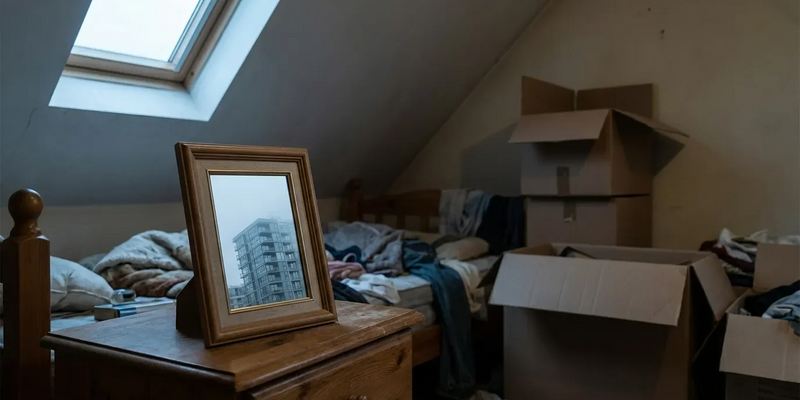
The image shows what many millennials now accept as a temporary, or even medium-term, living arrangement. The “Boomerang-Generation” isn’t failing to launch, it’s adapting to economic conditions that make independent living financially reckless.
The Mortgage Trap and Hidden Costs
Even for those who manage to save, the mortgage market presents new barriers. Interest rates for 10-year loans have settled between 3.5 and 4.0 percent, a far cry from the sub-2 percent rates available before 2022. A €400,000 loan now costs €800 to €1,000 more per month than it would have three years ago.
Banks have tightened lending standards dramatically. Full financing is nearly impossible, most now require 20 to 30 percent Eigenkapital (down payment). This not only reduces the interest rate but protects against value fluctuations. Without significant savings, property purchase in 2026 becomes a high-risk gamble.
Compounding this is the ticking time bomb of energetic renovation requirements. The federal government is cutting Bundesförderung für effiziente Gebäude (BEG) subsidies by over €3 billion in 2026, while new EU building directives mandate renovation of the worst-performing properties. Buyers face six-figure renovation costs for unsanitized “bargains”, with less state support available.
Regional Disparities and Structural Decline
The housing crisis isn’t uniform. The Postbank Wohnatlas projects that by 2035, 40 percent of German districts, primarily structurally weak rural regions, will see falling property values. In contrast, the “Big 7” metropolises (Berlin, Munich, Hamburg, Frankfurt, Cologne, Stuttgart, Düsseldorf) remain under severe pressure.
This creates a two-speed market where location determines financial feasibility. In rural areas, property values may decline but jobs are scarce. In cities, employment opportunities exist but housing costs are prohibitive. The Schere zwischen Stadt und Land (gap between city and countryside) widens, forcing difficult trade-offs between career and living standards.
The Hidden Tax Burden on Young Workers
While housing costs grab headlines, how rising pension contributions erode young workers’ net income despite wage increases represents a quieter but equally damaging squeeze. The Rentenpaket 2025 stabilizes pensions for retirees by increasing contributions from current workers, reducing take-home pay for millennials who already face higher living costs.
Similarly, how tax adjustments mask a hidden squeeze on take-home pay for middle earners reveals that while tax-free allowances rise modestly, the overall burden shifts in ways that reduce net purchasing power. For a generation struggling to save for property, every euro of reduced net income pushes homeownership further away.
The looming mortgage crisis adds another layer. As the refinancing shock facing homeowners as low-rate mortgages expire explains, those who bought during the low-rate era face payment shocks when their Zinsbindungen expire. This indirectly impacts millennials by reducing the supply of affordable starter homes, as current owners hesitate to sell and give up their favorable rates.
Practical Survival Strategies in a Broken System
What can millennials actually do? The conventional advice, save more, work harder, rings hollow when the system is structurally misaligned. Instead, consider these reality-based approaches:
- 1. Question the Ownership Orthodoxy: In Germany’s current market, renting may be permanently cheaper than buying. The old narrative that renting is “throwing money away” ignores the opportunity cost of a 20 percent down payment plus renovation reserves. Investing that capital in diversified ETFs could yield better long-term returns than concentrating wealth in an illiquid, overpriced asset.
- 2. Exploit Geographic Arbitrage: Remote work enables living in regions with falling property values while earning city salaries. The Postbank data identifying 40 percent of districts as structurally weak presents not just a warning, but a map of affordability. Cities like Magdeburg, Leipzig, or rural areas in eastern Germany offer housing at fractions of Munich or Berlin costs.
- 3. Build Trade Networks: For those with academic backgrounds, actively cultivate relationships with skilled tradespeople. The informal exchange economy among Handwerker (craftspeople) saves tens of thousands on renovation and construction. Offer your professional skills, legal, financial, tech, in exchange for their practical expertise.
- 4. Delay Family Formation Strategically: The traditional life script assumes homeownership precedes children. In modern Germany, this sequence may need reversal. Starting a family while living with parents or in subsidized social housing, then moving later when careers are established, represents a pragmatic adaptation.
- 5. Consider the Unconventional Path: An unconventional path to financial independence outside traditional career expectations shows that bypassing the academic track entirely can sometimes yield better results. The waste management entrepreneur who failed through Germany’s school system achieved financial independence by age 28, while his university-educated peers remain mired in debt and precarious employment.
The Systemic Nature of the Problem
The core issue extends beyond housing. How Germany’s failure to build housing intensifies the affordability crisis for younger generations connects to broader fiscal constraints. The growing burden of government debt reducing fiscal space for generational fairness shows that interest payments on Germany’s €60 billion debt load crowd out investment in education, infrastructure, and housing subsidies that could help younger cohorts.
Meanwhile, how inflation and cost pressures are reshaping middle-class lifestyle expectations illustrates the compounding effect. A Bavarian family’s identical summer vacation package jumped from €3,700 to €5,000 in three years, a 35 percent increase that mirrors housing cost inflation. Every aspect of middle-class life becomes more expensive while wages lag.
The German model, once celebrated for its stability and social mobility, now functions as a generational wealth transfer mechanism. Retirees benefit from stable pensions and property appreciation while young workers face higher contributions, stagnant wages, and asset prices that rise faster than savings can accumulate.
Conclusion: Adapting to Permanent Instability
The promise that education and hard work guarantee security was not a lie when it was made, it was a description of a system that no longer exists. For millennials caught in the transition, the path forward requires abandoning the old script and writing a new one.
This means recognizing that what middle-class income really means amid high housing and living costs has fundamentally changed. A nurse earning €3,500 net who spends €1,400 on housing and €1,000 on ancillary costs has just €1,100 left for life. This isn’t middle-class comfort, it’s precarious survival.
The solution isn’t individual better choices, it’s systemic reform. But until that occurs, millennials must operate within the broken system: questioning ownership dogma, exploiting geographic arbitrage, building alternative support networks, and abandoning outdated life scripts. The generation that was promised stability must now find a way to thrive in permanent uncertainty.
The German economic engine still runs, but it’s running on a fuel mix of generational sacrifice and broken promises. For millennials, the cost of stability has become the stability of cost, permanently high, permanently out of reach.