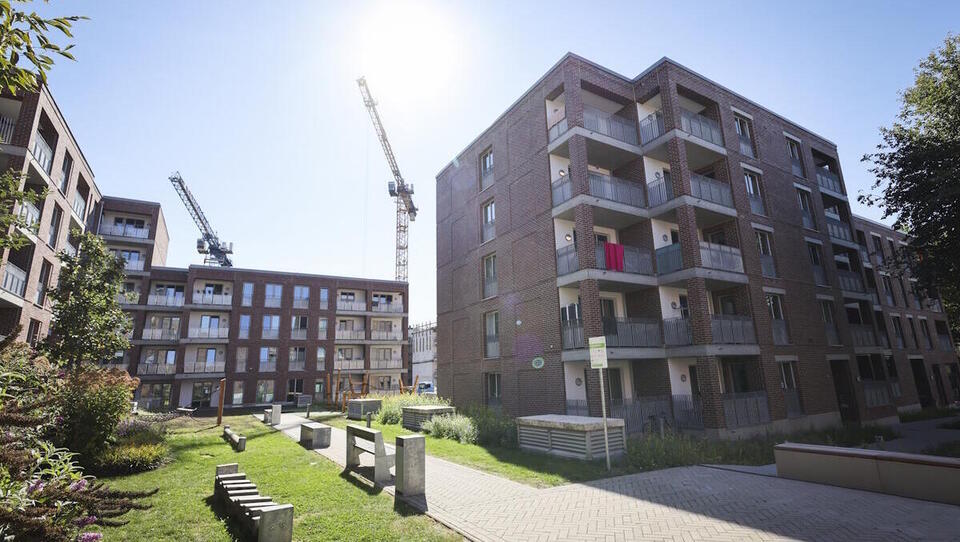
Germany’s housing market has become a cruel paradox: property prices keep climbing while construction activity collapses. In 2024, Europe’s largest economy completed just 251,900 new apartments, a 14% plunge from the previous year and the lowest figure since 2015. For a country grappling with a severe affordability crisis, this isn’t just disappointing, it’s a policy failure of historic proportions.
The numbers reveal a system in freefall. While Sweden and other EU peers maintain robust building rates, Germany’s construction sector is drowning in red tape, municipal resistance, and demographic headwinds. The result? A generation of young families priced out of homeownership, renters facing record burdens, and a middle class increasingly squeezed between luxury developments and social housing waitlists.
The Municipal Blockade: When Local Politics Kills Housing
The most damning bottleneck isn’t money or materials, it’s land. Or rather, the deliberate refusal to make it available.
German municipalities control the crucial first step: designating Bauland (building land). Yet across the country, from Munich’s sprawl to small Bavarian towns, local governments are simply refusing to expand housing zones. One Reddit user in a “mittelgroßen bayerischen Kleinstadt” reported that their local economic developer admitted the city council faces “massive Gegenwehr gegen jegliche ‘Versiegelung'” whenever new housing is proposed.
This isn’t accidental. Municipalities face a perverse financial calculus. As one commenter bluntly explained, cities earn 100% of Gewerbesteuer (business tax) from industrial zones but only 15% of income tax from residents. New housing brings infrastructure costs, kindergartens, sewage, roads, without commensurate revenue. Why build apartments when you can court Amazon warehouses?
The political incentives are even worse. In suburban Speckgürtel communities around major cities, the dominant voting blocs are homeowners who’ve paid off their mortgages. Their primary concern? Protecting property values. As one commenter noted with mathematical precision: “Die ‘Boomer’ haben Angst, dass sich dadurch der Wert ihrer Immobilie verringert.” New supply threatens their net worth, so they vote for parties promising “verantwortungsvolles Wachstum”, a euphemism for building nothing.
The Bureaucratic Abyss: 26 Months to Build a Wall
Even when land is available, Germany’s construction process moves at glacial speed. The average building project takes 26 months from permit to completion, nearly double the EU average. In 2024 alone, nearly 30,000 building permits expired because developers simply gave up navigating the labyrinth.
The regulatory burden borders on parody. Projects require Fledermausgutachten (bat habitat assessments), endless environmental reviews, and compliance with a patchwork of federal and state rules that even experts struggle to decode. Klaus Schaffner, technical chief at a municipal housing company in Ludwigshafen, told Tagesschau: “Wenn sich das alles so lange hinzieht, dann verschiebt sich auch der gesamte Zeitplan, und die Kosten explodieren.”
Digitalization, a promised solution, has flopped spectacularly. A PWC study found that 82% of German construction companies lack the knowledge to implement digital processes effectively. While other sectors automate, German builders still drown in paper. The government’s new “Bau-Turbo” program promises to slash regulations, but industry veterans are skeptical. As the Zentralverband Deutsches Baugewerbe warned: “Ohne zinsgünstige Darlehen, weniger Bürokratie und eine ernsthafte Entlastung beim Bauen wird der ‘Bau-Turbo’ nicht zünden.”
The Financial Vise: When Even Good Intentions Fail
Money should be the easy part. Germany is Europe’s financial powerhouse, with negative interest rates for most of the last decade. Yet the housing finance system has collapsed for everyone except cash-rich investors.
Rising interest rates have torpedoed mortgage affordability, but the deeper problem is the death of social housing. Since 2006, Germany’s stock of Sozialwohnungen has cratered from over 2 million to barely 1 million units. This wasn’t market forces, it was policy choice. Cities like Munich now own nearly 100,000 apartments directly, but this municipal socialism serves only the poorest, leaving the middle class stranded.
Private investors, meanwhile, chase luxury projects. Why build affordable flats when you can sell €800,000 condos to dual-income tech couples? The result is a hollowed-out market: subsidized housing for the bottom 20%, unaffordable speculation for the top 10%, and nothing for the 70% in between.
The proposed solution, Grundsteuer C, a punitive tax on undeveloped land, shows how desperate the situation has become. The tax aims to force landowners to build or sell, targeting speculators who sit on land for years waiting for prices to rise. But it’s a blunt instrument that may simply raise costs further without addressing the municipal blockade.
The Demographic Death Spiral
Germany’s construction crisis has a human resources problem. The workforce is shrinking, construction employment fell 0.9% in 2025, and aging rapidly. Young Germans aren’t entering trades, they’re studying marketing or moving to Berlin for startup jobs. Immigration helps, but not enough, and cultural integration remains a challenge.
One ad-hoc news analysis noted that intercultural management has become “überlebenswichtig” for construction firms trying to retain foreign workers. Yet the industry lacks the competence to manage diverse teams, and the current economic downturn is triggering a “Last in, first out” layoff pattern that disproportionately hits recent immigrants. When the next upswing comes, those workers will be gone, and the skills gap will be even worse.
The EU Comparison: Why Sweden Builds and Germany Doesn’t
The Reddit discussion highlighted a painful contrast: Sweden, despite similar environmental standards and labor costs, is building housing at rates Germany hasn’t seen in decades. The difference? Political will.
Swedish municipalities have streamlined permitting and embraced dense urban development. German cities, by contrast, remain paralyzed by what one commenter called “ZERSIEDELUNG” hysteria, the irrational fear that building anything destroys nature. Never mind that 94% of Germany remains undeveloped, or that a single percent point increase in settled area could house millions.
The irony is excruciating: Germany lectures the world on climate policy but can’t build energy-efficient apartments because a few bats might be disturbed. It preaches solidarity while its housing system segregates by income. It boasts engineering prowess but can’t digitize building permits.
The Path Forward: Less Turbo, More Bulldozer
The federal government’s €500 million “Bau-Turbo” fund is welcome, but it’s a band-aid on a bullet wound. Real solutions require attacking the structural problems:
-
Force municipalities’ hands: Tie federal infrastructure funding to housing targets. No new Autobahn exits unless the town zones for 1,000 new apartments.
-
Slash bureaucracy: Standardize building codes across states and digitize the entire permitting process. If Estonia can do it, so can Germany.
-
Revive social housing: Massively expand public development, but target the middle class, not just the poor.
-
Reform taxes: Replace Grundsteuer C with a land-value tax that rewards development and punishes speculation.
-
Import workers, and respect them: Build a proper immigration pipeline for construction trades and integrate foreign workers instead of treating them as temporary fixes.
Until then, the crisis will deepen. The same political forces that created this mess, local NIMBYism, bureaucratic inertia, and short-term thinking, will resist change. But as one frustrated commenter put it: “Alles bleibt so wie es ist und alle müssen bis Mitte dreißig in WGs wohnen?” If Germany wants to remain a country where normal families can afford normal homes, it needs to start building. Not tomorrow. Not after the next election. Now.
The EU’s economic engine has stalled on housing. Either Germany fixes its broken system, or it accepts that future generations will rent forever, and that the German dream of homeownership will belong only to the wealthy few.