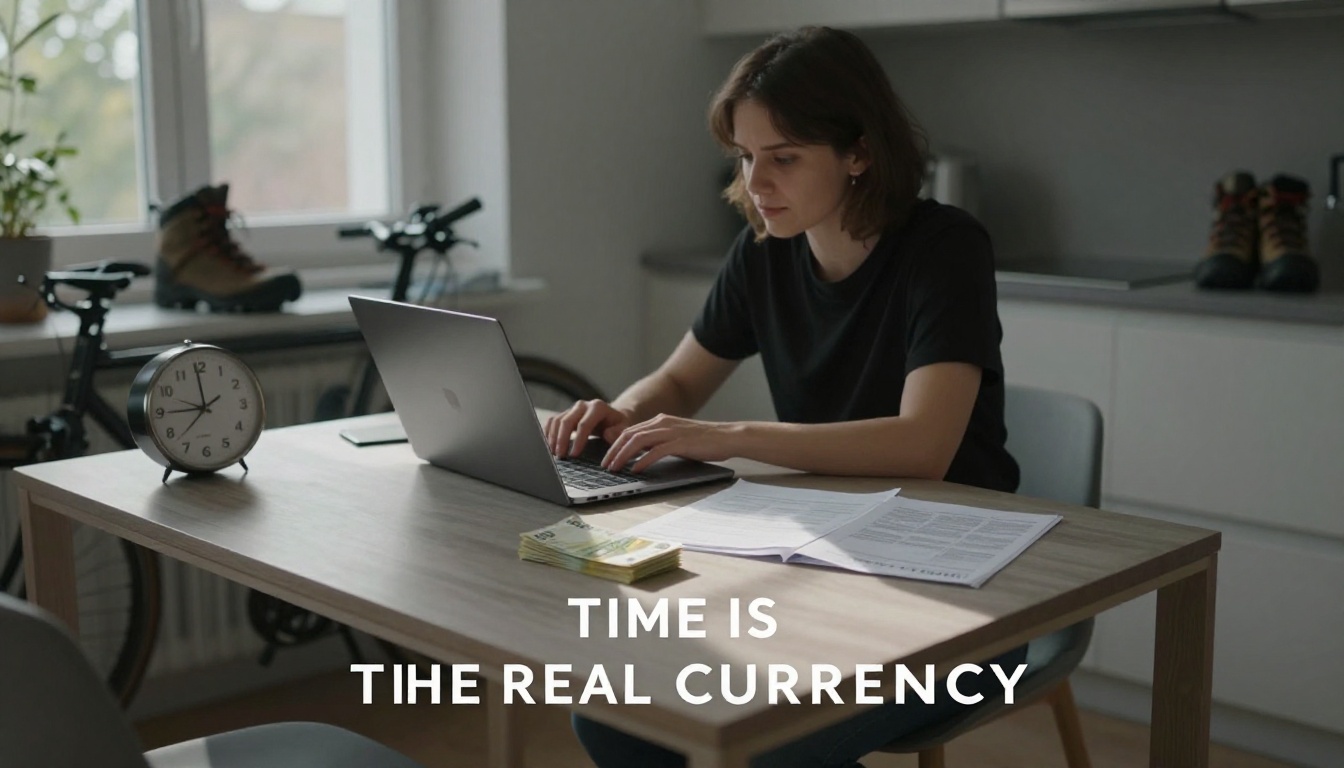
A 30-year-old German worker recently sparked a debate that cuts to the heart of modern career anxiety: they earn 80% of a full salary, save €600 monthly, and wonder if grinding through full-time work justifies the extra savings. After three months at 100%, they felt exhausted. The question isn’t just about money, it’s about what kind of life that money buys you in Germany’s system.
The Math That Misleads: Why 100% Work Doesn’t Equal 25% More Savings
At first glance, the calculation seems simple. If 80% work allows €600 in monthly savings, then 100% should yield €750, right? Not even close. Germany’s progressive tax system turns this linear assumption into a costly miscalculation.
That extra 20% of gross income lands squarely in your highest tax bracket. For a typical €50,000 annual salary (at 100%), you’d pay roughly 35% effective tax on the additional income, plus your full Sozialversicherung (social insurance) contributions of about 20%. By the time that money reaches your bank account, you’ve lost nearly half to Abgaben (deductions).
But the real damage happens after you receive the money. Full-time work in Germany comes with hidden price tags: higher commuting costs (that €49 Deutschlandticket doesn’t cover everything), more frequent restaurant lunches because you’re too tired to meal prep, and the psychological expense of having zero weekday flexibility for appointments or errands. Many workers report spending an extra €200-300 monthly just to manage the time deficit.
So your €150 theoretical savings boost might actually be €50-80 in practice. Is that worth sacrificing your free day?
The German Part-Time Paradox: More Freedom, Less Stress, Same Career?
Here’s what the finance blogs rarely mention: the hidden pressures of maintaining 80% work hours with full responsibility. Many German employers expect 100% output for 80% pay. The worker in question managed to avoid this trap, but it’s a national phenomenon.
The good news? German law protects you. The Teilzeitgesetz (Part-Time Act) gives employees the right to reduce hours, and employers can only refuse for specific operational reasons. This legal backbone makes the 80% lifestyle viable long-term, unlike in more precarious labor markets.
Yet cultural pressure persists. Colleagues make comments about leaving early on Fridays. Managers “forget” your reduced hours when scheduling meetings. The mental load of constantly asserting your boundaries can feel like a part-time job itself.
FIRE in Germany: When “More Savings” Becomes a Dangerous Obsession
The FIRE movement (Financial Independence, Retire Early) has taken root in Germany, but with a local twist: most Germans aren’t trying to retire at 35. They’re aiming for “Finanzielle Freiheit”, the option to work less, switch careers, or say no to toxic jobs.
Our 30-year-old saver has €8,000 in ETFs and €5,000 in their Notgroschen (emergency fund). At €600/month, they’ll hit €100,000 in roughly 12 years. Increasing to €650-680/month by working full-time shaves off maybe one year. For that, they sacrifice over 50 extra days of freedom annually.
The math gets worse when you factor in burnout. Germany’s Krankenkassen (health insurance funds) report a 23% increase in mental health-related sick days since 2020. One bout of burnout can wipe out six months of savings gains through therapy costs, medication, and lost income. Prevention, like maintaining a sustainable work schedule, is significantly cheaper.
Five Dimensions of Wealth: Beyond Your Kontostand (Account Balance)
A compelling framework from the Female Finance Forum challenges the entire premise. They identify five wealth types:
- Financial wealth: Your savings, investments, assets
- Time wealth: Control over your calendar
- Social wealth: Meaningful relationships
- Mental wealth: Emotional stability and self-knowledge
- Physical wealth: Health and energy
Our 30-year-old already scores high on time wealth. They have a weekday free for hobbies, relationships, exercise, or simply recovery. Going full-time would trade their most scarce resource, time, for their most abundant (potential income at age 30).
The framework reveals a truth: financial wealth is often a means to achieve the other four. But if you destroy your time, social, mental, and physical wealth to chase money, you’ve inverted the entire purpose. Many Germans in their 40s and 50s report exactly this regret, high earners with empty calendars and deteriorating health.
The Tax Trap: When Your Extra Income Triggers Higher Steuerklassen
Germany’s tax system has particularly nasty cliffs. Crossing certain income thresholds can bump you into a higher Steuerklasse (tax class) or trigger the Solidaritätszuschlag (solidarity surcharge). For married couples, the difference between Steuerklasse III and IV can mean thousands in lost tax advantages.
More concerning is the Progressionsvorbehalt (progression clause). If you receive severance pay or other special income while working full-time, it can retroactively increase the tax rate on your entire year’s earnings. Part-time workers sometimes avoid this trap entirely by staying below critical thresholds.
Additionally, working full-time might push you over the limit for certain subsidies. The Wohngeld (housing allowance), Kinderzuschlag (child supplement), and various regional benefits phase out at specific income levels. That extra €200 net per month could cost you €300 in lost benefits.
Realistic Scenarios: What Could You Actually Achieve?
Let’s run the numbers properly. Assume our worker earns €40,000 gross at 80% (€50,000 at 100%).
Current 80% situation:
– Net income: ~€2,200/month
– Savings: €600/month (27% savings rate)
– Annual savings: €7,200
Hypothetical 100% situation:
– Net income: ~€2,650/month
– Additional costs: ~€250/month
– Realistic savings: €700/month (26% savings rate)
– Annual savings: €8,400
The difference: €1,200 per year. Over 10 years at 7% returns, that’s €16,500 extra. Enough for maybe six months of living expenses. Is six months of future freedom worth five years of lost present freedom (one day per week for 10 years = 520 days)?
The calculation changes dramatically if you invest the time wisely. Using your free day for a side business, skill development, or networking could yield far higher returns than passive investing. Many German freelancers report earning more from their “free day” than from their main job, while deducting expenses and paying lower tax rates.
The Psychological Price: Burnout vs. Financial Independence
German mental health professionals report a pattern: clients who chase higher savings rates through overwork often develop an unhealthy relationship with money. They experience “Sparangst” (savings anxiety), a constant fear that they’re not saving enough, compounded by exhaustion that prevents clear thinking.
The three-month trial period at 100% work revealed this dynamic. The worker felt “anstrengend” (exhausting) effects. This isn’t laziness, it’s your nervous system sending clear signals. Ignoring them for marginal financial gains is like driving with the check engine light on to save time.
Consider the opportunity cost: that free day could be used for therapy, meditation, exercise, or simply rest, all investments in mental and physical wealth that pay compound interest in life satisfaction. Germany’s excellent public health system covers therapy, but you need time to attend sessions.
Alternative Strategies: Optimizing Your 80% Life
Instead of grinding to 100%, consider these German-specific optimizations:
1. Maximize your Steuererklärung (tax return)
The average German employee leaves €1,000+ on the table annually by not claiming deductions. Home office, commuting, professional development, and work equipment are all claimable. That free day is perfect for organizing receipts and filing properly.
2. Optimize your Sozialversicherung
At 80% income, you might stay below the Beitragsbemessungsgrenze (contribution assessment ceiling) for public pension insurance, allowing you to redirect those savings into higher-yielding private investments. Full-time work pushes you over, forcing mandatory contributions with lower returns.
3. Use the time for high-ROI activities
Learn German to B2/C1 level (unlocking higher-paying jobs), build a side business (potentially tax-advantaged as Nebenerwerb), or network in your industry. One German software engineer reported that using his free day for open-source contributions led to a job offer with 40% higher pay, at 80% hours.
4. Strategic patience
If your goal is financial independence, consider that the German system rewards longevity. Staying healthy and employed until 67 maximizes your public pension. Burning out at 45 trying to save aggressively defeats the entire purpose.
The Political Risk: Why Your Right to 80% Might Disappear
Here’s a sobering thought: political risks to part-time work rights in Germany are real. The CDU’s economic wing has proposed abolishing the legal entitlement to part-time work, arguing it hurts competitiveness.
If you have a stable 80% arrangement now, locking it in with a contract amendment might be wise. Once you’ve worked part-time for over a year, employers face higher hurdles to refuse an extension. Document everything.
This political uncertainty actually strengthens the case for maintaining your 80% position. If rights are rolled back, those already established in part-time roles may be grandfathered in. Early adopters could become the last ones standing.
When Full-Time Actually Makes Sense
Let’s be balanced. There are scenarios where 100% work is the right call:
- You’re significantly underpaid: If your 80% salary is below €35,000, the marginal utility of each extra Euro is higher
- You have high-interest debt: Credit card or Dispokredit (overdraft) debt at 10%+ interest rates justifies aggressive payoff
- You’re building a specific fund: Down payment for a Berlin apartment, startup capital, or family planning costs
- Your employer offers massive premiums: Some companies pay 110% for 100% work vs. 80% pay for 80% hours
The key is intentionality. Don’t drift into full-time work by default. Make it a conscious choice with a clear exit strategy and defined financial target.
The Verdict: €600 Is More Than Enough
Back to our original question: Is €600 monthly savings at 80% work “genug” (enough)?
If your goal is a traditional German retirement at 67 with public pension support, €600 monthly from age 30 to 67 (€266,400 total) grows to approximately €1.2 million at 7% returns. Combined with public pension, that’s a comfortable upper-middle-class lifestyle.
If your goal is FIRE by 50, you’d need to save roughly €1,800 monthly. But here’s the catch: that calculation assumes you want to maintain a full-time lifestyle without the income. If you’re content with a simpler life, your target drops dramatically.
The most honest answer: €600 is enough if you value time over money. It’s insufficient only if you’ve bought into the narrative that more is always better. Germany’s strong social safety net, excellent healthcare, and robust tenant protections mean you need less financial padding than in countries like the USA.
Your 80% life isn’t a compromise. It’s a strategy.
Action Steps: Making Your Decision
- Calculate your real marginal savings rate: Use a Brutto-Netto-Rechner (gross-net calculator) to see what that extra 20% work actually nets you after taxes and costs
- Define “enough”: Use a FIRE calculator that accounts for German taxes and public pension. The DeltaValue Finanzielle Freiheit Rechner is a solid starting point
- Audit your time wealth: Track how you spend your free day for a month. Is it creating value (rest, relationships, growth) or just disappearing?
- Test before committing: Negotiate a temporary 100% contract with a clear end date and exit clause. Don’t burn bridges to your 80% role
- Build optionality: Keep your fixed costs low enough that you could survive on 80% income even if forced into 100% hours temporarily
The German system offers a rare gift: the ability to choose time over money without financial ruin. Squandering that gift for an extra €50-80 monthly savings isn’t just suboptimal, it’s a misunderstanding of what wealth actually means in this country.
Your 80% life isn’t a compromise. It’s a strategy.