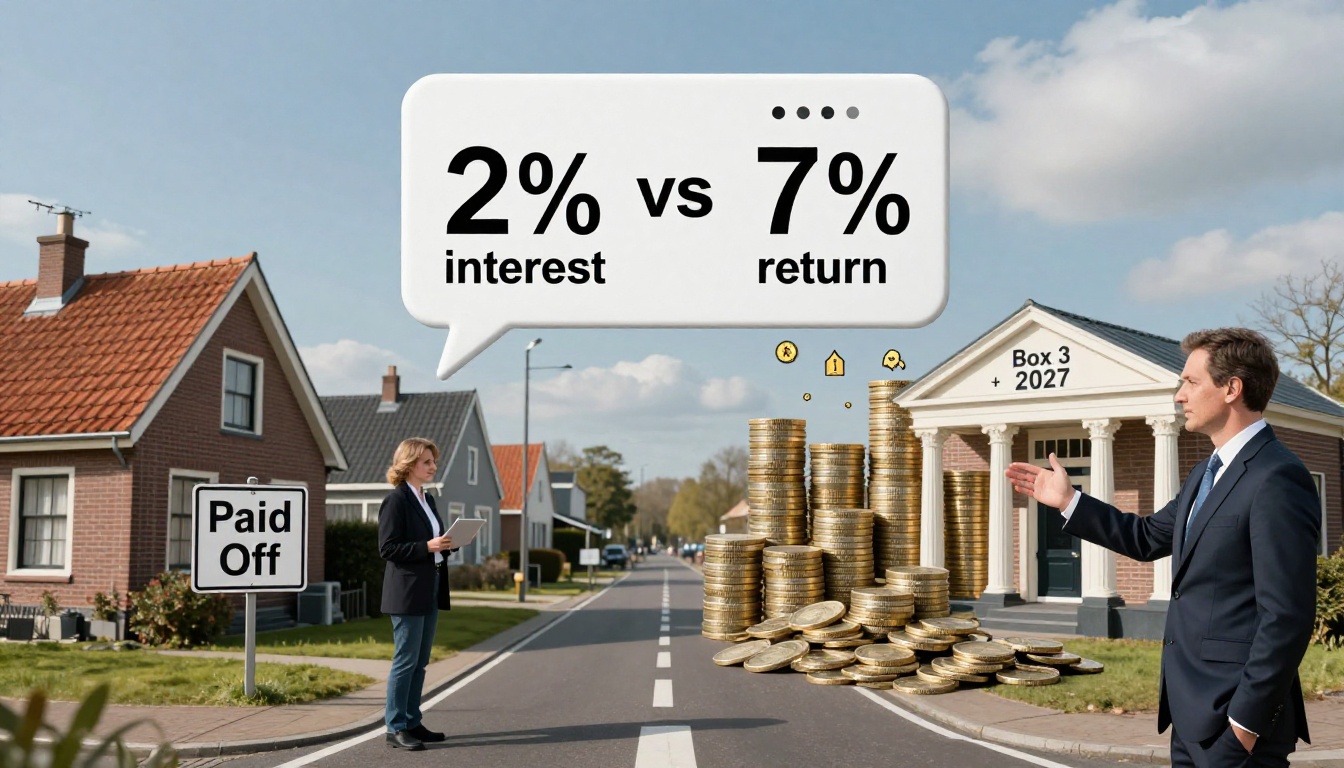
Your 30-year aflossingsvrije hypotheek (interest-only mortgage) is about to expire. You have exactly €100,000 remaining, the same amount you inherited two years ago. The math seems simple: pay it off and live debt-free. Yet your bank advisor is suddenly urging you to keep the debt and invest instead. This isn’t coincidence. It’s a calculated position that benefits them more than you.
The Dutch mortgage market has quietly transformed beneath your feet. While you’ve been paying interest-only for three decades, banks have been preparing for a wave of maturing loans that could expose systemic risks. Your individual decision now sits at the intersection of personal finance, bank profitability, and Dutch tax policy that’s about to shift dramatically in 2027.
The Real Reason Your Bank Wants You to Keep Paying
Let’s be direct: banks earn money from your debt. When you pay off a mortgage, their interest income stream disappears. The advice to “invest instead” sounds sophisticated, but it conveniently ignores that most retail investors underperform market averages after fees and taxes.
A typical Dutch bank earns 2-3% on your mortgage while paying you 0.5% on savings. That spread is their profit. When you pay off €100,000, they lose €2,000-3,000 in annual revenue. Multiply that by thousands of homeowners in your position, and you understand why the entire sector is nervous.
DNB (De Nederlandsche Bank) recently pressured lenders to tighten policies on aflossingsvrije hypotheken precisely because too many households face this cliff. Rabobank and Obvion now cap new interest-only loans at 30% of property value or €150,000, whichever is lower. They see the risk. Yet when you, an existing customer, want to eliminate that risk entirely, they suddenly become your “investment advisor.”
The Math That Actually Matters
The standard comparison goes like this: “If your mortgage costs 2% but investments return 7%, you’re better off investing.” This is technically true but practically misleading for three reasons:
First, risk adjustment matters. Your 2% mortgage cost is guaranteed. That 7% investment return is hypothetical and volatile. Dutch pension funds, the most sophisticated long-term investors in the country, assume future returns of just 4-5% for their portfolios. Your personal return will likely be lower after fees and behavioral mistakes.
Second, taxes change everything. From 2027, Box 3 (wealth tax) shifts from fictional to actual returns. If you invest that €100,000 and earn 7%, you’ll pay up to 36% tax on those gains. Your net return drops to 4.5%. Meanwhile, your mortgage interest deduction is already limited and will disappear entirely if you extend the loan beyond 30 years.
Third, timing is critical. You’re at mortgage maturity, not starting fresh. The calculus changes when you’re 60 versus 30. The investment horizon is shorter, and the value of “sleeping well” increases.
Here’s a concrete Dutch scenario: You have €100,000 in cash earning 2% interest (€2,000 annually). Your mortgage costs 2.5% (€2,500 annually). The simple math says you’re losing €500 per year by not paying it off. But if you invest in a mixed fund and earn 5% after costs (€5,000), you’ll pay about €1,500 in Box 3 taxes, leaving you €3,500, a €1,000 advantage over paying off the mortgage.
But this assumes consistent returns, no market crashes, and that you actually invest the money rather than letting it sit in a low-yield savings account, which is what many Dutch households do.
The Box 3 Tax Trap Nobody Mentions
Here’s what your bank advisor definitely didn’t explain: keeping your mortgage after 30 years pushes you into a completely different tax regime.
Under current rules, your interest-only mortgage qualifies for hypotheekrenteaftrek (mortgage interest deduction) in Box 1 (income tax). But this right expires after 30 years. If you refinance or extend, the loan moves to Box 3, where it becomes a debt that reduces your taxable wealth.
This sounds good, until you understand the new Box 3 system starting 2027. The Belastingdienst will tax actual returns, not fictional ones. If you keep €100,000 in investments and maintain a €100,000 mortgage, you might think they cancel out. They don’t.
The mortgage interest you pay (say, €2,500) reduces your taxable return, but the debt itself only offsets wealth at a fixed percentage rate (currently 2.62%). Meanwhile, your investments are taxed on actual dividends and capital gains. The math becomes complex and usually less favorable than the old system.
More importantly, if you simply pay off the mortgage, you remove €100,000 from your taxable wealth base entirely. For many Dutch households, this could mean dropping below the €57,000 tax-free threshold per person, eliminating Box 3 taxes completely.
The “Sleeping Well” Premium
Financial advisors love to quantify everything except peace of mind. Yet surveys of Dutch retirees consistently show that those without mortgage debt report significantly higher life satisfaction, even when they have lower net worth.
There’s a reason for this: cognitive load. Monitoring investments, worrying about market volatility, and dealing with annual tax complexity consumes mental energy. For a €1,000 potential annual advantage, is it worth it?
Consider your actual behavior. Many international residents report that despite good intentions, inherited money often sits in a spaarrekening (savings account) earning minimal interest. The “investment opportunity” is theoretical. The mortgage payment is real.
If you’re the disciplined type who actually maintains a diversified portfolio and doesn’t panic-sell during downturns, the investment strategy might work. But if you’re like most people, paying off the mortgage is the more reliable wealth-building move.
The DNB Warning: Systemic Risk in Numbers
DNB isn’t worried about individual choices, they’re worried about thousands making the same choice simultaneously. Their analysis shows two risk periods: 2035-2038 and 2047-2052, when massive waves of interest-only mortgages mature.
If housing values drop even 10-15% during these periods, many households will face restschuld (remaining debt) after sale. The banks know this. Their capital buffers depend on a smooth transition.
This is why Rabobank and Obvion preemptively restricted new interest-only lending. They need to de-risk their portfolios. Your advisor’s “personalized” recommendation is influenced by this macro concern. A mass payoff would hurt their quarterly earnings, a mass extension risks future defaults. They’re threading a needle.
Strategic Alternatives: The Middle Path
You don’t have to choose between all-or-nothing. Dutch mortgage law allows partial repayment without penalty on most loans. Consider:
-
Pay off 50% now, invest 50%: Reduces your risk and monthly costs while keeping some liquidity. Many banks like ING and ABN AMRO allow this through their online portals.
-
Pay off fully, then borrow strategically: If you later need funds for renovation or investment, you can take a new loan. The interest might be slightly higher, but you’ll have maintained your tax advantages and eliminated risk during the critical transition period.
-
Use the overwaarde (home equity) differently: If your home is worth significantly more than the mortgage, consider a smaller, fixed-rate loan against the equity for specific investments, rather than keeping the entire interest-only structure.
The Inheritance Factor
Since your €100,000 came from an erfenis (inheritance), there’s another consideration: emotion. Inherited money often feels different. Spending it on something as mundane as a mortgage can feel like “wasting” a gift.
But reframing helps: paying off debt is the highest guaranteed return available. It’s not spending, it’s converting one asset (cash) into another (home equity). Your monthly cash flow improves immediately, giving you more freedom to invest future income aggressively.
If you’re concerned about handling inheritance funds and tax implications in the Netherlands, remember that mortgage repayment is tax-free. Investing that same money creates future tax burdens in Box 3 that compound over time.
Concrete Decision Framework
Ask yourself these questions:
1. What’s your actual investment track record?
If you haven’t consistently beaten your mortgage rate after taxes, pay it off.
2. Will you sleep better without the debt?
If yes, the psychological return exceeds any financial premium.
3. Are you near retirement?
Shorter time horizons favor debt elimination. The overhaul of Dutch Box 3 wealth taxation starting in 2028 makes debt more expensive for older homeowners.
4. Do you have other high-interest debt?
Credit cards, personal loans, or car financing should always be cleared first.
5. What’s your pension situation?
DNB’s research shows many Dutch households face lower pension income than expected. Eliminating housing costs now hedges this risk.
6. Are you comfortable with the new Box 3 rules?
If you don’t understand how actual returns will be taxed in Box 3, you shouldn’t structure your finances around them.
The Bottom Line
Your bank’s advice isn’t technically wrong, it’s just incomplete. Yes, mathematically, you might earn more investing. But that calculation excludes risk, taxes, psychology, and the systemic pressures Dutch banks face from their massive interest-only mortgage portfolios.
The most honest answer: pay off the mortgage unless you have a concrete, tax-efficient investment plan that you’ve successfully executed before. The potential €1,000 annual advantage isn’t worth the complexity and risk for most people.
If you do invest, don’t buy individual stocks or trendy ETFs. Use a low-cost, globally diversified portfolio through a Dutch broker like Meesman or Brand New Day. And definitely don’t let the money sit in a savings account earning 2% while paying 2.5% mortgage interest.
But recognize that “staying invested” often serves the bank’s interests more than yours. They’re not evil, they’re just businesses managing their own risk. Your job is to manage yours.
The €100,000 question isn’t about maximizing returns. It’s about whether you want to be a bank’s customer for another 20 years or a homeowner who actually owns their home. For most Dutch homeowners approaching retirement, the second option wins.
Final check: If your mortgage rate is above 3%, pay it off immediately. If it’s below 2% and you have a proven investment strategy, consider keeping it. Between 2-3%, the decision hinges on your tax situation and risk tolerance. But whatever you do, make the choice based on your complete financial picture, not just the bank’s advice to keep you as a paying customer.