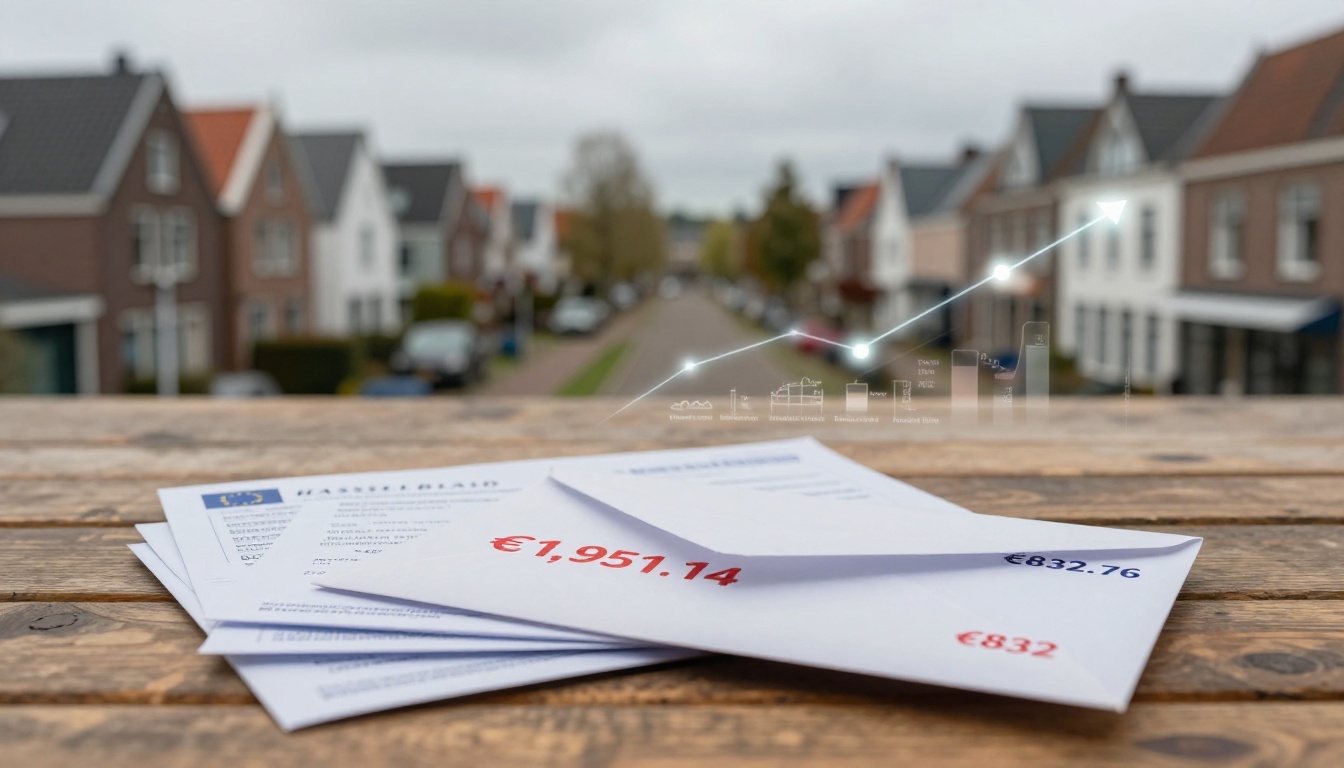
A homeowner in West-Betuwe recently opened his annual tax assessment and found a number that would make anyone wince: €1,951.14 in local charges for 2026. That’s not a typo. Nearly two thousand euros for a mid-terrace new-build house with a WOZ-waarde (property valuation) of €477,000. His father, living just 50 kilometers away in ‘s-Hertogenbosch with a slightly more valuable home, pays €832.76, less than half.
The natural reaction? Something must be wrong. But when he contacted the Belastingsamenwerking (tax cooperation authority), they confirmed the figures. The charges have climbed from €1,623.15 in 2024 to €1,781.78 in 2025, and now nearly €2,000. This isn’t just inflation, it’s a structural cost shift that’s hitting some Dutch municipalities far harder than others.
The Bill Breakdown: Where Your Money Actually Goes
Let’s dissect that €1,951.14 West-Betuwe bill, because the devil lives in the details:
- Onroerende zaakbelasting (OZB) (property tax): €446.47
- Rioolheffing (sewage charge): €542.00
- Afvalstoffenheffing (waste collection): €375.47
- Afvalstoffenheffing rest (extra waste): €30.00
- Zuiveringsheffing (water purification): €228.84
- Watersysteemheffingen (water system levies): €328.36
The father’s bill in ‘s-Hertogenbosch shows only OZB, sewage, and waste collection. The €1,100+ difference? It comes down to how Dutch water management costs are billed. West-Betuwe packages waterschapsheffingen (water board levies) directly into the municipal tax bill, while many municipalities send these separately. This single administrative choice creates the illusion of a massive tax disparity.

The WOZ Value Explosion: Why 2026 Hurts More
The underlying driver of these increases is the WOZ-waarde, which jumped an average of 10.6% nationally for 2026. Some municipalities saw even steeper hikes: Pekela (20.7%), Hardenberg (18.3%), and Waddinxveen (16.1%). Even Amsterdam clocked in at over 12%.
For our West-Betuwe homeowner, that 10%+ increase means his property valuation rose by roughly €45,000 in a single year, despite no improvements to the house. The OZB is calculated as a percentage of this valuation, so when WOZ values surge, tax bills follow automatically. Municipalities set their own OZB rates, but the valuation itself is non-negotiable unless you file a formal bezwaar (objection).
The Waarderingskamer (Valuation Chamber) determines these values based on sales prices from January 1 of the previous year. In 2024, housing prices were still climbing, and now homeowners are paying the price, literally. The system is designed to be objective, but it moves like a tanker: slow to react and impossible to stop once momentum builds.
The Hidden Tax on Top of Tax
Here’s what many international residents miss: the OZB is essentially a tax on a tax assessment. Your home’s market value is already theoretical, it’s not money you actually have, yet you pay annual charges based on this phantom number. The waste and sewage fees at least correspond to services you receive. The OZB is simply a levy for owning property.
This becomes particularly painful when you realize that over 100,000 WOZ values are adjusted downward every year after homeowners file bezwaar. Yet many don’t bother, either because the process seems daunting or because they assume the municipality is right. That assumption costs Dutch homeowners millions in overpaid taxes annually.
Why Appeals Work (And Why Fewer People Are Filing Them)
Recent data shows a sharp decline in WOZ bezwaren across Noord-Holland, dropping from over 3,000 to about 1,500 in Hilversum alone. The reason? Stricter rules have driven commercial “no cure, no pay” WOZ bureaus out of business. These agencies used to file mass objections, earning fees only when successful. While their tactics were sometimes questionable, they forced municipalities to justify valuations.
Now homeowners must navigate the system alone. But here’s the secret: you don’t need a bureau. The most successful appeals target factual errors:
- Incorrect square footage registered
- Wrong construction year listed
- Missing information about foundation issues or asbestos
- Comparisons to renovated homes when yours is in original condition
- Proximity to noise pollution, wind turbines, or other value-depressing factors
One Hilversum resident successfully appealed his valuation by proving the municipality had compared his modest home to larger, renovated properties nearby. His tax bill dropped by €180 annually, a small victory that compounds over years.
The Regional Lottery: Where You Live Determines What You Pay
The disparity between West-Betuwe and ‘s-Hertogenbosch reveals a deeper truth: Dutch local taxes are a postcode lottery. Municipalities facing budget shortfalls, often due to aging infrastructure or declining populations, have limited options. They can’t easily raise OZB rates without political backlash, but rising WOZ values give them a stealth increase.
Rural areas with extensive water management needs face higher waterschapsheffingen. Agricultural regions bear purification costs for runoff. Island communities like Terschelling have unique infrastructure expenses. Each factor gets baked into your annual bill, creating a system where identical homes 30 kilometers apart can have vastly different tax burdens.
This creates perverse incentives. Young families are priced out of municipalities with high combined levies, accelerating population decline in those areas and forcing remaining residents to shoulder an even larger share. It’s a fiscal death spiral masked as local autonomy.
The Broader Picture: Dutch Tax Pressure and Financial Resilience
These local charges don’t exist in isolation. They stack on top of the fundamental unfairness of taxing unrealized investment returns in the Dutch system, where Box 3 (wealth tax) reforms will soon tax paper gains at up to 36%. For homeowners with modest savings, the combination of rising OZB, stagnant wages, and wealth taxes creates a cost-of-living squeeze that official inflation figures don’t capture.
Some Dutch investors are exploring using foreign real estate to manage Dutch wealth tax liabilities, while others debate emigration as a response to rising tax burdens. The conversation has shifted from “how do we optimize?” to “how do we survive?”
Even personal finance strategies are under pressure. The disconnect between official financial data and real household cost pressures means many families feel poorer than statistics suggest. When your local taxes jump €300 in two years while your income stays flat, the official 3% inflation rate feels like gaslighting.
What You Can Actually Do
If your bill looks like the West-Betuwe example, take these steps:
1. Demand Your Taxatieverslag
Every WOZ assessment includes a valuation report. You’re entitled to see which comparable properties the municipality used. Check if they’re truly similar, same size, condition, location. If they’ve compared your 1980s kitchen to a newly renovated home, you have grounds for appeal.
2. File Bezwaar Within Six Weeks
The deadline is strict. Use your municipality’s online portal or send a registered letter. Focus on factual errors, not “I think it’s too high.” Provide evidence: photos of defects, floor plans showing actual size, documentation of noise issues.
3. Check Waterschapsheffing Separation
If your bill seems unusually high, verify whether water board levies are included. Contact your waterschap (water board) directly to understand their charges. Sometimes you can challenge these separately.
4. Consider Strategic Timing
If you plan to sell soon, a lower WOZ value reduces your tax burden but might signal problems to buyers. If you’re staying long-term, every euro reduced is a permanent saving. For inherited property, lower valuations can save thousands in erfbelasting (inheritance tax).
5. Join Forces with Neighbors
If multiple homes on your street received identical inflated valuations, coordinate a joint appeal. Municipalities take mass objections more seriously and may recalculate entire neighborhoods.
The Uncomfortable Truth
Is €1,951 normal? In West-Betuwe, unfortunately, yes. But “normal” doesn’t mean “fair” or “inevitable.” The Dutch system assumes homeowners will actively monitor and challenge their assessments. Those who don’t, often elderly residents, immigrants unfamiliar with the system, or busy families, subsidize everyone else.
The real scandal isn’t the high number, it’s the opacity. Bills arrive with dozens of line items, no clear explanation of how WOZ values are calculated, and a byzantine appeals process designed to discourage challenges. Meanwhile, municipalities benefit from inertia.
Until the system becomes more transparent, or until enough homeowners flood municipalities with well-founded bezwaren, bills will keep climbing. The West-Betuwe homeowner who went public with his bill has already filed an appeal against his sewage charge, which is €391 higher than the national average. He’s not accepting the status quo.
Neither should you. That “official” tax bill is often just the opening bid in a negotiation most people don’t realize they’re allowed to have.