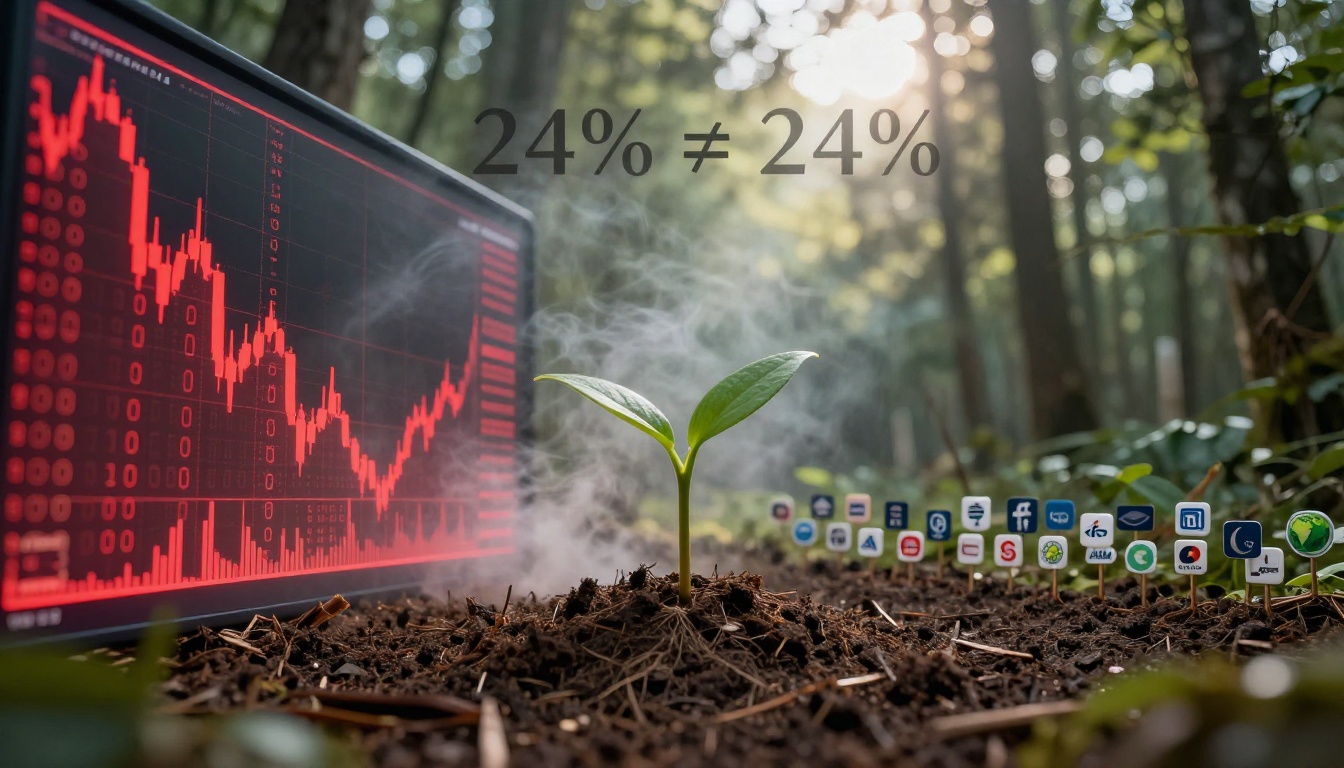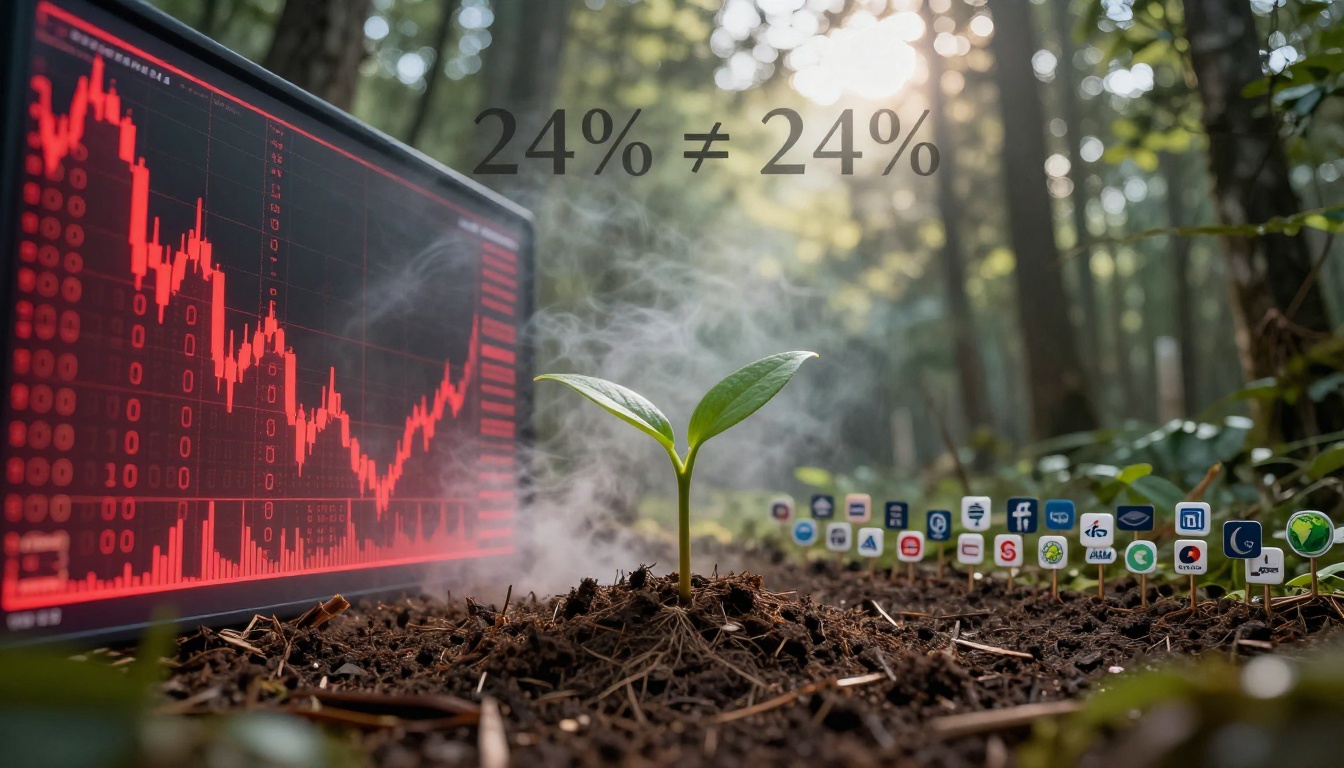
You’re staring at your broker app, probably DeGiro or maybe your ING Beleggingsrekening (investment account), and something isn’t adding up. Microsoft has shed 25% of its value. Tesla’s down 20%. IBM just took a 13% nosedive because some AI can now streamline COBOL code. Your Twitter feed is a dumpster fire of tech bros panic-selling. Yet your VWCE (Vanguard FTSE All-World UCITS ETF) position? Barely a scratch. Maybe it’s even green.
This disconnect has become the single most confusing phenomenon for Dutch investors in 2026, sparking heated debates in every FIRE café meetup from Amsterdam to Eindhoven. The anxiety is palpable: is your ETF broken? Is the whole system a scam? Are you missing some hidden risk that will vaporize your portfolio next quarter?
The answer is simultaneously more boring and more important than you think.
The Math Behind the Magic: Why 24% in Top 10 Isn’t 24% in Tech
Let’s start with the numbers that trigger this confusion. VWCE’s top 10 holdings represent 24.15% of the fund. NVIDIA at 4.34%, Apple at 4.25%, Microsoft at 3.82%, and the rest of the usual suspects. On paper, this looks like a tech concentration nightmare. If these stocks are crashing, why isn’t your ETF?
The critical mistake, and it’s a common one among even experienced investors, is conflating “top holdings” with “tech exposure.” The research data shows that while these companies are indeed technology-adjacent, they’re not all moving in the same direction. When one commenter pointed out that Apple, Alphabet, TSMC, Broadcom, and NVIDIA have remained relatively stable, they were onto something crucial. Your ETF’s performance is the sum of all its parts, not just the loudest ones.
More importantly, the global market is precisely that: global. While U.S. tech giants wobble, European industrials might be rallying. Japanese financials could be surging. Emerging market consumer goods might be having their moment. The €100 you invested doesn’t just buy tech, it buys a microscopic slice of nearly 3,700 companies across 49 developed and emerging markets. When money flees Microsoft, it doesn’t vanish into thin air. It often rotates into other components of the same index, creating a stabilizing effect that feels like financial sorcery but is just basic arithmetic.
The Rebalancing Myth: Why Your ETF Doesn’t “Wait” to Adjust
Here’s where Dutch investors, accustomed to the methodical precision of the Belastingdienst (Tax Authority) and the predictable rhythms of their VvE (Homeowners Association) meetings, often get tripped up. Many believe ETFs rebalance quarterly or semi-annually, creating a dangerous lag between individual stock movements and fund performance. This assumption is fundamentally wrong for index trackers.
Index funds like VWCE don’t manually rebalance on a schedule. They track their benchmark continuously, adjusting holdings in real-time as market capitalizations change. When Microsoft’s value drops relative to the total market, its weight in the FTSE All-World Index drops automatically. The ETF provider doesn’t wait for a quarterly meeting to sell shares, they’re constantly tweaking to match the index’s composition.
The “delay” you perceive is mostly psychological. Market data updates after hours, while news headlines hit in real-time. You see IBM crashing at 3 PM, but the index calculation won’t reflect this until after market close. By morning, your ETF price has adjusted, but so have dozens of other holdings, creating a net effect that’s far less dramatic than the individual stock movements suggest.
The Currency Cushion: How the Euro Saves Your Bacon
Here’s a uniquely Dutch twist: your VWCE is denominated in euros, but most of its holdings trade in dollars. When U.S. tech stocks crash, the dollar often weakens simultaneously. This creates a natural hedge. A 20% drop in a U.S. stock might be partially offset by a 3-4% decline in USD/EUR exchange rate, softening the blow when converted back to your home currency.
This currency effect is why Dutch investors sometimes outperform their American counterparts during U.S. market downturns. Your ETF isn’t just a bet on companies, it’s a bet on currencies, regions, and sectors all at once. When the dollar dips, your euro-based reporting makes the damage look less severe. It’s not manipulation, it’s just how international investing works.
Sector Rotation: The Money’s Still in the Market
The most sophisticated explanation, and the one that should actually change your investment strategy, involves sector rotation. When institutional investors get nervous about tech, they don’t typically yank money from the market entirely. They move it.
The Seeking Alpha research on “smart money” shorting tech reveals something counterintuitive: those same institutional investors are often buying other sectors simultaneously. They might short the XLK (Technology Select Sector SPDR Fund) while going long on industrial, healthcare, or financial ETFs. This money stays in the market, just reallocated.
For your VWCE, this means capital that leaves Microsoft might flow into Roche, Nestlé, or ASML, all holdings in your fund. The net asset value remains stable even as the composition shifts beneath the surface. You’re witnessing a live-action rebalancing that requires no action on your part.
The Concentration Risk You’re Actually Missing
While Dutch investors panic about tech exposure, they’re often blind to the real concentration risk: geography. The U.S. represents roughly 60% of VWCE. If the entire American market sneezes, your portfolio catches a cold regardless of sector distribution.
This is where the internal debate about geopolitical risks affecting global portfolios becomes relevant. American political instability or trade policy changes can impact your ETF more than any single tech stock’s performance. The current Greenland tensions, for instance, expose how European investors are vulnerable to U.S. foreign policy whims.
The tech stock crash you’re worried about might be a distraction from bigger structural risks. A 25% drop in Microsoft is noise compared to a 10% decline across the entire U.S. market, which would wipe €6,000 off a €10,000 VWCE position.
The Dutch Tax Angle: Why Stability Matters More Than You Think
Here’s where this gets practical for Netherlands-based investors. The new Box 3 tax reforms coming in 2028 will tax actual returns, not deemed returns. This means volatility directly impacts your tax efficiency. A portfolio that crashes 20% one year and recovers 25% the next will generate tax liabilities during the recovery year, even if you’re still underwater overall.
This makes the stabilizing effect of global ETFs like VWCE more valuable than their raw returns suggest. By smoothing out the ride, you’re not just preserving capital, you’re optimizing for the Belastingdienst’s new reality. A stable €10,000 portfolio is better than a volatile one that ends at the same value but generates taxable events along the way.
For Dutch investors considering shifting from individual stocks to diversified ETFs, this tax implication adds urgency. Your ABN Amro and ING Groep (ING Group) positions might feel patriotic, but they’re exposing you to unnecessary volatility in a tax regime that punishes it.
The Equal-Weight Alternative: When You Actually Want Tech Exposure
If you’re convinced tech is oversold and want to bet on a recovery, consider this: the equal-weighted S&P 500 has outperformed its market-cap-weighted cousin by over 5% recently, precisely because it doesn’t let tech giants dominate. But for targeted tech exposure, Dutch investors have better options.
Instead of VWCE, you could allocate a small portion to a sector-specific ETF. The iShares MSCI World Information Technology Sector UCITS ETF, for instance, holds 15.99% in Apple alone. But remember: tax efficiency of investment funds for Dutch investors becomes critical here. Northern Trust funds through ING might offer better dividend tax treatment than direct U.S. ETF exposure.
What This Means for Your Monthly Investment Plan
For those investing with regular monthly contributions in the Netherlands, this stability is a feature, not a bug. Your €100 monthly VWCE purchase is buying more shares when tech dips and fewer when it rallies, but the global diversification ensures you’re not timing a single sector.
The key insight: stop checking individual stock prices. Your ETF’s job isn’t to mirror the NASDAQ’s daily drama, it’s to deliver market returns minus minimal costs. If you wanted volatility, you’d pick individual stocks. But if you’re holding VWCE, you’re presumably seeking the decision-making around moving savings into investments with lower risk.
When to Actually Worry
There is one scenario where your VWCE should concern you: when everything is falling simultaneously. If U.S. tech, European industrials, Asian financials, and emerging markets all decline together, your ETF will reflect that pain. This happened in 2022, and it will happen again.
But isolated sector crashes? They’re noise in a properly diversified portfolio. The fact that you’re not seeing tech losses in your VWCE statement isn’t a sign of malfunction, it’s proof the fund is doing exactly what it promised.
The Bottom Line: Trust the Design, Not the Headlines
Dutch investors are trained to be skeptical. The poldermodel (consensus-based decision-making) teaches us to question everything. But in this case, the apparent disconnect between tech crashes and ETF stability isn’t a conspiracy, it’s diversification working as intended.
Your VWCE isn’t broken. It’s just not a tech ETF. The 24% concentration in top holdings feels scary until you realize it’s spread across companies, sectors, and currencies that move independently. The real risk isn’t that your ETF fails to crash with tech, it’s that you abandon a sound strategy because you don’t understand why it’s working.
Keep investing monthly. Keep costs low. And for the love of all that is financially holy, stop comparing your global ETF to the NASDAQ. They’re not playing the same game.
Actionable takeaway: If you still can’t sleep at night, use a portfolio tracker to see your actual sector exposure. You might be surprised to find tech is a smaller slice of your financial lekkerbek (tasty treat) than you thought.