Gold just smashed through 150€ per gram in Austria, barely five months after crossing 100€. If you’re holding Wiener Philharmoniker coins in a safe deposit box at your local Raiffeisen branch, you’re probably feeling pretty smug right now. If you’re sitting on cash in a Tagesgeldkonto (savings account) earning 0.3% interest while inflation eats your purchasing power alive, you’re probably feeling something else entirely.
The numbers are stark: A one-ounce gold Philharmoniker cost €2,926 last August. By late December, it hit €3,857. This Monday morning, it reached €4,420, a 50% jump in under six months. The Austrian Mint (Münze Österreich) reports lines out the door, with customers “buying everything they can get their hands on.” In 2025 alone, they sold one million gold coins and bars. The gold rush is here, and it’s wearing Lederhosen.
The Austrian Gold Frenzy: From Collector’s Hobby to Survival Strategy
What’s particularly Austrian about this gold surge isn’t just the currency conversion, it’s the behavior patterns. While global investors trade XAU/USD futures and gold ETFs, Austrians are doing something decidedly old-school: they’re buying physical.
The Münze Österreich sales data reveals a fascinating split. By unit volume, sales run 80% silver Philharmoniker coins, 20% gold. But by revenue, it’s 91% gold, 9% silver. Translation: Small investors stack silver while serious wealth preservation flows into gold. The Mint’s customers aren’t speculators, they’re people who remember what inflation did to their grandparents’ savings in the 1970s and 1980s.
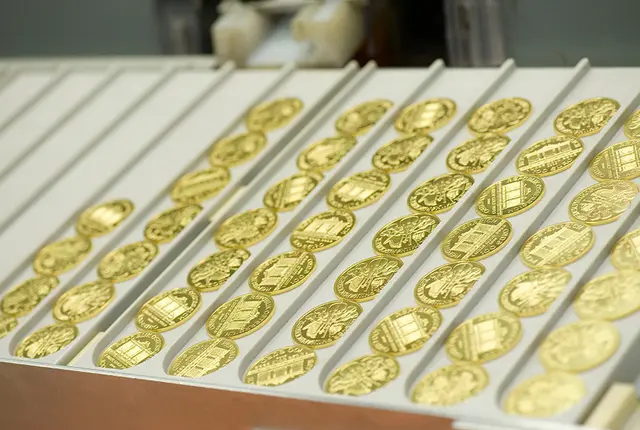
This physical preference creates immediate practical challenges. Where do you store a growing stack of gold Philharmoniker coins? Home safes are an option, but Austrian insurance policies typically cap coverage at €10,000-€20,000 for precious metals kept at home. Bank safe deposit boxes (Schließfächer) cost €80-200 annually depending on size, and good luck finding availability in Vienna’s Innere Stadt branches, most have waiting lists stretching months.
The 27.5% Tax Trap That Catches Austrian Gold Investors
Here’s where the Austrian financial system reveals its bureaucratic teeth. Many international residents discover too late that not all gold investments are taxed equally. The Finanzamt (Tax Office) treats physical gold and paper gold completely differently, and the difference hits your wallet hard.
Physical gold coins like the Philharmoniker, Maple Leaf, or Krügerrand enjoy special status. They’re considered legal tender and escape the 27.5% KESt (capital gains tax) when held longer than one year. But gold ETCs (Exchange Traded Commodities), the convenient, broker-friendly way to invest, get hammered with full KESt on every gain, with no minimum holding period relief.
Austrian tax pitfalls for gold ETC investors explains how this works in practice. A Viennese investor who bought a gold ETC through Flatex in May 2025 watched it appreciate 40% by January. Their €10,000 investment became €14,000. Sounds great, until the tax bill arrives. The Finanzamt takes €1,100 (27.5% of the €4,000 gain), leaving €12,900. Had they bought physical Philharmoniker coins instead and held them for a year, that entire gain would be tax-free.
tax implications of gold savings plans in Austria shows why this matters for regular savers. That €250 monthly gold savings plan through your Austrian broker looks efficient until you realize each purchase gets a new one-year clock before tax-free status applies. It’s enough to make you reconsider the old-school approach of walking into the Münze Österreich shop on Am Heumarkt and buying coins with cash.
What’s Really Driving This Surge?
The Reddit finance crowd correctly identified the core issue: simultaneous record highs in both gold and the S&P 500 signal something fundamental about trust in the monetary system. When traditional safe havens and risk assets both surge, it suggests capital is fleeing somewhere else, specifically, from faith in fiat currency stability.
Several Austrian-specific factors amplify this:
- 1. Dollar Weakness and Euro Hedging: Gold trades globally in USD. When the dollar weakens against the Euro, Austrian investors get a double benefit: rising gold prices and favorable currency conversion. The European Central Bank’s monetary policy, still accommodative compared to the Fed’s, keeps the Euro relatively stable while dollar confidence wavers.
- 2. Geopolitical Anxiety: geopolitical drivers behind gold investment trends details how Austrian investors are increasingly uncomfortable with US market exposure. The Ukraine conflict, Middle East tensions, and US political instability create a perfect storm for gold demand. Austrians, living in a neutral-adjacent country with historical experience of currency collapse, react strongly to geopolitical stress.
- 3. Inflation Persistence: While official inflation rates have moderated from 2022 peaks, Austrian consumers feel differently. Housing costs in Vienna rose 8% in 2025. Energy prices remain volatile. Restaurant prices increased 12%. The gap between official statistics and lived experience drives demand for tangible assets.
- 4. Central Bank Gold Accumulation: The National Bank of Austria holds 280 tonnes of gold, but the real story is emerging market central banks. China, India, and BRICS nations have been accumulating gold reserves for three years straight, reducing dollar dependence. This structural demand creates a floor under prices that didn’t exist in previous cycles.
Expert Predictions: How High Can This Go?
Analyst forecasts now look conservative compared to market reality. Goldman Sachs predicted $4,900/ounce by December 2026, gold hit $5,500 in January. JP Morgan’s $5,055 target for late 2026 already looks timid. The most aggressive forecasts from Yardeni Research suggest $10,000/ounce by 2030 isn’t impossible.
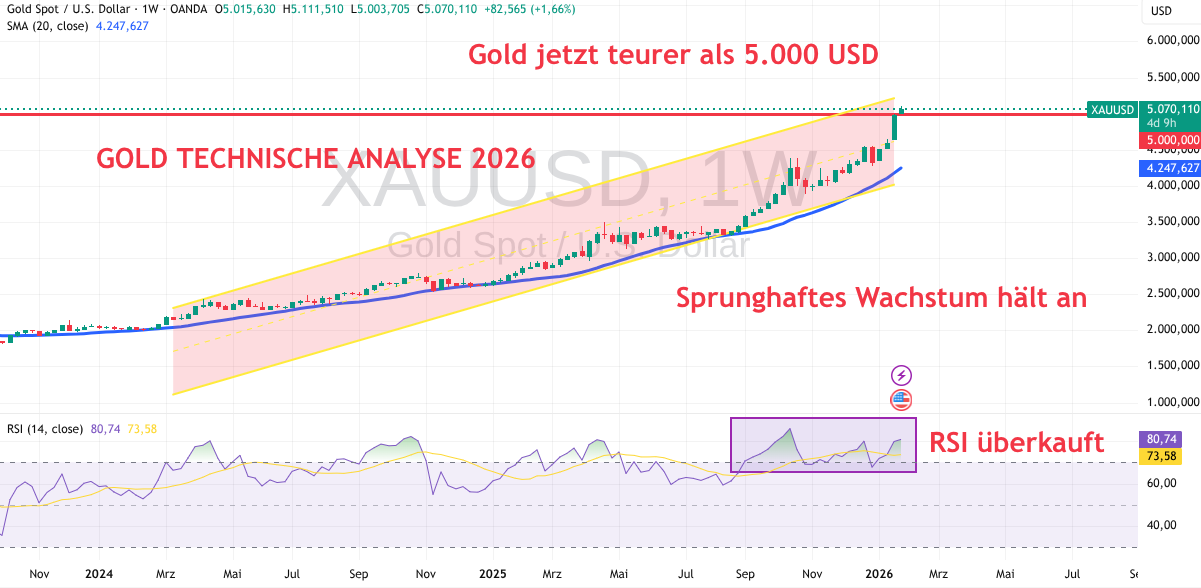
From an Austrian perspective, €150/gram might just be the beginning. If gold reaches $7,000/ounce by 2030 (a realistic scenario according to Charlie Morris of Atlantic House Investments), that’s approximately €200/gram at current exchange rates. Factor in potential Euro weakness, and €250/gram becomes plausible.
But predictions are cheap. The better question: what’s your strategy?
Physical vs. Paper: The Austrian Dilemma
The Austrian Mint sells gold Philharmoniker coins at a 3-5% premium over spot price. A one-ounce coin (31.1g) at €4,420 means you’re paying about €142/gram when spot is around €137/gram. That premium covers production, distribution, and the Mint’s profit margin.
Compare that to a gold ETC like Xetra-Gold, which tracks spot prices with minimal spread but exposes you to the full 27.5% KESt. Or consider gold mining stocks, which amplify gold’s moves but add corporate risk.
For Austrian residents, the calculus is clear but uncomfortable: physical gold offers tax advantages but creates storage and insurance headaches. Paper gold offers convenience but surrenders nearly a third of your gains to the Finanzamt. There’s no perfect solution, only trade-offs.
The FOMO Trap: Are You Too Late?
Social media is awash with goldbug propaganda. TikTok videos show Austrian teenagers buying their first gram of gold at the Münze Österreich shop. Instagram influencers display their growing stacks of Philharmoniker coins. The sentiment feels dangerously euphoric.
History offers caution. Gold hit $850/ounce in January 1980, equivalent to $3,500 today adjusting for inflation. It then fell 65% over the next two decades. Investors who bought at the peak waited until 2008 just to break even.
Yet the macro environment differs fundamentally today. The 1980s saw aggressive rate hikes to crush inflation. Today’s central banks face the opposite problem: they’re trapped between inflation persistence and recession risk. They can’t raise rates much higher without breaking something in the financial system, but they can’t let inflation run wild either.
This policy impasse is gold’s rocket fuel. When real interest rates (nominal rates minus inflation) turn negative, gold shines. Austrian investors understand this intuitively, they’ve seen what happens when central banks lose control.
What Austrian Investors Should Do Now
1. Start Small, Stay Consistent: If you’re new to gold, don’t dump your life savings at €150/gram. Consider a monthly purchase plan of €100-200 in physical coins. This averages your entry price and builds a position without timing risk.
2. Understand Your Tax Exposure: Before buying any gold product, map out the tax implications. Physical coins held >1 year = 0% KESt. ETCs = 27.5% KESt immediately. legal requirements for selling gold in Austria explains documentation you’ll need when selling.
3. Diversify Your “Safe” Assets: Gold shouldn’t exceed 10% of your portfolio, but also consider what that other 90% holds. long-term risks of ‘safe’ government bonds vs. gold as inflation hedge shows why Austria’s century bonds (RAGB 2117) might be riskier than they appear. A 3.7% yield for 92 years looks attractive until inflation runs at 4%.
4. Storage Strategy: For holdings under €20,000, a quality home safe with proper insurance may suffice. Above that, diversify storage locations. Consider keeping some coins at home, some in a bank safe, perhaps some in a private vault facility like Degussa in Vienna’s 3rd district.
5. Avoid Leverage: Gold CFDs with 10:1 leverage might seem tempting at Flatex or Comdirect, but a 10% price drop wipes out your entire position. In volatile markets, leverage is a wealth destruction machine.
6. Keep Transaction Records: Austrian tax law requires you to prove purchase dates for physical gold to claim the one-year holding exemption. Save every receipt, take photos of coins with serial numbers, maintain a spreadsheet. The Finanzamt will ask questions when you sell.
The Bigger Picture: Gold as Systemic Insurance
Beyond price targets and tax optimization, Austrian investors are buying something else: peace of mind. In a world where limitations of global ETF diversification amid market instability shows that your “diversified” MSCI World ETF is 70% correlated with the S&P 500, true diversification requires assets that move independently.
Gold’s correlation with stocks during normal times is near zero. During crises, it often turns negative. That property alone justifies a small allocation, regardless of price predictions.
The 150€/gram milestone matters not because it’s a magic number, but because it forces a psychological shift. Gold isn’t “cheap” anymore. It’s not an contrarian play. It’s now a mainstream crisis hedge, and that changes the risk-reward calculation.
Austrian investors face a classic dilemma: buy high and risk being the last fool in, or stay in cash and watch purchasing power evaporate. The middle path, steady accumulation, tax-aware structure, realistic position sizing looks boring but beats both extremes.
Final Thoughts: The Vienna Coffee House Test
Here’s a practical way to think about your gold allocation: Imagine explaining your investment strategy to a regular at Café Hawelka. If you say “I have 25% of my portfolio in gold because the dollar is collapsing and we’re heading for Weimar-style hyperinflation”, you’ll get raised eyebrows and a recommendation for a good psychiatrist.
If you say “I keep 8-10% of my wealth in gold Philharmoniker coins as insurance against currency devaluation and geopolitical shocks, and I buy a little each month regardless of price”, you’ll get a nod of respect and probably a story about someone’s Oma (grandmother) who did the same thing in the 1970s.
The Austrian approach to gold has always been pragmatic, not ideological. It’s not about betting on Armageddon, it’s about acknowledging that in a world of financial repression, negative real rates, and geopolitical fragility, holding some wealth outside the banking system isn’t crazy. It’s prudent.
At 150€/gram, gold isn’t cheap. But neither is Austrian real estate. Neither are quality stocks. In a world where everything is expensive, the question isn’t “is gold overpriced?” but “what’s the alternative?” For many Austrians, the answer is increasingly: “not much.”
So while the Reddit crowd debates whether this signals the end of fiat currency, Austrian investors are quietly lining up at the Münze Österreich, buying their monthly allotment of Philharmoniker coins, and filing their receipts carefully for the Finanzamt. It’s not exciting. It’s not revolutionary. But in Austrian finance, boring and methodical usually beats exciting and speculative.
And if gold hits 200€/gram by summer, those boring, methodical investors will be the ones smiling quietly over their Melange at Café Central, while the FOMO crowd panics about whether to chase the price even higher.