Austria’s IT sector employs 90,000 people, but after five rounds of collective agreement negotiations, employers and the Gewerkschaft (trade union) remain deadlocked. The core conflict: employers propose a 1.9% increase to Mindestgehälter (minimum salaries) while workers demand meaningful raises that reflect their actual contributions during economic turbulence. Meanwhile, real salary data reveals massive disparities between roles, experience levels, and company types, from €39,000 for junior developers to €170,000+ for IT directors.
The Kollektivvertrag (Collective Agreement) Deadlock
The Austrian IT sector operates under a Kollektivvertrag (collective agreement) that sets baseline standards for roughly 90,000 employees. Since early January 2026, the Gewerkschaft GPA (Union GPA) and the Wirtschaftskammer Österreich (Austrian Economic Chamber, WKÖ) have met five times without reaching a deal.
The central sticking point isn’t just percentage numbers, it’s about which numbers matter. Employers have offered a 1.9% bump to Mindestgehälter (minimum salaries), which sounds reasonable until you realize most IT professionals earn well above those floors. The union wants increases applied to IST-Gehälter (actual salaries), the real amounts hitting workers’ bank accounts each month.
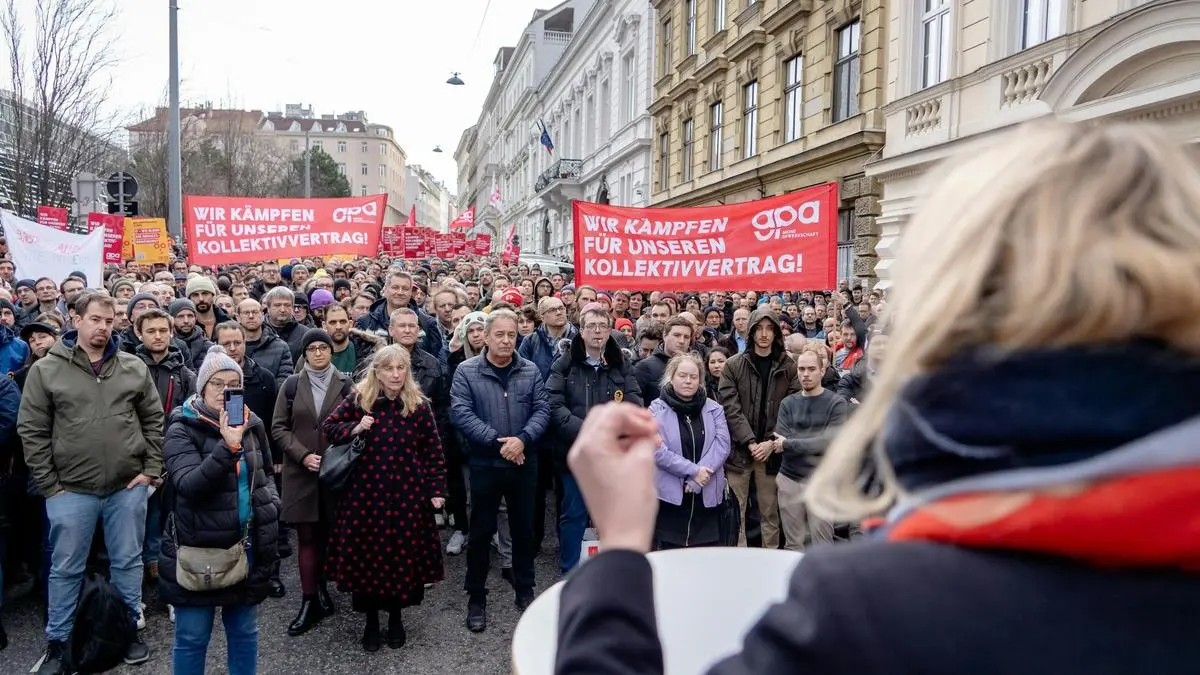
On January 23, around 2,000 IT workers protested outside the WKÖ headquarters in Vienna, carrying signs that made their position clear: “Blockade beenden” (end the blockade). The GPA has announced Betriebsversammlungen (company meetings) across Austria to increase pressure, while the WKÖ accuses the union of treating negotiations like a “Match” (match) they must win rather than a collaborative problem-solving exercise.
What IT Workers Actually Earn: The Unfiltered Numbers
While negotiators debate percentages, actual salaries vary wildly based on specialization, experience, and employer type. Here’s what the market really looks like in 2026:
- Base salary: €86,000 for 38.5 hours/week
- Cash bonus: €6,000
- Equity compensation: $12,500 in RSUs (Restricted Stock Units)
- Additional perks: Employee Stock Purchase Program (ESPP) discount, Klimaticket (climate ticket) for public transport
- Total compensation: ~€95,000+ plus equity upside
- Base salary: €80,000 for 40 hours/week
- Bonus: €5,000
- Total: €85,000
Fullstack Developers (1 year experience)
- Base salary: €39,000 for 32 hours/week (effectively €47,000-€48,000 full-time equivalent)
- No bonus
- Total: €39,000-€48,000 depending on hours
- Base salary: €64,000 for 38.5 hours/week
- Total: €64,000 (plus 13th/14th month salary in many cases)
- Base salary: €170,000 for 38 hours/week
- Bonus: €30,000
- Company car: €50,000 value
- Total compensation: €250,000+
These numbers reveal a crucial pattern: American tech companies with Austrian operations pay in USD-denominated equity, dramatically increasing total compensation. Traditional Austrian firms stick to cash-only packages, creating a two-tier market.
The Hidden Compensation Layer: Beyond Base Salary
Austrian IT compensation includes several layers that don’t appear in base salary figures:
- Klimaticket: Many Viennese tech firms now include Austria’s nationwide public transport pass (worth €1,095 annually) as standard. This isn’t just a perk, it directly impacts your personal inflation rate vs. official metrics by eliminating commuting costs.
- RSUs and ESPP: American parent companies offer Restricted Stock Units and Employee Stock Purchase Programs, but these come with currency risk. When the dollar weakens against the euro, your effective compensation drops, even if your performance stays strong.
- 13th and 14th Month Salary: Many Austrian contracts include these extra payments, but they’re often excluded from “base salary” discussions. A €64,000 base actually means €77,000+ annually when these are included.
- Working Time: The difference between 32-hour and 40-hour contracts complicates comparisons. Always calculate Stundenlohn (hourly wage) when evaluating offers.
Vienna’s Cost Reality: Why €80,000 Doesn’t Go as Far as You Think
A €80,000 salary sounds solid, until you factor in Vienna’s housing market. The city’s real estate prices have become increasingly disconnected from wages. An Altbau (old building) apartment in the 7th district costs €15-€18 per square meter monthly, meaning a 70m² flat runs €1,050-€1,260 before utilities.
This housing pressure explains why many IT professionals are rethinking the great Austrian property dream. With entry-level condos starting at €400,000-€500,000 in Vienna, even senior engineers struggle to save the 20% down payment while renting.
The regional differences in net salary due to Wohnbauförderung (housing promotion fund) add another layer of complexity. Your net pay drops by €5-€15 monthly simply for being registered in Vienna versus Lower Austria, directly impacting your saving capacity.
Economic Headwinds: The Uncertainty Freeze
The economic situation casts a long shadow over negotiations. Austria’s GDP growth remains sluggish, and inflation, while officially reported at 3.2%, feels much higher for tech workers. Your personal inflation rate vs. official metrics likely runs 5-7% when accounting for rent increases, rising Nebenkosten (utility costs), and higher restaurant prices.
This uncertainty creates a paradox: employers claim they can’t afford large increases due to economic pressure, while workers see their real purchasing power erode. The result is a negotiation standoff where both sides feel justified.
Meanwhile, the threat of brain drain looms large. German and Swiss firms actively recruit Austrian IT talent, offering 20-30% salary premiums. The WKÖ’s argument that generous raises threaten job security rings hollow when workers can simply leave for better-paying positions abroad.
Your Action Plan: Navigating the Standoff
While negotiators argue, you need concrete steps:
- 1. Benchmark Your Real Market Value
Use the salary ranges above, but adjust for your specific tech stack. Cloud engineers and AI specialists command 15-25% premiums over generalist developers. Check platforms like Glassdoor, but verify with actual Austrian colleagues, many international salary databases underreport Austrian compensation. - 2. Negotiate Beyond Base Salary
If your employer claims they can’t raise your Grundgehalt (base salary), push for:
– Additional RSUs or equity
– Higher bonus targets
– Klimaticket or other tax-advantaged perks
– Professional development budgets (worth €2,000-€5,000 annually)
– Reduced hours without proportional pay cuts - 3. Consider the Total Package
When evaluating offers, calculate your effective hourly rate including all benefits. A €75,000 job with RSUs and a Klimaticket often beats an €80,000 cash-only position. - 4. Optimize Your Banking Setup
With variable compensation becoming common, choose a bank that handles international transfers and equity sales efficiently. Austrian direct banks compared shows significant differences in fees for USD transactions and stock sale processing. - 5. Plan for Pension Shortfalls
Given that three out of four Austrians now believe state pensions won’t be sufficient, treat your IT salary as your primary retirement vehicle. Maximize betriebliche Vorsorge (company pension) contributions and consider private pension plans, especially if you’re on a high-deductible salary.
The Bottom Line
The Kollektivvertrag (collective agreement) deadlock reflects a deeper shift in Austria’s IT market. Traditional employers cling to modest increases while international competition and Vienna’s rising costs demand more. The 1.9% offer doesn’t just undervalue workers, it threatens Austria’s position as a competitive tech hub.
Whether you’re earning €39,000 as a junior developer or €170,000 as a director, the negotiation outcome affects your financial planning, housing options, and retirement security. While the GPA and WKÖ continue their five-round marathon, your best move is understanding your true market value and negotiating accordingly.
The protest signs outside the WKÖ said it plainly: this isn’t just about percentages. It’s about whether Austria can retain the talent that powers its digital economy. For now, 90,000 IT workers wait, and watch their real incomes shrink.