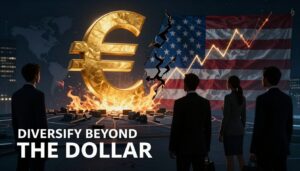
European ETF investors are losing sleep over a single question: could their US holdings become untradeable overnight? The fear isn’t about market crashes or currency fluctuations, it’s about waking up to discover that the world’s deepest capital markets have suddenly become a gated community with no entry for foreigners. Under a re-elected Donald Trump, this scenario has moved from paranoid fantasy to legitimate risk assessment.
When Political Risk Becomes Portfolio Risk
The anxiety runs deeper than typical market volatility. Investors who’ve built their retirement strategies around classic MSCI World and MSCI Emerging Markets allocations now face unprecedented political risk. The concern isn’t that US companies will underperform, it’s that the US government might deliberately sever market access or impose punitive taxes on foreign capital.
This isn’t abstract speculation. The Trump administration has already demonstrated willingness to weaponize trade policy, with India serving as a cautionary tale. When Trump threatened tariffs up to 50% on Indian goods over Russian oil purchases, foreign investors didn’t wait to see if he was bluffing. They liquidated Indian equities worth $169.95 million in a single day, sending the Nifty 50 down 0.75% and the Sensex tumbling 0.72%. The message was clear: political rhetoric translates directly to capital flight.
Foreign capital outflows from Indian markets demonstrate how quickly political tensions can trigger investor flight
The Market Access Question
The core fear among European investors centers on two potential scenarios: direct trading restrictions or discriminatory taxation. Could US regulators block European brokerages from executing trades? Might the Treasury impose withholding taxes specifically on foreign-held assets?
Historical precedent offers little comfort. The Trump administration’s approach to international agreements suggests a willingness to prioritize American interests above multilateral commitments. The recent OECD global minimum tax debacle illustrates this perfectly. Despite 145 countries agreeing to a 15% minimum corporate tax, the US secured an exemption for its multinationals, who now operate under the more favorable GILTI regime (10.5-13.125% effective rate).
French economist Gabriel Zucman called this a “shameful capitulation”, but for investors, the takeaway is more practical: the US plays by its own rules. If Washington can rewrite international tax law to favor American companies, why assume capital markets remain sacrosanct?
Reading the Tea Leaves: What Trump’s Policies Signal
The global minimum tax episode reveals a pattern. When the Trump administration declared the OECD agreement “null and void” on Inauguration Day 2025, it didn’t just reject the policy, it rejected the principle of multilateral constraint. The subsequent “side-by-side” arrangement, where US firms report via GloBE but face no actual top-up taxes, demonstrates how the US can maintain appearances while gutting substance.
For European ETF investors, this creates asymmetric risk. Your Austrian-domiciled fund holding Apple or Microsoft faces no immediate threat, but the precedent is set. If the US exempts itself from global tax standards, what’s to stop it from imposing special registration requirements on foreign investment vehicles? Or favoring domestic investors in future stimulus packages?
The threat isn’t theoretical. Trump’s proposed Section 899 “revenge tax” would have penalized countries that dared apply the minimum tax to US firms. Though ultimately dropped after G7 capitulation, the message was unmistakable: economic coercion remains on the table.
The Diversification Dilemma
Some European investors are already voting with their wallets. One portfolio manager noted being “almost completely out of the USA”, pointing to European indices that outperformed the S&P 500 last year. The ATX, Austria’s benchmark, had what they described as an “extremely strong year.”
This sentiment reflects a broader recalibration. If US markets carry not just economic but political risk that can’t be hedged, then the traditional 60/40 global portfolio needs rethinking. Home bias, once considered an investor’s cardinal sin, starts looking like prudent risk management.
But this creates its own trap. Avoiding the US means missing the world’s most liquid markets, deepest innovation ecosystems, and reserve currency. European tech simply doesn’t offer Nvidia equivalents. German, Austrian, or Swiss pharmaceutical giants can’t match the scale of their American counterparts. The concentration risk of US markets is real, but so is the opportunity cost of ignoring them.
What Actually Changes for Your Portfolio
Let’s ground this in specifics. For an Austrian investor holding a standard MSCI World ETF through a local broker:
Immediate risks remain low. Your ability to buy and sell US securities hasn’t changed. Settlement systems (DTCC, Euroclear) operate independently of political cycles. Austrian banks like Erste Group and Raiffeisen maintain their US correspondent relationships.
Tax treatment is stable. The US-Austria double taxation treaty still governs withholding taxes on dividends (typically 15% for qualified portfolios). The terrifying prospect of a special “foreign investor surcharge” hasn’t materialized, yet.
Currency risk persists. The dollar’s reserve status actually strengthens during global uncertainty, which paradoxically benefits European investors when converting back to euros.
The real shift is qualitative. You’re no longer just buying exposure to American GDP growth and corporate earnings. You’re making a political bet on US institutional stability. That’s a different calculation entirely.
Practical Steps for Austrian Investors
Rather than panic-selling, European investors should implement measured safeguards:
First, verify your brokerage’s contingency planning. Ask explicitly: “What happens if US market access is restricted?” Established Austrian banks should have legal opinions on this scenario. If they don’t, that’s your cue to diversify brokers.
Second, consider splitting US exposure across multiple jurisdictions. Hold some US ETFs through German listings, others through Swiss or Irish domiciles. This doesn’t eliminate risk but creates multiple points of failure rather than a single chokepoint.
Third, explore European alternatives where they exist. For broad tech exposure, the Nasdaq 100 has European-listed equivalents. For S&P 500 exposure, synthetic swaps on European exchanges can replicate returns without direct US ownership.
Fourth, monitor the Finanzamt’s guidance. Austrian tax authorities have been notably silent on how they’d treat forced liquidation of US assets due to political restrictions. Getting clarity now beats discovering unfavorable treatment later.
The Bigger Picture: Geopolitical Portfolio Theory
This situation demands a new framework. Traditional modern portfolio theory assumes markets are efficient and apolitical. Trump’s second term challenges both assumptions. We’re entering an era where government policy can target specific investor classes, where tweets move markets more than earnings, and where “rule of law” becomes negotiable.
The Austrian perspective matters here. As a small, open economy, Austria has always understood that geopolitical winds shift. The country’s pension funds and insurance giants have long diversified across jurisdictions precisely because they can’t dictate terms to larger powers. Individual investors should adopt similar humility.
Bottom Line: Safe, But Not Secure
US investments remain safe in the narrow sense, your money won’t vanish overnight, and you can still trade freely. But they’re no longer secure in the broader sense of predictable, rules-based returns insulated from political whim.
The research shows European investors are right to be concerned, but wrong to panic. The appropriate response isn’t flight from US markets, but a more sophisticated approach to exposure. Treat US holdings as you would any concentrated position: valuable, but requiring active risk management and clear exit strategies.
For now, the MSCI World ETF in your portfolio isn’t going to zero because of political risk. But the days of treating it as a passive, buy-and-forget core holding are over. In Trump’s second term, even index investing requires vigilance.
The markets haven’t closed. They’ve just become more complicated. Austrian investors, accustomed to navigating complex bureaucratic systems at home, may actually be better prepared for this new reality than their American counterparts. The Finanzamt and Meldezettel system teaches a valuable lesson: always read the fine print, because the rules can change.