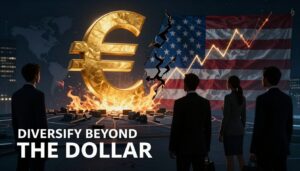
German investors are having a moment of reckoning with their US stock portfolios. After years of dutifully pumping money into MSCI World ETFs and Silicon Valley darlings, a growing chorus is asking: “What if America isn’t the safe bet we thought?” The catalyst isn’t just market volatility, it’s politics, tariffs, and a lingering fear that foreign investors might eventually wear targets on their backs.
When the White House Becomes a Portfolio Risk
The math used to be simple. US markets offered liquidity, innovation, and returns that made German investors weep with envy. Your ETF-Sparplan (savings plan) automatically funneled 60-70% into US companies because, well, that’s what global indices do. But now, as one German retail investor bluntly put it, “there’s a gentleman in the White House who gives me stomachaches.”
The concerns aren’t abstract. Trump’s administration has floated tariffs of 10% on European goods starting February 2026, potentially rising to 25% by June. The justification? A bizarre diplomatic standoff over Greenland that has German exporters nervously checking their order books. Deutsche Bank analysts have flagged the exploding US national debt, now at $38 trillion, as America’s “Achilles’ heel”, warning that European investors could dump $8 trillion in US assets if trade wars escalate.
The bank’s own stock has already felt the pinch, dropping 2.94% in a week as investors price in the risk of a transatlantic trade war. When Germany’s largest financial institution starts warning about American fiscal irresponsibility while its own share price suffers from US policy announcements, you know the relationship is getting complicated.
The Market’s Dangerous Game of Ignore-and-Pray
Here’s what makes this situation particularly volatile: markets are barely acknowledging the risk. Analysts at Activtrades note that discussions about US annexation of Greenland and potential military intervention in Iran are “largely ignored” in current pricing. It’s as if investors collectively decided that geopolitical risk is just background noise, until it isn’t.
This creates a classic setup for what German traders call a “böses Erwachen” (nasty awakening). When serious political or military escalations aren’t priced in, any actual event triggers disproportionate selling. The DAX recently hit record highs above 25,500 points, with international investors piling in, betting on German industrial resilience. But that confidence rests on the assumption that US policy won’t torpedo the export-dependent economy.
The same pattern shows up in how German investors discuss their options. Many have shifted future contributions from US-heavy ETFs like the FTSE All World to European alternatives such as the Amundi Prime All Country World. The goal isn’t necessarily to sell everything overnight, it’s to stop feeding the beast while uncertainty reigns.
From “Buy the Dip” to “Dump the Risk”
The shift in sentiment is palpable. Where German investors once saw US tech stocks as must-haves, they’re now applying a geopolitical filter. Defense stocks? Sold, on fears Trump might classify them as “strategically important” and restrict foreign ownership. Microsoft? Dumped, on concerns it’s losing the AI race to Google. Amazon and payment processors remain under scrutiny.
This isn’t just about returns anymore, it’s about Anlagehorizont (investment horizon) and whether US assets will remain accessible and protected for foreign investors. The fear isn’t entirely speculative. Trump previously suggested a special annual levy on foreign holders of US government bonds as a “privilege fee” for lending money to America. While that specific proposal went nowhere, it planted a seed of doubt about how welcome foreign capital really is.

The ETF Trap No One Talks About
German investors are particularly exposed because their favorite investment vehicles, ETF-Sparpläne, are secretly US concentration bets. That “diversified” MSCI World ETF? It’s over 68% US stocks. Even the FTSE All World, marketed as global exposure, has nearly 60% in American companies. For years, this was a feature, not a bug. Now it’s a vulnerability.
The hidden concentration risks in supposedly diversified US-heavy ETFs mean that German savers who think they’re spreading risk across the globe are actually doubling down on US political stability. When you combine this with the fact that most German brokers default to US-listed ETFs for cost reasons, you’ve got a perfect storm of concentration risk that few retail investors understand.
Some are responding by switching to European-domiciled ETFs with similar exposure but different risk profiles. Others are actively overweighting European stocks to counterbalance the US tech giants that dominate their portfolios. The goal is to maintain market exposure while reducing political risk, what one investor called “geopolitical hedging through regional rebalancing.”
Is This Rational or Just German Angst?
Germany’s risk-averse investing culture is legendary. With only about 17% of Germans owning stocks directly (compared to over 50% of Americans), the default setting is caution. The German investor behavior and risk perception has always favored savings accounts and insurance products over volatile equities. So is this US sell-off just another expression of that caution, or is it justified?
Evidence suggests it’s a bit of both. The concerns about US debt and political instability are real and quantifiable. Deutsche Bank’s warning about the $38 trillion deficit isn’t alarmism, it’s math. The tariff threats aren’t hypothetical, they’re scheduled to take effect. And the Greenland situation, while bizarre, follows a pattern of using economic leverage for territorial ambitions.
But there’s also an element of “Bauchempfinden” (gut feeling) driving decisions. Many German investors admit they’re not running sophisticated geopolitical risk models, they’re simply uncomfortable with the direction of US politics and would rather not have their retirement savings caught in the crossfire. As one put it, “If World War III breaks out, investment returns are the least of our worries, but that doesn’t mean I should ignore the warning signs.”
The Tesla Effect: When Politics Hits Performance
The political backlash affecting market performance provides a case study. Tesla’s European sales have crashed, with market share in Germany down to 0.7% as of late 2025. While this reflects multiple factors, it’s a concrete example of how political sentiment can translate into market reality. If German consumers will shun an American brand over political discomfort, what’s stopping German investors from doing the same?
This creates a feedback loop. As more German capital stays home or flows into European alternatives, it strengthens the Eurozone economy while reducing demand for US assets. Not enough to move markets single-handedly, but enough to contribute to the broader trend of deglobalization in finance.
Practical Strategies for the Conflicted Investor
So what’s a German investor to do? The consensus among those who’ve thought this through isn’t “sell everything and hide in gold.” It’s more nuanced:
- 1. Stop new US exposure: Redirect your monthly ETF-Sparplan from FTSE All World to European-domiciled alternatives like Amundi Prime All Country World. This maintains market participation while reducing US political risk.
- 2. Gradual rebalancing: Don’t trigger capital gains taxes by panic-selling. Instead, let your US positions shrink naturally as you allocate new money elsewhere. German tax law makes selling after holding periods shorter than one year expensive.
- 3. Focus on what you know: Overweight European stocks where you understand the regulatory environment and political landscape. The DAX might not have Apple, but it has solid industrial companies with global reach.
- 4. Consider currency risk: A declining US dollar, possible if debt concerns grow, would hurt returns even if stock prices hold steady. European ETFs hedge this automatically.
- 5. Stay liquid: Keep some powder dry. If US assets do sell off sharply on geopolitical news, that might be the buying opportunity contrarians wait for. As the saying goes, “be greedy when others are fearful.”
The investor concerns over US trade policy and European exposure are driving a broader shift toward regional diversification. German investors are discovering that “global” doesn’t have to mean “US-dominated.”
The Greenland Wildcard
No discussion of this topic is complete without addressing the absurdity of Greenland. Trump’s push to annex the Danish territory, threatening tariffs until Denmark sells, sounds like satire but has real market implications. It’s a test case for whether the US will weaponize trade policy for non-economic goals.
If European investors perceive that US markets are no longer governed by economic fundamentals but by political whims, the Vertrauensverlust (loss of confidence) could be irreversible. Markets depend on predictable rules. When those rules become arbitrary, rational investors reduce exposure.
The geopolitical tensions impacting passive investment strategies might seem overblown, until they’re not. The scenario where European investors collectively reduce US exposure by $8 trillion isn’t fantasy, it’s Deutsche Bank’s estimate if trade wars escalate.
Bottom Line: Don’t Panic, But Don’t Ignore
Selling America isn’t about hating the US or predicting collapse. It’s about recognizing that the risk profile has changed. For German investors, whose retirement systems already favor stability over speculation, the new uncertainties tilt the balance toward European alternatives.
The smartest approach isn’t a dramatic “SELL AMERICA” declaration. It’s a quiet, methodical shift in allocation, moving from 70% US exposure to something more balanced, perhaps 40-50%, while keeping quality US positions that would survive political turmoil. Think less “abandon ship” and more “diversify the fleet.”
Your Depot (investment account) doesn’t need to become a geopolitical battleground. But it also shouldn’t be blind to risks that markets are stubbornly ignoring. In German investing culture, “sicher ist sicher” (better safe than sorry) isn’t just a saying, it’s a survival strategy. Right now, “sicher” means asking hard questions about that comforting US stock allocation.
The DAX might not offer the same growth story as the S&P 500, but at least you know where the politicians stand, and they probably won’t annex your portfolio.