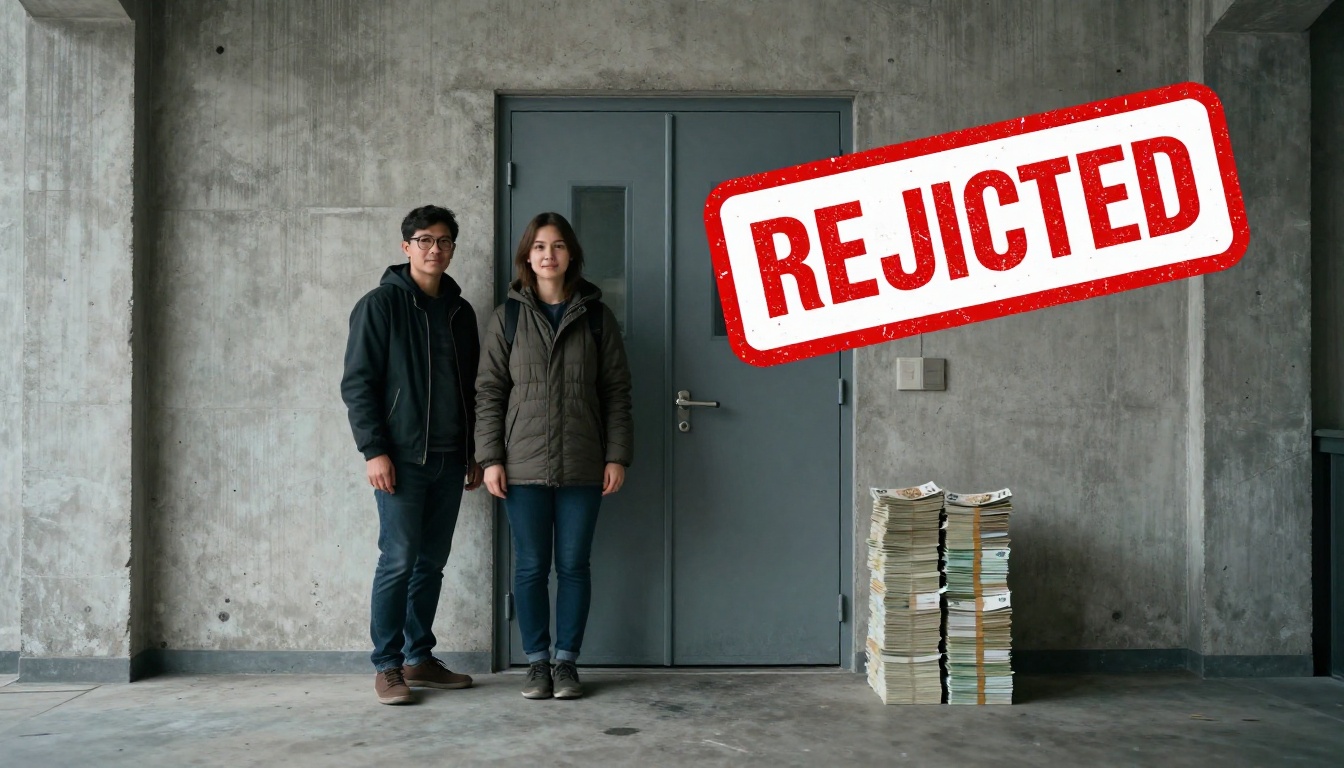
A three-person family pulling in €5,200 net monthly, sitting on €80,000 equity, just got laughed out of two Austrian banks. Not because they’re risky. Not because they’re self-employed with irregular income. Because the math, Austrian bank math, says they can’t afford a €338,000 upgrade. If that sounds backwards, welcome to the 2026 reality of Immobilienfinanzierung (real estate financing) where your solid financial track record matters less than the algorithm’s worst-case scenario.
The Numbers That Actually Matter (Hint: Not Yours)
Let’s break down the case that’s lighting up finance forums across Austria. The family owns an 80m² apartment, bought four years ago for what’s now estimated at €200,000. Their current mortgage payment: €800 monthly. They’ve found a larger place for €338,000, plan to sell the old one, and have €50,000 cash plus expected €30,000 from the sale. Total equity: €80,000. On paper, this looks reasonable.
Bank #1’s response: We need €150,000 in Eigenmittel (equity). Bank #2’s rejection: Their system only allocates €2,000 monthly for living costs for a family of three, making the deal “untragbar” (unsustainable).
Here’s where it gets technical, and where most applicants get blindsided.
The Beleihungswert Trap
Austrian banks don’t care about your purchase price. They care about the Beleihungswert (loan-to-value ratio), and they’re legally required to be conservative. The magic formula:
Kreditsumme × 1.2 = Grundbucheintrag (land registry entry)
The Beleihungswert cannot exceed 90% of that entry. So for a €338,000 purchase, you need financing of roughly €288,000 (assuming you cover 10% plus costs). But the bank must register €345,600 in the Grundbuch (€288,000 × 1.2). For that to work at 90% Beleihungswert, the property must be worth at least €384,000.
If the bank’s appraiser values it at €320,000? Your required equity jumps overnight. That €80,000 you saved suddenly covers only the shortfall, leaving nothing for the Nebenkosten (ancillary costs) that run 10-15% of purchase price.
Why Your Unsold Property Is a Liability, Not an Asset
The family’s biggest problem? Their current apartment isn’t sold yet. Austrian banks operate on Worst-Case-Planung (worst-case planning). What if you can’t sell for six months? What if the market drops? What if your buyer backs out?
One bank employee explained it bluntly: “Der Verkaufserlös ist keineswegs sicher.” (The sale proceeds are by no means certain.) Until you have a signed Kaufvertrag (purchase agreement) and the buyer’s financing is approved, that €30,000 might as well not exist. This forces families into a brutal choice: sell first and risk being homeless, or buy first and risk double mortgages.
Zwischenfinanzierung (bridge financing) sounds like a solution, but here’s the catch, it gets added to your DSTI (Debt Service to Income) ratio. With your existing €800 payment still running, the bank calculates you servicing both loans simultaneously. Even if you know the old place will sell in weeks, the algorithm says you’re overleveraged.
The €2,000 Monthly Living Cost Fiction
Bank #2’s €2,000 monthly living cost assumption seems “völlig übertrieben” (completely exaggerated) to most families. For a three-person household in Austria today, that barely covers groceries, insurance, and utilities, let alone childcare, car repairs, or a single trip to the dentist.
But here’s the thing: the number isn’t random. It’s based on standardized tables from the Finanzmarktaufsicht (Financial Market Authority) that banks must follow. These tables assume certain frugality levels and ignore regional differences. Living in Vienna? Same number as rural Burgenland. Have a teenager who eats like a professional athlete? The table doesn’t care.
This standardized approach, meant to protect consumers from overextension, now acts as a Kreditklemme (credit squeeze) for middle-class families whose real spending is higher but whose income is stable. The system penalizes you for not fitting the statistical average.
The Regulatory Squeeze Nobody Talks About
Austrian banks didn’t get this conservative by choice. Post-2008 regulations forced them to increase capital buffers. Post-COVID, the FMA Mindeststandards (FMA minimum standards) and KIM-VO (Consumer Credit Directive Implementation Regulation) tightened the screws further.
But there’s another layer: AML-Überwachung (anti-money laundering scrutiny). Banks now track every unusual transaction. That €5,000 you transferred from your savings account to cover the Maklerprovision (real estate agent commission)? Expect questions. The €2,000 monthly Revolut top-ups you use for convenience? Some Austrian banks now treat these as red flags, as we detailed in our analysis of how Austrian anti-money laundering policies affect consumer lending behavior.
This means your financial life is under a microscope not because you’re suspicious, but because the bank must document everything. One unexplained transaction can delay your application by weeks.
What Actually Works: A Survival Guide
1. Sell First, Buy Second (Yes, Really)
The safest path is selling your current property before hunting for the next one. This gives you liquid funds and eliminates the DSTI problem. The risk? You might need temporary housing. Many families negotiate Übergangsmieten (transitional rentals) or stay with relatives for 2-3 months. It’s inconvenient, but it’s what banks want to see.
2. Target Genossenschaftsbanken
Raiffeisen and Volksbank (cooperative banks) often have more flexible criteria than large commercial banks like Bank Austria or Erste Bank. They know local markets better and may appraise your target property more generously. One commenter noted they secured financing where commercial banks refused, though as we’ve warned in our piece on long-term repayment burdens in Austrian renovation loans, always calculate the total cost over the full term.
3. Document Everything, Twice
Banks want paper trails. That €20,000 gift from your parents? Needs a Schenkungsvertrag (gift contract). Your side freelance income? Must be documented for three years with Einkommensteuerbescheide (income tax assessments). Even your Kinderbetreuungskosten (childcare costs) need receipts if you want them deducted from the living cost calculation.
4. Time Your Application Strategically
Don’t apply in December when banks hit their annual quotas. March-April is optimal. Also, avoid applying during Karensperioden (probationary periods) at new jobs, even if your income is higher. Banks want 6+ months of stable employment history.
5. Consider a Bausparvertrag (Building Savings Contract)
If you’re planning 2-3 years ahead, a Bausparvertrag can serve as additional collateral. Even if not yet zuteilungsreif (ready for allocation), some banks count it as quasi-equity, especially Raiffeisen and local Bausparkassen.
The Bottom Line: Your Financial Health Is Secondary to Bank Risk Models
The harsh truth? Austrian banks aren’t rejecting you, they’re rejecting the statistical probability of your deal under worst-case conditions. Your €80,000 equity is real, your €5,200 income is stable, but the model says: What if interest rates hit 6%? What if you lose your job? What if the property market crashes 20%?
This conservatism protects the financial system, but it’s grinding down middle-class mobility. Families who could upgrade five years ago are now stuck. The gap between öffentliche Erwartungen (public expectations) and Bankenpraxis (banking practice) has never been wider.
Before you apply, run your numbers through a Baufinanzierungsrechner (construction financing calculator) that includes Austrian-specific parameters. Better yet, pay for an independent Finanzierungsberater (financial advisor) who knows which banks are currently aggressive versus cautious. The €500 fee can save you from multiple rejections that tank your Schufa score.
And remember: in Austria’s current climate, Eigenmittel (equity) is necessary but not sufficient. You need the right timing, the right bank, the right documentation, and a property that fits the bank’s valuation model, not yours.
The system isn’t broken. It’s working exactly as designed. It’s just not designed for you.