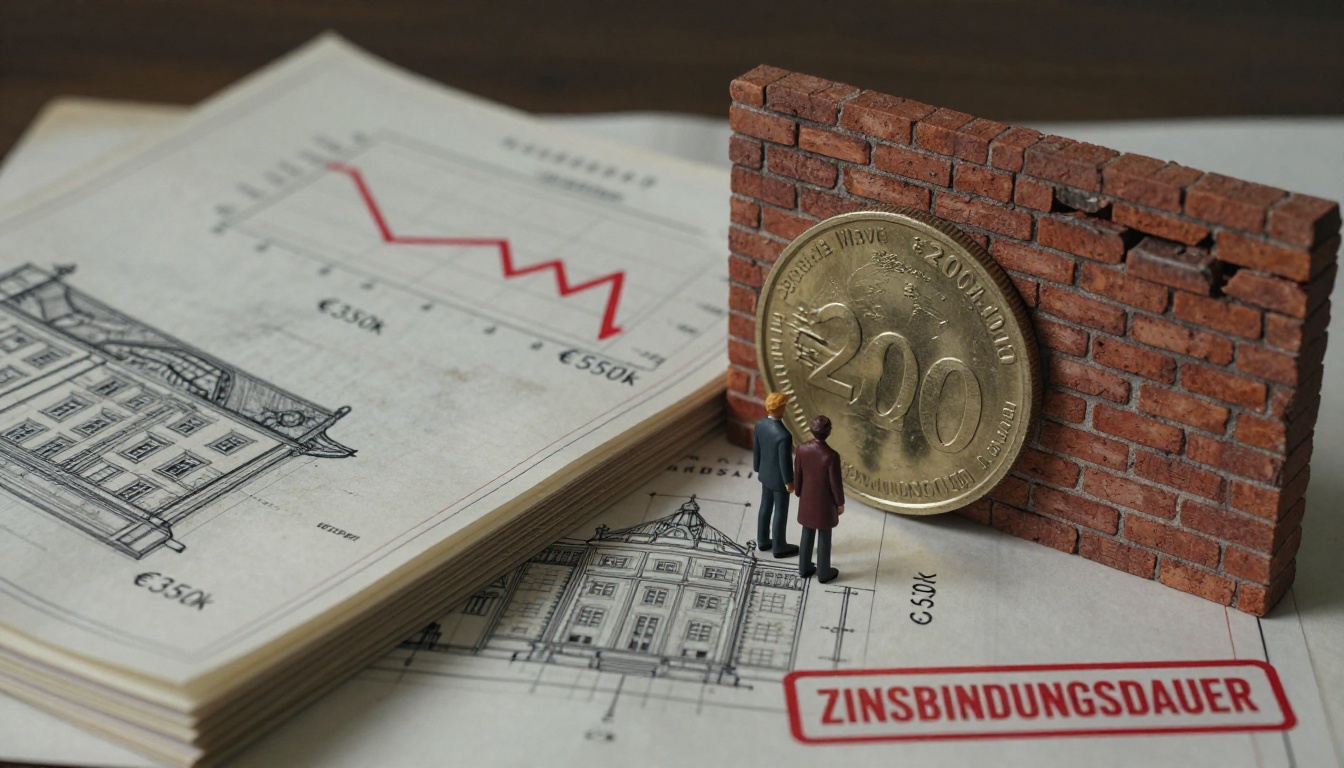
A young couple in Austria recently received a renovation loan offer that looked reasonable at first glance: €350,000 to fix up their aging family house. The interest rate? 3.7% fixed. The bank called it a “competitive package.” The total repayment amount over 35 years? €550,000. That €200,000 difference represents the quiet reality of Austrian house renovation financing in 2026.
This scenario plays out across the country as homeowners grapple with aging Altbau (old building) properties and the pressure to modernize. The research shows many international residents and locals alike struggle to evaluate what makes a loan offer genuinely fair versus a financial trap that locks them into decades of expensive payments.
The Math That Banks Hope You Won’t Calculate
The core numbers reveal why renovation loans create such stress. For a €350,000 Sanierung (renovation) credit at 3.7% interest over 35 years, you pay roughly €200,000 in interest alone. That assumes the rate stays stable, which introduces the first major complication.
Many homeowners focus only on the monthly payment amount and whether it fits their current budget. Banks structure offers to emphasize this affordability. The Austrian consumer protection law requires them to disclose the total cost, but this figure often appears in small print on page seventeen of the contract.
The effective annual percentage rate (effektiver Jahreszins) must include all costs: processing fees, mandatory insurance, and valuation expenses. Yet many borrowers discover additional charges for the Grundbucheintrag (land registry entry) and Notar (notary) fees that add thousands more.
The Fixed-Rate Duration Trap: 10 Years vs. 35 Years
Here’s where Austrian renovation loans become particularly tricky. That 3.7% rate might be fixed for only 10 years, not the full 35-year loan term. After the Zinsbindungsdauer (interest rate fixation period) ends, the bank can adjust the rate based on current market conditions.
Market data from February 2026 shows construction loan rates ranging from 3.38% to 4.13% depending on the fixation period. A 10-year fixation sits at the lower end, while true 35-year fixation commands rates above 4%. The difference seems small but compounds dramatically over decades.
Many borrowers assume “fixed” means “fixed for the entire loan.” Austrian banks rarely offer true 35-year fixation at advertised rates. The small print reveals the truth: after 10 years, you’re exposed to whatever rates exist in 2036. Given the current upward pressure from European Central Bank policies, that risk is substantial.
This creates a dangerous scenario where your affordable €1,300 monthly payment could jump to €1,700 or more after the fixation ends. The research shows homeowners regularly underestimate this risk, focusing only on immediate affordability.
Why Sondertilgungen (Special Repayments) Change Everything
One commenter mentioned securing 3.7% fixed for 35 years with penalty-free Sondertilgungen in beliebiger Höhe (special repayments in any amount). This detail transforms a mediocre offer into an excellent one.
Standard Austrian renovation loans restrict special repayments to 5% or 10% of the original loan amount annually, often with penalties for exceeding this limit. Some banks charge 0.5% to 1% of the extra payment amount as a “prepayment penalty.”

Unlimited penalty-free special repayments give you flexibility to reduce the principal when you have extra income, inheritance, or savings. Every extra €10,000 paid in year five saves approximately €15,000 in interest over the loan’s lifetime.
When evaluating offers, this feature matters more than a slightly lower interest rate. A 3.8% loan with unlimited special repayments beats a 3.6% loan with strict limits for anyone expecting income growth or windfalls.
The Wohnbauförderung (Housing Subsidy) Mirage
Austria’s state-level housing subsidies promise attractive rates as low as 1% for qualifying projects. Each Bundesland (federal state) sets its own rules:
- Vienna offers 1% fixed for 30 years through its Wohnbauförderung program
- Lower Austria provides similar rates with income-based points systems
- Tyrol and Vorarlberg have hybrid subsidy models
However, these programs primarily support new construction (Neubau) and first-time purchases, not renovations of existing family homes. The income limits (Einkommensgrenzen) exclude middle-class families in most cases. A two-person household in Vienna faces a €68,530 annual net income cap. In Salzburg, it’s €87,000. Exceed these limits by even one euro, and you lose eligibility.
Even when you qualify, the subsidized amount rarely covers full renovation costs. Most homeowners need a combination of Eigenmittel (personal funds), Wohnbauförderung, and a commercial bank loan. The complexity often drives borrowers straight to commercial banks like Raiffeisen.
regional housing subsidies affecting affordability and financing decisions
The research shows many homeowners waste months pursuing subsidies only to discover they don’t qualify for renovation projects, delaying critical repairs while interest rates climb.
Current Austrian Market Reality: Why 3.7% Is Actually “Fair”
Comparing offers across Austrian banks in early 2026 reveals why that 3.7% rate, while painful, reflects market reality:
- Raiffeisen, Hypo Bank, and Sparkasse all quote similar rates for renovation loans
- Online banks like ING and Consorsbank offer slightly lower rates (3.47-3.55%) but with stricter conditions
- The best available 10-year fixation sits at 3.38% through specialized brokers
- True 35-year fixation pushes rates above 4%
The Austrian renovation loan market shows limited competition compared to Germany. Local banks maintain relationships with regional contractors and architects, creating a closed ecosystem where shopping around yields diminishing returns.
One homeowner reported getting quotes from Raiffeisen, Hypo, and Sparkasse, with Raiffeisen offering the best terms despite being “still quite expensive.” This matches broader market observations where traditional banks dominate renovation financing.
Austrian loan acceleration clauses and financial risks during income loss
Processing Fees and the OGH Ruling
Austrian banks traditionally charged 1-2% processing fees (Bearbeitungsgebühren) on renovation loans. A recent OGH (Austrian Supreme Court) ruling declared many of these fees illegal, forcing banks to refund millions.
However, banks now embed these costs elsewhere: higher interest rates, mandatory insurance products, or valuation fees. The effective interest rate must reflect all costs, but creative accounting still obscures the true total.
Always ask for the “Effektivzins ohne zusätzliche Produkte” (effective interest rate without additional products) to compare offers fairly.
The Eigenkapital (Equity) Requirement Reality Check
Austrian banks typically require 20% Eigenkapital for renovation loans. On a €350,000 project, that’s €70,000 upfront.
Many homeowners underestimate renovation costs, particularly for Altbau properties. A project budgeted at €300,000 frequently runs to €400,000 or more once workers expose structural issues. Banks won’t increase the loan amount mid-project without requalifying, leaving homeowners scrambling for cash.
This creates a dangerous scenario where you commit to a €350,000 loan, discover you need €400,000, but only have €70,000 in equity. The bank might refuse the additional €50,000, forcing you to accept inferior materials or incomplete work.
real construction and renovation cost expectations in Austria
What Actually Makes a Renovation Loan Offer “Fair”?
Based on the research, evaluate offers using this checklist:
Interest Rate Components:
– Is the rate fixed for the full term or just 10 years?
– What’s the effektiver Jahreszins including all fees?
– Are there penalties for special repayments?
Flexibility Terms:
– Sondertilgungen: How much can you repay annually without penalty?
– Can you pause payments during financial hardship?
– Is there a Bausparen (building savings) component that reduces rates later?
Hidden Costs:
– Grundbucheintrag fees: €500-2,000
– Notar costs: 1-2% of loan amount
– Valuation fees: €300-800
– Mandatory insurance: €50-100 monthly
Risk Protection:
– Does the contract include a Kündigungsrecht (right to terminate) after 10 years?
– What happens if you lose income? Austrian loan acceleration clauses and financial risks during income loss
– Can you transfer the loan to a new buyer if you sell?
The 35-Year Commitment Trap
Committing to 35 years of payments at age 35 means paying until age 70. Austrian employment law protects against age discrimination, but the reality of working continuously for four decades is questionable.
Consider these scenarios:
– Health issues force early retirement
– The property needs another renovation in 20 years
– Your income peaks at 50 and declines
– Interest rates spike after the fixation ends
A 35-year loan for a renovation project you hope lasts 30 years creates a mismatch. You might pay for the renovation twice over while the house needs another round of updates.
affordability and financing of residential property in Austria
Actionable Steps Before Signing
-
Get three written offers: Raiffeisen, a direct bank (ING), and a broker. Compare effective rates, not nominal.
-
Calculate total cost scenarios: Run numbers for 10, 20, and 35-year payoff periods using a Tilgungsrechner (repayment calculator).
-
Verify Sondertilgungen terms: Get written confirmation of penalty-free repayment amounts and timing.
-
Check Wohnbauförderung eligibility: Contact your Bundesland’s housing office before committing to commercial financing.
-
Budget 30% cost overrun: Austrian renovation projects routinely exceed estimates. Ensure you have equity or credit lines for surprises.
-
Review the acceleration clause: Understand what happens if you miss payments. Some Austrian banks can demand full repayment after just two missed months.
-
Consider splitting the loan: A smaller 10-year fixed loan for urgent work plus a separate Bausparen contract for future projects often costs less overall.
The Bottom Line
That €350,000 renovation loan at 3.7% is neither a scam nor a bargain, it’s a product of Austria’s concentrated banking market and current interest environment. The €200,000 interest cost shocks because Austrian homeowners historically enjoyed rates below 2%.
The real decision isn’t whether 3.7% is “fair” but whether renovating makes financial sense at all. In many cases, selling and purchasing a newer property costs less than renovating an old house with expensive financing.
If you proceed, prioritize flexibility over marginal rate differences. Unlimited Sondertilgungen and a shorter fixation period with clear exit options protect you better than a 0.1% rate reduction.
The Austrian renovation loan market rewards those who negotiate aggressively and understand that the lowest monthly payment often hides the highest total cost. Your bank’s “competitive package” might be their best offer, but that doesn’t make it good for your financial future.
Austrian saving and investment priorities related to homeownership