France just handed its army of freelancers, side-hustlers, and solo operators a new administrative headache. Starting September 2026, every micro-entrepreneur (micro-entrepreneur) in the country, yes, even that graphic designer billing three clients from a café in Marseille, must be able to receive electronic invoices through an approved platform. By September 2027, they must issue them too. The kicker? The government scrapped its planned free portal, leaving you to navigate a jungle of over 100 private platforms, some charging upward of €25 per month.
This isn’t just another paperwork shuffle. It’s a fundamental rewiring of how France’s smallest businesses handle money, and many are sleepwalking into compliance costs they haven’t budgeted for.
The Timeline: Two Dates That Change Everything
Mark these in your calendar, because the tax authorities (Direction Générale des Finances Publiques or DGFiP) won’t accept “I didn’t know” as an excuse.
September 1, 2026: The Reception Mandate
Every micro-entrepreneur must be able to receive electronic invoices from suppliers. If your internet provider or software vendor sends you an electronic invoice and you’re not set up to receive it, you’re technically non-compliant. The old PDF in your email inbox? That won’t cut it anymore.
September 1, 2027: The Emission Mandate
This is where it gets real. Any invoice you send to a business client (B2B) must go through an approved platform in a structured format. Your current Word or Excel template, exported as PDF and emailed? Legally worthless. You’ll need to generate what’s called a Factur-X file, a hybrid format that looks like a PDF but contains machine-readable data that plugs directly into your client’s accounting system.
The penalties are concrete: €15 per non-compliant invoice, capped at €15,000 annually. For a micro-entrepreneur clearing €25,000 in revenue, that’s a potential 60% hit.
The Free Portal That Vanished
Here’s where the controversy ignites. The government originally promised a free public portal (Portail Public de Facturation or PPF) where businesses could create and send invoices at no cost. That plan died quietly in late 2024. The PPF will now serve only as a directory and data collector, not a functional tool for micro-entrepreneurs.
Many international residents report frustration with this bait-and-switch. The expectation was that France would provide the same free tools it offers for tax declarations. Instead, the state outsourced the entire system to private operators.
The consequence: you’re now shopping in a marketplace of plateformes agréées (approved platforms) where “free” options exist but come with limitations. Solutions like Indy, Tiime, and Henrri offer no-cost tiers, but they’re banking on upselling you later. Others start at €10-25 monthly, a fixed cost that doesn’t care if you invoice one client or one hundred.
E-Invoicing vs. E-Reporting: The Confusion Tax
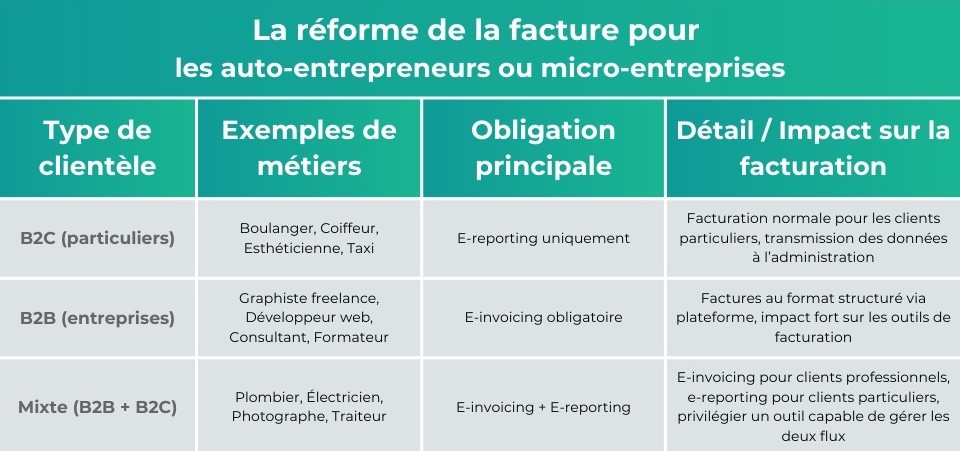
The reform splits your obligations based on who you’re selling to, and this is where most micro-entrepreneurs get lost.
B2B Clients (Business-to-Business):
– Full e-invoicing applies
– Must use a plateforme agréée
– Invoice must be in structured format (Factur-X, UBL, or CII)
– Data transmits automatically to tax authorities
B2C Clients (Business-to-Consumer):
– No e-invoicing required, you can still send a regular PDF or paper invoice to the customer
– But you must submit e-reporting: periodic data transmissions to the DGFiP summarizing your B2C sales
– Same timeline applies: reporting starts September 2027
If you’re a freelance developer with five corporate clients, you’re in the first camp. If you’re a piano teacher billing families, you’re in the second. If you do both? You need a platform that handles both e-invoicing and e-reporting, or you’ll be juggling two systems.
The rising financial strain on households and micro-entrepreneurs makes these new costs particularly painful right now.
Choosing Your Platform: A Minefield of 100+ Options
The official DGFiP list of approved platforms reads like a phone book of European tech companies. As of February 2026, 108 platforms have passed interoperability tests and received definitive registration. Names range from French fintechs (Qonto, Pennylane) to international giants (SAP, Basware) to niche players you’ve never heard of.
The selection criteria matter more than the brand name:
- Is it actually approved? Check the official DGFiP list. Some platforms are still “under review” and might not make the cut.
- Does it handle your client mix? If you have both B2B and B2C, you need both e-invoicing and e-reporting capabilities.
- Will it integrate with your tools? If you use accounting software like Pennylane or Indy, their native platform might be easiest.
- What’s the real cost? Some “free” platforms limit invoice volume. Others charge per transaction. A baker sending 200 monthly invoices faces different math than a consultant billing two clients.
Many newcomers express frustration, finding platform selection the hardest adjustment to financial life in France. The paradox of choice is real when you’re staring at 108 approved providers, each with slightly different pricing and features.
The Franchise de TVA Trap
A common misconception: “I’m in franchise de TVA (VAT exemption), so this doesn’t apply to me.”
Wrong. The DGFiP clarifies that being exempt from charging VAT doesn’t mean you’re exempt from the e-invoicing mandate. You’re still an “assujetti à la TVA” (VAT-registered entity) under French law, just one with a special exemption. The obligation stands.
If you’re in franchise de TVA and sell exclusively to individuals, you skip e-invoicing but still face e-reporting. If you sell to even one business, full e-invoicing applies to that transaction.
What You Must Do Now: A Survival Checklist
Don’t wait until August 2027. The platforms will be slammed with last-minute registrations, and you’ll be stuck in support queues.
Q1 2026: Assess Your Situation
– Map your client base: what percentage is B2B vs B2C?
– Check your current invoicing tool: will it be updated for Factur-X, or do you need a new solution?
– Contact your accountant: they often have negotiated rates with specific platforms
Q2 2026: Choose and Test
– Select 2-3 platforms that fit your needs
– Sign up for free trials and test with sample invoices
– Verify the platform can handle your specific requirements (recurring invoices, multiple currencies, etc.)
Q3 2026: Migrate and Train
– Move your client data to the chosen platform
– Update your invoice templates with required new fields (client SIREN, delivery address if different)
– Inform your B2B clients about the change
Q4 2026: Full Compliance
– All incoming invoices from suppliers should arrive electronically
– You’re ready for the September 2027 emission deadline
The Hidden Upside (Yes, There Is One)
For all the griping, e-invoicing does offer tangible benefits. The automated data transmission means your VAT declarations will eventually be pre-filled, reducing errors. Payment tracking becomes more reliable, clients can’t claim they “lost” the invoice when there’s a digital receipt trail. And for B2B sales, structured invoices often process faster, potentially improving cash flow.
The question is whether these benefits outweigh the costs and learning curve for a one-person operation. That’s a personal calculation, but the state isn’t waiting for your answer.
Bottom Line: The Clock Is Ticking
France’s e-invoicing mandate represents a rare bureaucratic certainty: the deadlines are fixed, the penalties are defined, and the free alternative is dead. Micro-entrepreneurs face a classic French administrative paradox, an obligation that’s universal but requires individual navigation of a complex private market.
The inflation and household financial pressures make this an especially tough pill to swallow. But swallow it you must. Start researching platforms now, test them before the rush, and budget for the monthly fees. The alternative is a tax penalty that could erase your profit margin for the year.
The days of simple PDF invoicing are numbered. Whether this reform streamlines your business or sinks it under new costs depends entirely on how quickly you act, and how wisely you choose.
Need to understand how broader economic pressures affect your business? Check our analysis of rising financial strain on households and micro-entrepreneurs and why inflation and household financial pressures make compliance costs even more painful right now.