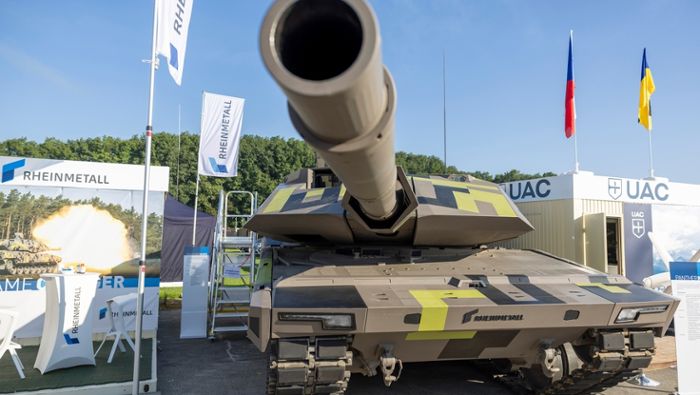
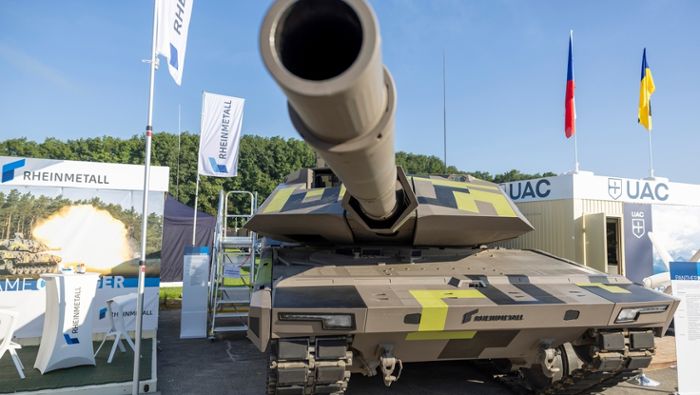
Rheinmetall’s stock is having a meltdown while its order books are overflowing. The DAX-listed defense giant has shed nearly 8% this week alone, dropping to around €1,498 per share, yet simultaneously announced a joint tank development project approved by Germany’s Bundeskartellamt and a major Skyranger 30 order from the Netherlands extending through 2029. This isn’t just market volatility, it’s a fundamental disconnect between operational excellence and investor psychology that every German retail investor should understand.
When Good News Becomes a Sell Signal
The paradox is almost absurd. On Monday, the Bundeskartellamt gave Rheinmetall and its partner green light for a joint project to develop a new main battle tank, securing revenue streams potentially through 2045. The company is targeting €50 billion in revenue by 2030. The Netherlands just ordered their Skyranger 30 air defense systems. By all fundamental metrics, Rheinmetall should be soaring.
Instead, the stock dropped 3.65% in a single day, landing in the bottom third of DAX performers. The reason? High-level peace talks in Berlin involving Ukrainian President Zelenskyj and US representatives. Reports suggesting American security guarantees might replace NATO membership for Ukraine sent defense stocks tumbling. As the Stuttgarter Zeitung reported, investors are pricing in that a ceasefire could dampen long-term demand for Rheinmetall’s products.
This is the new reality for German defense investors: diplomatic progress hurts more than military escalation helps. The stock doesn’t trade on current earnings or confirmed orders, but on the probability of future conflicts. It’s a grim calculation that turns peacetime optimism into a bearish signal.
The Technical Death Cross Scaring Traders
Beyond geopolitics, Rheinmetall’s chart looks increasingly precarious. The stock has fallen below its 200-day moving average, a critical technical level watched by institutional investors, and is approaching its 50-week line. More concerning is the potential double-top formation around the €1,480 mark. If the price significantly breaches this level, technical analysts warn of further sharp declines regardless of fundamentals.
The MACD indicator shows no signs of hope on either daily or weekly timeframes. As Börsen Online noted, Rheinmetall has also violated short-term trend marks, triggering algorithmic selling from quantitative funds. In essence, the stock is caught in a self-reinforcing technical downturn that fundamental good news can’t seem to break.
Insider Transactions: Mixed Signals from Management
Adding to the confusion, Rheinmetall’s leadership has been actively trading their own shares. Multiple supervisory board members and executives have sold substantial positions, with each sale announcement coinciding with notable same-day price drops. Conversely, other board members have bought during dips, which typically signals confidence.
The market reaction has been predictably schizophrenic. Sales trigger immediate point losses, purchases provide temporary stabilization but fail to shift the longer-term trend. This pattern, documented by BörsenNEWS, suggests that even those closest to the company are uncertain about near-term price direction. When insiders can’t coordinate their message, retail investors are left guessing.
The €1 Fallacy: Understanding Retail Investor Confusion
The original Reddit post that sparked this discussion claimed “1 Aktie = 1€”, a figure so detached from reality it reveals a deeper problem. At €1,500+ per share, Rheinmetall is priced beyond reach for many small German investors, creating a psychological barrier. Some retail traders half-jokingly suggest stock splits to make shares “feel” cheaper, though this would be purely cosmetic.
This disconnect between perception and reality highlights how Germany’s retail investment culture, still dominated by savings accounts and Bausparverträge, struggles with high-priced equities. Unlike US investors who cheer fractional shares, many German investors see four-digit share prices as institutional territory. The “€1” meme reflects genuine frustration with a stock that seems both expensive and falling, a toxic combination for the traditional German retail psyche.
Analysts vs. Algorithms: The Stalemate
Here’s where it gets interesting: professional analysts remain overwhelmingly bullish. Deutsche Bank and other institutions maintain buy ratings with price targets far above current levels, citing Europe’s structural shift toward higher defense spending. They correctly point out that even a Ukraine ceasefire won’t reverse Germany’s commitment to NATO’s 2% GDP defense target or the EU’s strategic autonomy goals.
But algorithms and momentum traders currently control the price action. They don’t read analyst reports, they scan headlines for “peace”, “ceasefire”, and “diplomacy”, then hit sell. As Börsen Online bluntly stated: “Due to the turning sentiment in the market, entry into defense stocks currently appears poorly timed from a timing perspective.”
This creates a rare opportunity, or trap. Value investors see a company trading at a discount to its long-term prospects. Momentum investors see a falling knife. The stalemate won’t break until either geopolitical clarity emerges or technical indicators turn positive.
What German Investors Should Actually Do
For those holding Rheinmetall in their Depot, the decision hinges on your time horizon:
Short-term traders should respect the technical damage. The stock could easily test support levels between €1,403-€1,417 or even €1,308-€1,322 if peace talks gain traction. The 8% weekly drop could extend further before stabilizing.
Long-term investors face a trickier question. The fundamental case remains intact: Rheinmetall is positioned to benefit from a generational increase in European defense spending. However, as the insider transactions show, even management expects continued volatility.
The middle path? Consider scaling in gradually rather than making a single bet. Use the Dollar-Cost-Averaging approach familiar from ETF-Sparplan strategies. This acknowledges that timing the bottom is impossible while capturing potential upside.
The Bottom Line: Hope Is the Real Enemy
Rheinmetall’s stagnation reveals an uncomfortable truth about defense investing in Germany: the market fears peace more than it rewards war. While the company transforms itself into a European defense champion, its stock price dances to the tune of diplomatic bulletins from Berlin and Washington.
For German investors, this creates a uniquely frustrating situation where corporate success and shareholder returns have decoupled. The €1,500 price tag isn’t just a number, it’s a psychological battleground between value-oriented analysts and sentiment-driven traders.
Until the market accepts that European rearmament is structural rather than cyclical, Rheinmetall will likely remain a “show me” story. The next catalyst could be Q4 earnings, a major order announcement, or, ironically, renewed geopolitical tension. Until then, the stock may continue its painful consolidation, reminding investors that in Germany’s cautious market, even war profiteers need patience.
The information provided is for informational purposes only and does not constitute investment advice. German investors should consult their financial advisor and consider their individual risk tolerance before making investment decisions.