title: “Trade Republic’s Customer Service Crisis: How Bad Is It Really?”
description: “Growing customer complaints about Trade Republic’s service failures, including locked accounts, lack of support, and fraud vulnerabilities, are raising serious concerns about the reliability of one of Germany’s most popular Neobrokers.”
slug: trade-republics-customer-service-crisis-how-bad-is-it-really
image: “trade-republics-customer-service-crisis-how-bad-is-it-really_trade-republic-beendet-den-chat-zwang-kommt-jetzt-der-telefon-support.jpg”
date: 2025-12-05
tags: [“Trade Republic”, “Neobroker”, “BaFin”, “Kundenservice”, “Verbraucherzentrale”]
categories: [“Germany”]
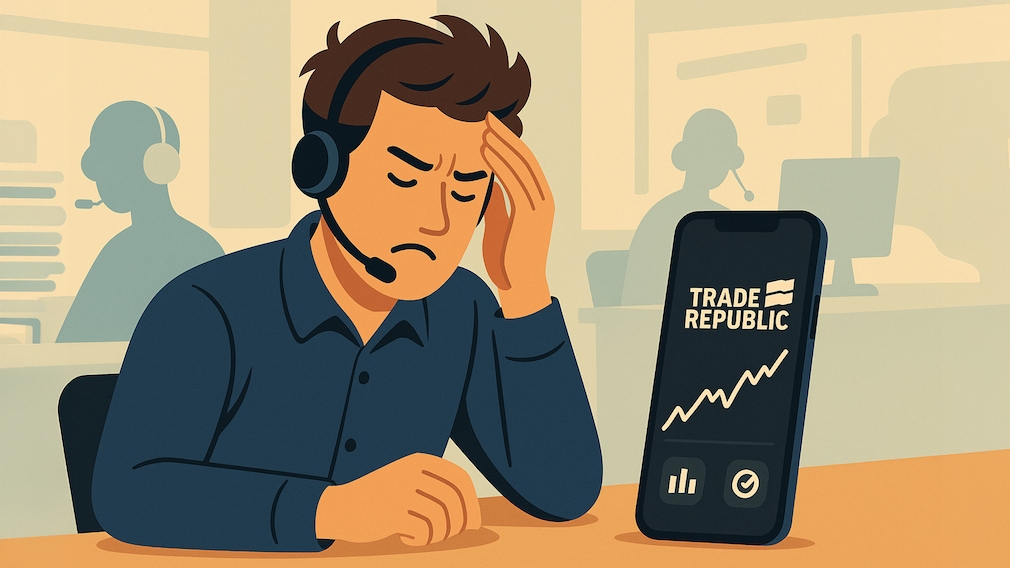
When Armin Miekautsch, a Trade Republic customer, tried to withdraw his own money starting in September 2025, he entered a Kafkaesque nightmare that lasted three months. After sending at least 20 messages to customer service, he received only “bullshit-answers from an AI-Agent.” Eventually, he had to involve his lawyer and file a complaint with the BaFin. His story isn’t an outlier, it’s becoming the new normal for Germany’s largest neobroker.
The Numbers Tell a Damning Story
The scale of Trade Republic’s customer service collapse is staggering. By the end of October 2025, the Verbraucherzentrale Bundesverband (VZBV) had received 350 formal complaints, a 120% increase compared to the previous year. But here’s what makes this truly alarming: no other German digital bank or neobroker generates as many complaints. The BaFin, Germany’s financial watchdog, is seeing a similar percentage increase in grievances.
Trade Republic claims these are “individual cases”, but when your customer base of over 10 million produces complaint numbers that dwarf every competitor, something systemic is rotten. As one financial expert dryly noted, individual cases don’t typically trigger regulatory attention from both consumer protection agencies and banking supervisors simultaneously.
The AI Chatbot Trap
The core of the problem lies in Trade Republic’s support architecture. Customers have two options: an in-app chat or email. Both lead to the same dead end, an AI chatbot that many describe as worse than useless.
Self-employed users report submitting complete tax returns, balance sheets, and bank statements, only to have the AI reject them repeatedly and ask for “proof of irregular income” that doesn’t exist. One business owner went through this loop four times before initiating a depot transfer to a competitor. Even a bank employee familiar with KYC requirements failed to satisfy the algorithm’s demands after three attempts.
The pattern is consistent: upload documents, receive AI rejection, wait weeks for a human response, get redirected back to the chatbot. When complex fraud cases arise, like telephone scams that lock victims out of their accounts, this system crumbles completely. People report being unable to access their money for months while the AI cheerfully asks them to upload yet another document.
When Your Money Becomes Hostage
The real-world consequences range from frustrating to financially devastating. A user who moved abroad had €50,000 stuck in their account for over six months. Trade Republic eventually closed the account on October 29th, 2025, but refused to pay approximately €80 in accrued interest, claiming no interest is paid on closed accounts, even though the funds remained with them for most of the month.
Another customer trying to withdraw crypto had their funds locked for 11 days while support repeatedly claimed the issue was “resolved” with no actual change. The withdrawal remained pending, preventing any buying or selling. “Support is unreachable, and I only receive automated replies”, they reported. “You should not buy crypto on this platform.”
These aren’t isolated technical glitches. They represent a fundamental breakdown in the basic promise of a financial institution: that you can access your own money.
Trade Republic’s Defense and Promised Turnaround
Facing mounting pressure, Trade Republic has acknowledged the problem. A spokesperson told WirtschaftsWoche that the company will focus on “personal contact” in the next phase of service expansion, with changes potentially launching in March 2026. They’ve invested a nine-figure sum into customer service improvements.
The company insists most inquiries are resolved within 24 hours and that for every complaining customer, “thousands” have their issues solved quickly in-app. They also dismiss many complaints as “long-resolved topics” that affected multiple institutions, not just Trade Republic.
Yet this defense rings hollow when the Verbraucherzentralen data shows Trade Republic stands alone in complaint volume. And promising phone support in March 2026 does little for the customer whose account is locked right now.
BaFin’s Watching, But Will They Act?
The regulatory landscape is where this gets interesting. The BaFin has confirmed they’re seeing increased complaints about neobrokers, particularly regarding order execution and service accessibility. Their official stance: if they find evidence of consumer protection violations affecting many customers, they “take the necessary measures.”
Industry insiders suggest the BaFin is running out of patience. The pattern echoes N26’s trajectory, where similar issues, technical failures, compliance weaknesses, high complaint volumes, eventually led to regulatory intervention and operational restrictions.
Markus van de Weyer, CEO of Alpha Beta Asset Management, sees a broader industry problem: “When a market leader like Trade Republic makes headlines for months with technical failures, tax accounting problems, and hard-to-reach customer service, it inevitably reflects on the entire category.”
The Real Cost of “Free”
Trade Republic’s business model, commission-free trades, sleek app, low fees, relies on minimal human overhead. But German financial law doesn’t care about your business model. It demands that anyone holding customer funds and executing securities transactions must have “structures, processes, and service capacities that can withstand it, appropriate to size and growth.”
The uncomfortable truth: providing competent human support at scale is expensive. Really expensive. The company’s summer 2024 decision to close its internal service team and rely on external providers looks increasingly like a classic growth-at-all-costs mistake.
Competitors like Scalable Capital offer similar conditions but maintain reachable phone support. The difference? They built service infrastructure before hitting 10 million customers, not after.
What Trade Republic Customers Should Do Now
If you’re already a customer experiencing issues:
- Document everything: Screenshot every chat interaction, save all emails. German courts and regulators take written evidence seriously.
- Escalate systematically: Start with the in-app chat, but immediately follow up via email. If you receive no response within two weeks, file a formal complaint with the BaFin and your local Verbraucherzentrale.
- Consider depot transfer: Under German law, you can transfer your securities to another broker. While the process can take 4-8 weeks, it might be faster than resolving complex issues with Trade Republic’s support.
- For fraud victims: File a police report immediately. German banks must follow specific protocols for fraud cases, and a police report triggers additional legal obligations.
If you’re considering opening an account:
- Start small: Test the support system with a minor issue before committing significant funds.
- Check your risk tolerance: If you need quick access to your money or might require complex support, traditional brokers with phone support may be worth the higher fees.
- Read the fine print: Trade Republic’s interest-bearing cash accounts are actually money market funds, not protected deposits, a distinction that matters in crisis scenarios.
The Bigger Picture for German Fintech
Trade Republic’s crisis represents a turning point for Germany’s neobroker industry. The “move fast and break things” Silicon Valley mantra collides head-on with Germany’s tradition of financial stability and consumer protection.
Carsten Böhme, a communications expert, captures the core issue: “Customers accept errors, but they don’t accept unreachability and lack of communication. If a platform hangs on crash days and support doesn’t respond, the feeling arises: In the decisive moment, I’m left alone. That’s more toxic for reputation than the technical error itself.”
The fundamental question is whether neobrokers can scale their tech-first philosophy while meeting German regulatory expectations for service quality and stability. Trade Republic’s experience suggests that acquiring customers faster than you can support them creates a ticking time bomb.
For now, the company has until March 2026 to deliver on its promise of human contact. But with the BaFin watching and complaint numbers rising, the clock is ticking louder every day. Trade Republic isn’t just fighting for its reputation, it’s fighting to prove that the German fintech model can work at scale without sacrificing the basic promise of customer protection.
Until then, users like Armin Miekautsch wait, lawyers on speed dial, wondering why accessing their own money requires a regulatory intervention.