
That used Skoda Octavia seems like a steal at CHF 20,000, until you realize it costs another CHF 8,400 every year just to keep it legal on Swiss roads. Many international residents discover this financial reality only after signing the purchase contract, when the first stack of bills arrives from the Steueramt (Tax Office), insurance provider, and garage.
The Touring Club Schweiz (Swiss Touring Club) recently dropped its annual calculation: driving a typical car in Switzerland now costs 74 Rappen per kilometer in 2026, down two Rappen from last year thanks to cheaper fuel. That sounds like good news, until you multiply it by the average 12,000 kilometers most drivers cover annually. Suddenly you’re looking at CHF 8,880 before parking, fines, or unexpected repairs. The online comparison service Comparis puts the total annual burden even higher at around CHF 10,000.
The Fixed Cost Trap: Why Your Car Loses Value While Sitting Still
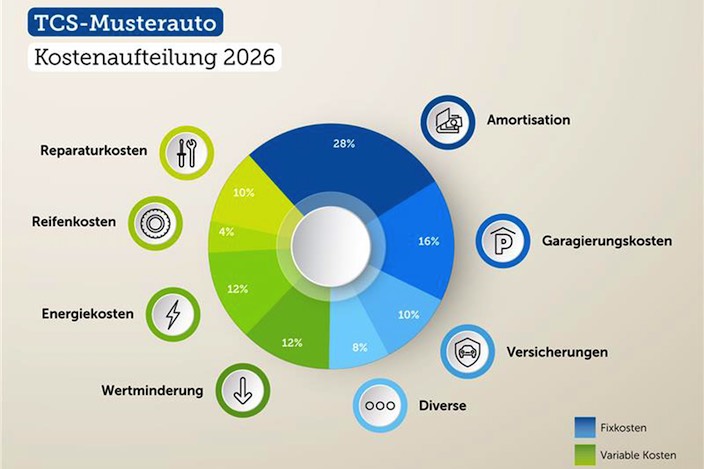
Fixed costs consume the lion’s share of your budget, CHF 6,977 per year according to TCS calculations, even if your car never leaves the garage. These expenses bleed your wallet predictably and painfully.
Depreciation hits hardest. A four-year-old Skoda Octavia purchased for CHF 20,000 might retain value better than most, but you’re still losing roughly CHF 1,400 annually. The TCS model car depreciates from CHF 45,000 to zero over its lifespan, averaging CHF 3,000+ per year. Many buyers focus on the purchase price while ignoring that their asset loses 15% of its value the moment they sign.
Insurance premiums have jumped 14% for comprehensive coverage in 2026. A typical Vollkasko (full comprehensive insurance) policy runs CHF 800-1,200 annually for a mid-size car, while Teilkasko (partial coverage) costs about half. The catch? Most Swiss drop Vollkasko after year five, but lenders require it for leased vehicles. One driver reported paying CHF 655 for liability coverage alone on a 2018 Peugeot Partner, a relatively modest vehicle.
Cantonal vehicle tax varies dramatically. Zurich residents pay roughly CHF 300 annually for a compact car, while Geneva or Vaud rates differ based on engine size and emissions. This tax arrives like clockwork every year, regardless of mileage.
Parking represents the silent budget killer. A garage spot in Zurich averages CHF 150-200 monthly (CHF 1,800-2,400 yearly), while surface parking permits in city centers can exceed CHF 1,200 annually. Even in smaller cities, expect CHF 80-120 monthly. One Vaud resident budgets CHF 1,440 yearly just for their apartment garage, more than their annual tax bill.
Variable Costs: The Death by a Thousand Cuts
Variable costs add another CHF 4,135 annually for typical drivers, and these fluctuate in ways that frustrate precise budgeting.
Fuel costs finally dropped, 7% cheaper in 2026 at CHF 1.71 per liter for unleaded 95. The TCS assumes 5 liters per 100km consumption, translating to CHF 1,026 yearly for 12,000km. But real-world driving, especially in hilly regions or winter conditions, often pushes consumption to 6.5-7 liters, adding CHF 300+.
Maintenance surprises even careful owners. The MFK (Motor Vehicle Inspection) occurs every 2-3 years for newer cars, but costs CHF 100-150 each time. More importantly, it often reveals mandatory repairs, brake pads, rust spots, emissions issues, that can trigger CHF 500-2,000 bills. One driver spent CHF 1,620 on annual service including front brakes for their Peugeot, while another budgeted CHF 800 yearly for routine items but faced unexpected battery replacement (CHF 130) and other age-related failures.
Tires demand two complete sets in Switzerland. The law doesn’t mandate winter tires, but driving without them in adverse conditions makes you liable for accidents. Most Swiss cars come 8-fach bereift (with two sets of tires). Budget CHF 50-100 twice yearly for professional swapping, plus CHF 800-1,200 for a new set every 5-6 years. The independent garage charging CHF 50 per swap beats dealer prices of CHF 150+.
The Vignette seems trivial at CHF 40 yearly, but it’s mandatory for highway driving. Forget to display it and you’re facing CHF 200 fines. This sticker represents Switzerland’s efficient approach to road funding, small, mandatory, and strictly enforced.
The Hidden Costs That Ambush Expats
Beyond the TCS calculations lie expenses that disproportionately affect international residents.
Cross-border maintenance tempts many. A Vaud resident noted that servicing in France could save 30-40% on labor costs. However, warranty coverage and MFK compliance complicate this strategy. Swiss garages understand local requirements, French mechanics might not.
Insurance penalties for foreign licenses persist for years. New residents often pay 20-30% higher premiums until they establish a Swiss driving record. One newcomer discovered their German license, considered equivalent, still triggered a “no Swiss history” surcharge of CHF 250 annually.
Parking fines in Swiss cities start at CHF 40 but escalate rapidly. Zurich’s blue zone system confuses many expats, and meter violations cost CHF 80+. The efficiency of Swiss parking enforcement means you rarely get away with infractions.
Battery replacement has become surprisingly complex. Modern cars require registration of new batteries with the car’s computer system. A CHF 130 DIY battery purchase becomes CHF 300+ at a dealer who must “code” it to your vehicle.
Real-World Budgets: What Residents Actually Spend
A Vaud resident with an 8-year-old compact car shared their actual costs:
- Taxes: CHF 300 (Kanton ZH rate)
- General maintenance: CHF 800 (tires, oil, filters)
- Irregular maintenance: CHF 500 (battery, unexpected repairs)
- Insurance: CHF 300 (minimum coverage)
- Total: CHF 1,900 before fuel or parking
Another driver with a company Peugeot Partner reported CHF 2,713 annually in fixed costs, plus CHF 1,440 parking and fuel. The 40% depreciation rate shocked them, CHF 345 yearly on a vehicle valued at only CHF 518 in company books.
The rule of thumb emerging from community experience: budget CHF 600-800 monthly for a reliable used car, including all fixed and variable costs but excluding parking. That CHF 20,000 Skoda actually costs CHF 28,000-32,000 over four years.
Buy, Lease, or Go Car-Free?
Buying used makes financial sense if you can pay cash and avoid interest. The sweet spot is a 4-5 year old car just after its first MFK, with under 80,000km and two tire sets. Popular models like the Skoda Octavia, dubbed the “unofficial car of Switzerland”, offer cheap parts and widespread service knowledge.
Leasing appeals to those wanting predictability, but Swiss leases hide costs. The money factor (interest) often works out to 3-5% APR, and mandatory Vollkasko insurance adds CHF 1,000+ yearly. Early termination penalties can reach thousands. The only advantage: predictable monthly payments and warranty coverage.
Going car-free becomes viable if you live near Zurich, Basel, or Geneva. The GA (General Abonnement / travel pass) costs CHF 3,860 yearly for unlimited public transport. When you factor in parking savings alone, many urban residents break even. The flexibility of Mobility car-sharing (CHF 0.56/minute including fuel) handles occasional needs without ownership burdens.
Cantonal Differences: Vaud vs Zurich vs Geneva
Vaud residents benefit from proximity to French service centers but face higher parking costs in Lausanne. Zurich’s efficient public transport makes car ownership least justifiable. Geneva’s cross-border commuter culture creates unique insurance and tax situations. Always check your Gemeinde’s (municipality) parking permit wait times, some Zurich neighborhoods have 2-year waiting lists.
Practical Steps to Control Costs
- Insurance optimization: Start with Teilkasko and increase deductibles. Use online comparators like Comparis to find CHF 200-300 savings.
- Maintenance timing: Schedule major services right before MFK to catch issues early. Independent garages often charge 30% less than dealers.
- Tire strategy: Buy from online retailers like Reifendirekt (CHF 600-800 for a set vs CHF 1,200+ at dealers). Find a local garage that swaps them for CHF 50.
- Parking: Negotiate garage costs when renting apartments. Some landlords include parking for CHF 80-100 monthly instead of CHF 150+.
- Fuel: Use apps like “benzinpreis” to find cheapest stations. Avoid highway stations charging 15-20% premiums.
The Bottom Line
Swiss car ownership demands CHF 8,000-12,000 yearly depending on your car, canton, and driving habits. The TCS figure of 74 Rappen per kilometer provides a baseline, but parking, unexpected repairs, and depreciation push real costs higher. Before buying, calculate whether you’d actually spend less with a GA plus occasional car rentals. For many expats, the math reveals that Swiss efficiency applies more to public transport than private car economics.
The freedom of the open road comes with a distinctly Swiss price tag, one that requires planning, budgeting, and accepting that your car is a liability, not an asset.