When your spouse dies, the last thing you need is a letter from the Grundbuch (Land Registry) telling you that your two minor children now co-own your house. Yet this exact scenario sends Swiss residents into panic spirals, convinced they’ll be forced to sell their family home to pay off their own kids. The reality? Swiss law is designed to keep you exactly where you are, though the paperwork will test your patience.
The Panic Attack: When Your Children Inherit Half Your House
A recent case illustrates the emotional rollercoaster perfectly. A man lost his wife and discovered their jointly owned house would be split according to Erbrecht (inheritance law). With two minor children, he calculated they would inherit 50% of her estate, which included half the house. The math seemed simple: his children would own 25% each, and he would somehow need to buy them out or face forced sale.
His panic intensified when considering his son’s medical needs and the disruption of changing schools. The idea that Switzerland, a country that prides itself on family stability, would force a grieving parent to liquidate the family home felt like a bureaucratic nightmare.
But here’s what the initial panic misses: Swiss inheritance law operates in two distinct phases that fundamentally protect the surviving spouse.
The Two-Step Inheritance Process That Saves You
Swiss law doesn’t throw you into a forced buyout scenario. Instead, it follows a logical progression:
Step 1: Marital Property Division
You automatically keep your 50% share of the house. This isn’t inheritance, it’s your existing property right. The Grundbuch (Land Registry) already shows you as co-owner, and that doesn’t change.
Step 2: Inheritance of the Deceased’s Share
Only your spouse’s 50% portion enters the inheritance pool. With a surviving spouse and children, Swiss law allocates this portion as follows:
– 50% to the surviving spouse (that’s you)
– 50% shared equally among the children
The Final Ownership Structure:
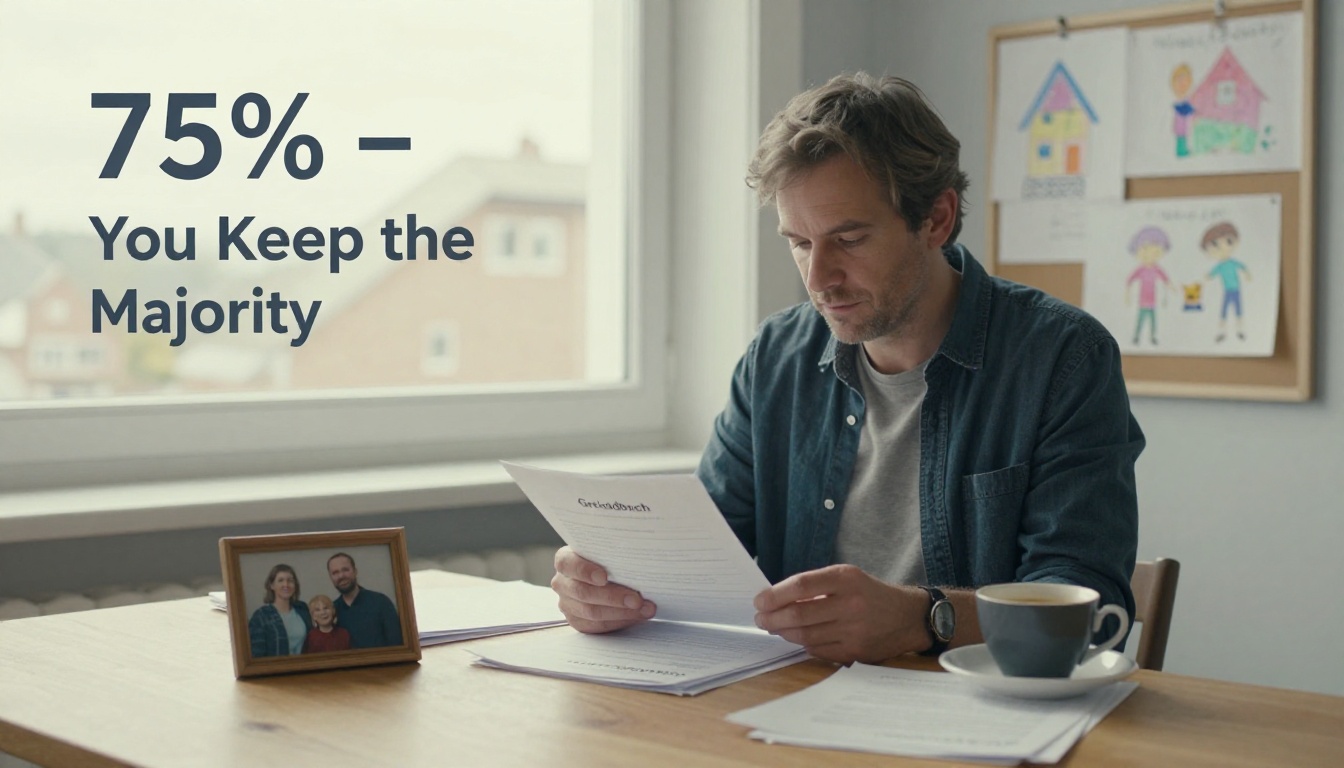
– You: 50% (original) + 25% (inherited) = 75% total ownership
– Each child: 12.5% ownership
This structure means you hold a controlling majority. Your children cannot outvote you on property decisions, and more importantly, they cannot force a sale while they’re minors.
Minor Children as Co-Owners: What It Actually Means
When children under 18 inherit property in Switzerland, they enter a legal limbo that actually works in your favor. They become Erbengemeinschaft (community of heirs) members, but with significant restrictions:
Guardianship and Asset Management
As the surviving parent, you automatically become the legal representative for your children’s property shares. You manage their 12.5% interests without needing court approval for day-to-day decisions. This includes continuing mortgage payments, maintenance, and living in the home.
KESB Oversight (Child and Adult Protection Authority)
The KESB (Kinder- und Erwachsenenschutzbehörde) doesn’t micromanage your every move. However, they serve as a backstop against abuse. You cannot:
– Sell the children’s shares to fund your vacation
– Remortgage the property to cash out their equity
– Make decisions that diminish their inheritance
If you want to sell the entire house later, you’ll need KESB approval to ensure the transaction serves the children’s financial interests. But for simply living in the home and maintaining it? No interference.
The Paper Ownership Reality
Your children’s ownership exists primarily on paper. They have no right to demand rent from you for living in “their” portion. They cannot force you to downsize. Their 12.5% shares are essentially frozen assets until they reach adulthood or you collectively decide to sell.
Mortgage Liability: The Bank Doesn’t Care About Inheritance Splits
Here’s where Swiss financial pragmatism kicks in. When you and your spouse took out the Hypothek (mortgage), the bank assessed your combined income and assets. After your spouse’s death, the bank’s primary concern remains simple: can you service the debt?
What Actually Happens:
– The mortgage contract remains unchanged
– You continue making the same monthly payments
– The bank cannot demand immediate repayment because ownership percentages shifted
– Your mortgage interest tax deductions continue unchanged
The bank views your 75% ownership as sufficient collateral. They’re not interested in forcing a sale that would convert a performing loan into a potential loss. Swiss banks, for all their reputation for precision, operate on the same principle as an SBB train, keep things running smoothly, avoid unnecessary disruptions.
However, you should inform your bank about the ownership change. While they won’t call the loan, they need updated Grundbuch information for their records. This is administrative, not adversarial.
The “Forced Sale” Myth: Why Courts Won’t Evict You
The fear that children, or their legal guardians, can force a sale stems from misunderstanding Swiss property law. While co-owners generally have the right to request partition, Swiss courts apply a family protection doctrine that prioritizes housing security for surviving spouses and minor children.
Legal Precedent and Practice:
Swiss judges consistently deny forced sale requests when:
– Minor children reside in the property
– The surviving parent lacks resources to buy out the shares
– Sale would cause undue hardship or disrupt education/medical care
– The property serves as the family home, not an investment asset
The KESB’s mandate includes protecting children’s welfare, which includes housing stability. Forcing a sale that makes a child homeless or disrupts their schooling would violate this principle. The authority acts as a shield, not a sword.
Tax Implications: The Silver Lining
Swiss inheritance tax is cantonal, but most follow a family-friendly pattern. In Zurich, and most cantons, spouses and direct descendants pay zero inheritance tax. This means:
- No tax bill on the 25% you inherit from your spouse
- No tax on the children’s 12.5% shares
- No wealth tax complications for the children’s minor ownership
You’ll need to declare the children’s property shares in your tax return while they’re minors, but this is informational only. The Steueramt (Tax Office) won’t send a bill.
Property Transfer Tax
When updating the Grundbuch to reflect the new ownership percentages, you’ll pay a small property transfer tax, typically 0.5-1.5% of the property value depending on your canton. On a CHF 1 million house, this might be CHF 5,000-15,000, a fraction of what you’d pay in most countries.
Future Planning: When the Children Turn 18
Your children’s 12.5% shares don’t remain frozen forever. When each child reaches adulthood, they gain full control of their portion. This creates potential future scenarios:
Scenario 1: Harmonious Agreement
Your children, now adults, understand that selling would force you to move. They agree to keep the status quo, perhaps signing a Nachlassvertrag (inheritance contract) that delays partition until you voluntarily downsize or pass away.
Scenario 2: Buyout Negotiation
If you want to sell and downsize after the children move out, you can negotiate a buyout of their shares at fair market value. Since you own 75%, you control the timing and terms.
Scenario 3: Forced Partition (Rare)
An adult child could theoretically request court partition, but Swiss courts still consider your housing needs. If you’re elderly and the house is your primary asset, courts often delay or deny forced sale.
Practical Tip: Discuss your long-term plans with your children as they approach adulthood. Transparency prevents misunderstandings. Many families create a written agreement that the family home remains undivided until the surviving parent’s death or voluntary relocation.
The Spanish Law Parallel: Why Court Approval Matters
While Swiss law doesn’t require court approval for minors to accept inheritance (unlike Spain’s requirement for gerichtliche Genehmigung), the principle of asset protection functions similarly. In Spain, Article 166 CC mandates court approval for simple inheritance acceptance by minors, with an inventory requirement if approval is denied.
Switzerland achieves the same protection through the KESB system. The authority ensures that parents don’t exploit their management role. If you proposed selling the house and investing the proceeds in a risky venture, the KESB would intervene. But maintaining the family home? That’s the expected and approved course.
Common Mistakes That Actually Cause Problems
While the law protects you, certain missteps can create real complications:
1. Failing to Update the Grundbuch
Delaying the official ownership update won’t change the legal reality, but it creates administrative headaches. Banks, insurance companies, and eventually the Steueramt need correct records. The process costs money but prevents bigger problems later.
2. Ignoring the Mortgage Bank
Not informing your bank about the ownership change violates most mortgage terms. While they won’t foreclose, they could theoretically call the loan if they discover the omission years later. A simple letter with the death certificate and inheritance documents suffices.
3. Confusing Management with Ownership
You can manage the children’s shares, but you cannot gift yourself their portions or sell the property without proper process. The KESB reviews significant transactions. Treat the children’s shares as sacred trust assets, not extensions of your own wealth.
4. Forgetting Pflichtteil (Forced Heirship) Rules
If you remarry and have more children, or if you write a will favoring one child, Swiss Pflichtteil rules guarantee each child receives at least 50% of their statutory inheritance. The 12.5% house shares count toward this. You cannot disinherit your children from these portions without their consent.
Immediate Action Steps: What to Do Now
Week 1: Documentation
– Obtain multiple certified copies of the death certificate
– Gather the property deed (Grundbuchauszug)
– Collect the mortgage contract and recent statements
Week 2: Legal Consultation
– Schedule with a Notar (notary) or inheritance lawyer
– Bring all documents plus your marriage certificate and children’s birth certificates
– Ask for a written summary of the ownership transfer process and costs
Week 3: Notifications
– Inform your mortgage bank (in writing, with death certificate)
– Contact your property insurance provider
– Notify the Steueramt that you’ll be declaring minor children’s property shares
Month 2: Grundbuch Update
– Complete the notarial process to register the new ownership structure
– Pay the property transfer tax
– Obtain updated mortgage statements reflecting the new ownership
Ongoing: Documentation
– Keep records of all property-related expenses
– File annual tax returns including the children’s ownership shares
– Maintain a file for each child documenting their 12.5% interest
The Bigger Financial Picture: Mortgages and Affordability
If you’re worried about affording the mortgage on a single income, you’re not alone. Swiss banks assess affordability based on your individual income now, but existing mortgages are grandfathered. However, if you need to refinance in the future, you’ll face how Swiss banks assess mortgage affordability and financial capacity with stricter criteria.
The bank will calculate your Tragbarkeit (affordability) using current interest rates (often 5% for stress testing) and require that housing costs not exceed 33% of gross income. If your spouse’s income was significant, you might struggle to refinance. This is a genuine risk, unlike the forced sale myth.
For understanding how banks hide real costs, see understanding hidden mortgage costs in Switzerland. The published SARON rates are rarely what you actually pay.
Renting vs. Keeping the Property: A Rational Calculation
Emotionally, keeping the family home feels necessary. Financially, you should run the numbers. Switzerland’s unique property market means that financial implications of property ownership vs. alternatives in Switzerland deserve serious analysis.
Calculate:
– Annual mortgage interest (currently deductible from income)
– Maintenance costs (1-2% of property value annually)
– Opportunity cost of tied-up equity
– Tax implications of eventual sale
Sometimes, selling and renting provides better financial flexibility, especially if the house is oversized for your new reality. The children’s 12.5% shares don’t prevent a sale, they just require that proceeds be split according to ownership percentages, with their portions held in trust until adulthood.
Co-Ownership with Strangers vs. Your Own Children
If the idea of co-ownership makes you nervous, consider the alternative: co-owning property with others under Swiss law is far riskier than sharing with your minor children. At least your children share your interest in maintaining the property and won’t force a sale during their minority.
The Swiss system, while initially shocking, creates a protected ownership structure that prioritizes family stability over creditor demands. Your children are co-owners in name only until they reach adulthood.
Investing the Children’s Shares: A Long-Term View
If you eventually sell, you’ll need to manage the children’s proceeds responsibly. Swiss law requires you to preserve and grow their assets prudently. This might mean:
– Opening blocked bank accounts in their names
– Investing in low-risk securities
– Purchasing replacement property with their shares as partial owners
For guidance on investment decisions, consider whether investing inheritance proceeds vs. buying rental property makes sense for your family’s situation.
Final Reality Check: You’re Protected, But Not Powerless
Swiss inheritance law isn’t designed to punish surviving spouses. The system that gives minor children automatic property shares also shields you from forced sales, tax burdens, and financial exploitation. Your 75% controlling interest, combined with guardianship rights and KESB protection, means you call the shots on housing decisions.
The emotional shock of discovering your children are co-owners is real. The legal and financial threat is largely imaginary. Focus your energy on the administrative process, not panic about losing your home. The law is on your side, unusual for a bureaucracy that operates with the same reliability as an SBB train, usually impeccable until construction slows the line.
Bottom line: Get a notary, update the Grundbuch, inform your bank, and keep living your life. The house is yours to keep, manage, and eventually sell on your terms. The children’s inheritance is secure, and your family’s stability is legally protected. The Swiss system might seem cold on paper, but it understands that children need their home more than they need cash.