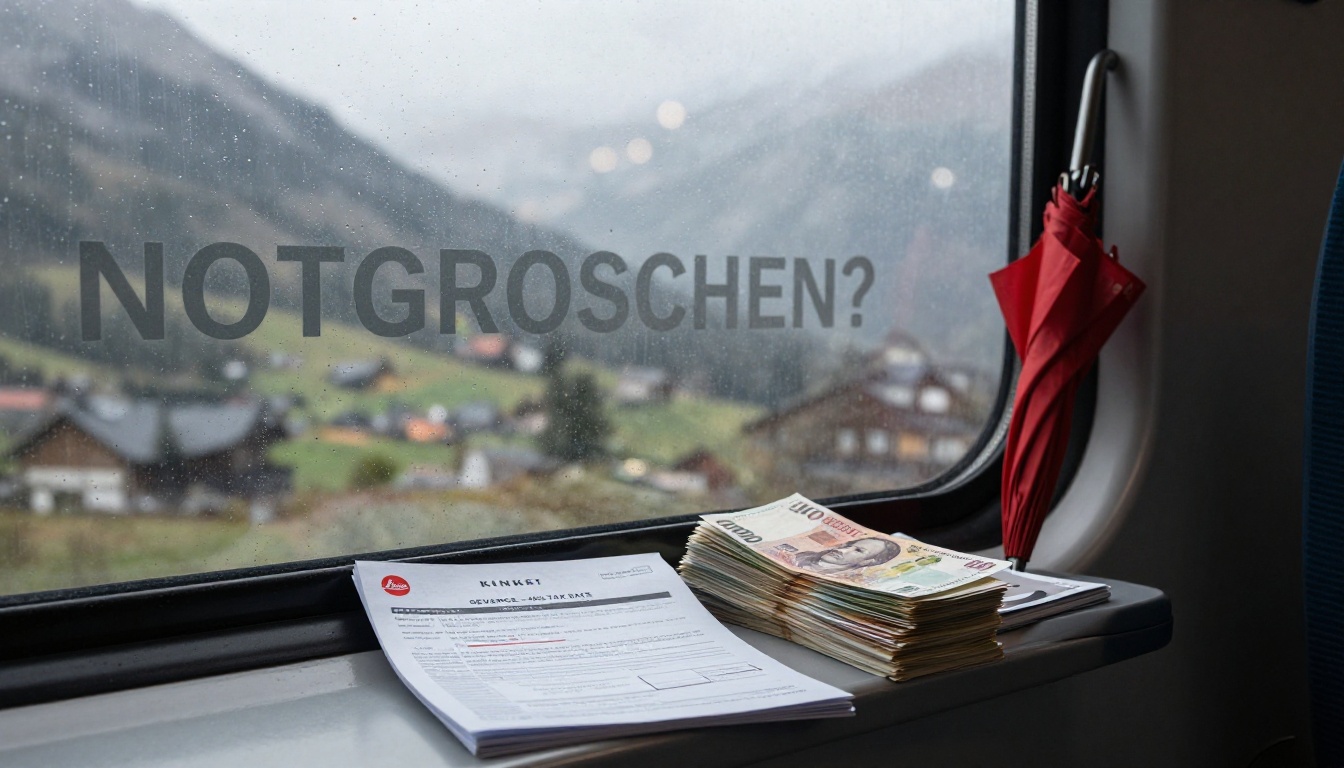
The Reddit thread started innocently enough: a doctor’s spouse, secure job, corporate worker wondering if 10,000 francs in cash was enough. The responses revealed something far more interesting than another lazy debate about emergency funds. They exposed a fundamental crack in how we think about financial safety in Switzerland.
That crack? The Swiss social safety net is simultaneously more robust and more treacherous than it appears. And your emergency fund might be the wrong tool to navigate it.
The RAV Mirage: When Unemployment Insurance Isn’t Enough
Switzerland’s unemployment insurance (RAV) pays 70-80% of your salary for up to two years. Sounds generous, right? This is precisely why many financially savvy residents keep minimal cash, sometimes as little as 10,000 CHF, and shovel everything into investments.
But the RAV system has teeth. One resident learned this the hard way when their employer stopped paying salaries for two months. Quitting would have meant RAV penalties. Staying meant racking up legal fees to recover lost wages. The RAV safety net doesn’t catch you when your employer is the problem, it penalizes you for leaving a toxic situation.
This reveals the first emergency fund blind spot: RAV protects against job loss, not job hostage situations. Your emergency fund needs to cover not just living expenses, but the legal costs and cash flow gaps that come with Swiss employment disputes. That 10,000 CHF cushion? It evaporates fast when you’re paying a lawyer 300 CHF per hour while your salary is frozen.
The Severance Tax Trap Nobody Warns You About
Here’s where Swiss emergency fund logic completely breaks down. A high-earning corporate worker shared their sobering experience: after losing their job, they discovered they needed substantial cash immediately, not for living expenses, but for tax optimization.
The timeline works like this: You get your last salary, pro-rated bonus, and 13th salary on your final day. But your severance package, potentially 6-12 months of pay, arrives months later, after legal clearance. Meanwhile, you have until the 30th of your termination month to make massive voluntary contributions to your Pensionskasse (pension fund) to offset the tax bomb coming your way.
The math is brutal: normal salary + severance + bonus = artificially inflated annual income = much higher tax rate. The only way to reduce this is pumping cash into your second pillar before you lose access. But you can’t do that if all your money is locked in ETFs.
This resident’s severance was nine months’ salary. Combined with unemployment benefits and half a bonus, their annual income nearly doubled. The tax hit was staggering. They needed tens of thousands in cash immediately, not for emergencies, but for strategic tax defense.
This is the Swiss emergency fund paradox: the safer your job seems, the more cash you might need. High earners with generous severance packages face a liquidity crunch that RAV does nothing to solve. Your emergency fund isn’t just for job loss, it’s for the 30-day window where you can still manipulate your tax situation.
The Opportunity Cost Problem: When Cash Is a Guaranteed Loser
The Swiss National Bank (SNB) has created an environment where holding cash is actively punished. With the policy rate at 0% and the threat of negative rates constantly looming, your emergency fund in a standard savings account earns virtually nothing.
Worse, the Swiss Franc’s relentless strength means your purchasing power increases against the Euro and Dollar, making Swiss assets, including cash, more expensive. The NZZ recently highlighted this “investment drought” (Anlagenotstand) where savers and pension funds struggle to find yield. Every franc sitting in your emergency fund is a franc not earning returns in a market where generating income is already brutally difficult.
Consider the numbers: If you hold 30,000 CHF in cash earning 0.1% interest, you’re losing purchasing power to inflation (currently around 1.5%). That’s a guaranteed loss of over 400 CHF annually. Over five years, you’ve effectively burned 2,000 CHF for the privilege of feeling “safe.”
This is where conventional emergency fund wisdom collides with Swiss reality. The 3-6 month rule made sense in countries where you could earn 4-5% on savings. In Switzerland’s engineered low-rate environment, that rule is financial self-sabotage.
Real Swiss Emergencies: What Actually Drains Your Account
Reddit discussions reveal the specific shocks Swiss residents face, scenarios that RAV and insurance don’t cover:
Dental disasters: One resident keeps 5,000 CHF specifically for emergency dental work. Swiss health insurance (Krankenkasse) covers medical emergencies but leaves massive gaps for dental. A single implant can cost 4,000 CHF. Your emergency fund needs to cover what your insurance considers “optional.”
Car catastrophes: With both summer and winter tires needing replacement every few years, residents face 1,500-2,000 CHF hits that aren’t true emergencies but can’t be postponed. Public transport alternatives exist, but many Swiss workers, especially in rural areas, are car-dependent.
Family crises abroad: A resident’s parents faced a medical emergency in their home country, requiring immediate cash for surgery. The parents were self-employed, so lost income compounded the problem. RAV doesn’t help when the emergency is 5,000 kilometers away.
Legal insurance gaps: After experiencing unpaid wages, one resident now pays for legal insurance annually. But insurance doesn’t cover everything, deductibles and uncovered disputes still require cash.
These scenarios share a pattern: they’re irregular, high-cost, and fall through the cracks of Switzerland’s comprehensive but rigid social systems.
The Swiss Emergency Fund Formula: Beyond Simple Multipliers
So how much is enough? The answer isn’t a simple multiple of monthly expenses. It’s a layered calculation:
Layer 1: The RAV Bridge
Calculate your actual RAV payment (70% of salary up to 12,350 CHF/month max). Subtract this from your monthly expenses. Multiply the gap by 3 months, the average time to first RAV payment. For a high earner spending 8,000 CHF/month with a 6,000 CHF RAV payment, that’s 6,000 CHF needed.
Layer 2: The Swiss-Specific Shocks
Add specific buffers for:
– Dental: 3,000-5,000 CHF
– Car replacement/down payment: 5,000-10,000 CHF
– Family emergency travel/cash: 3,000-5,000 CHF
– Legal retainer: 2,000-3,000 CHF
– Tax payment buffer: 2,000-5,000 CHF (especially for Quellensteuer taxpayers who might owe extra)
Layer 3: The Severance Optimization Fund
If you’re in a corporate role with potential severance, add 15,000-30,000 CHF for voluntary pension contributions. This is your “use it or lose it” tax shield money.
For a typical Zurich professional, this totals 25,000-40,000 CHF, far more than the 10,000 CHF some minimalists hold, but less than the 50,000+ CHF that traditional advice might suggest.
Where to Park It: Swiss Cash Optimization
Once you calculate your number, the next question is where to store it. Swiss banks offer pitiful savings rates, but you have options:
Kassenobligationen (bank-issued bonds): Offer 1-2% interest with terms from 1-5 years. Not liquid enough for immediate emergencies, but suitable for Layer 3 (severance fund) that has a specific 30-day deployment window.
Säule 3a (third pillar): Some providers offer cash accounts within the 3a wrapper. The money is locked until retirement, but you get tax deductions. This is actually perfect for Layer 3, severance optimization money that goes into pension anyway. You’re just pre-funding it.
Multi-currency accounts: With the Swiss Franc chronically strong, holding 20-30% of your emergency fund in EUR or USD can provide diversification. If the Franc weakens, you benefit. If it strengthens further, your foreign cash buys more.
Krankenkasse reserves: Some health insurers offer optional dental coverage riders. Instead of holding 5,000 CHF for dental emergencies, you might pay 300 CHF/year for better coverage. This is a form of “emergency fund insurance.”
The Internal Link Web: How Emergency Funds Connect to Everything
Your emergency fund isn’t an isolated decision, it cascades through your entire Swiss financial plan. Consider how it interacts with other pillars:
When you contribute to your second pillar to offset severance taxes, you’re affecting your long-term retirement allocation. The 2nd pillar buy-in trap becomes relevant, over-contributing early can reduce future flexibility.
Your emergency fund size also determines your Swiss financial order of operations. Do you fund Säule 3a first, or keep cash liquid? The answer depends on your job security and severance potential.
For young professionals, the budgeting realities often make large emergency funds impossible. A 26-year-old in Aargau allocating CHF 1,500 to household expenses and CHF 300 to health insurance simply can’t stash 30,000 CHF without sacrificing investment growth.
And ultimately, your emergency fund decision shapes your path to financial independence. Every franc in cash is a franc not compounding in the market. Swiss residents already face structural headwinds, high costs, mandatory contributions, stagnant wages. An oversized emergency fund can be the difference between retiring at 55 versus 65.
The Verdict: A Tiered Swiss Emergency Fund
The data points to a clear conclusion: Switzerland’s safety nets don’t eliminate the need for emergency funds, they change the type of emergency fund you need.
Tier 1 (Immediate liquidity): 5,000-10,000 CHF in a checking account for true emergencies: dental, car breakdown, legal retainer. This is your “sleep at night” money.
Tier 2 (Strategic reserve): 15,000-30,000 CHF in a mix of 3-month Kassenobligationen and Säule 3a cash accounts. This is your severance optimization and extended unemployment buffer.
Tier 3 (Opportunity fund): Keep the remainder invested. Switzerland’s stability means you can afford to be aggressive with funds beyond these thresholds.
For the doctor’s spouse from the original Reddit thread, this means their 10,000 CHF is adequate for Tier 1 but leaves them exposed to the severance tax trap. For the corporate worker who lost their job, even 30,000 CHF felt tight when faced with immediate pension decisions.
The spicy truth? Your emergency fund size should correlate with your income and severance potential, not just your expenses. The higher you climb in Swiss corporate hierarchies, the more cash you paradoxically need, because your tax optimization windows shrink and your shocks become more expensive.
In Switzerland’s safe economy, the real risk isn’t job loss. It’s liquidity constraints at the precise moment you need flexibility. Your emergency fund isn’t just protection, it’s optionality. And in a system as rigid as Switzerland’s, optionality is the ultimate currency.