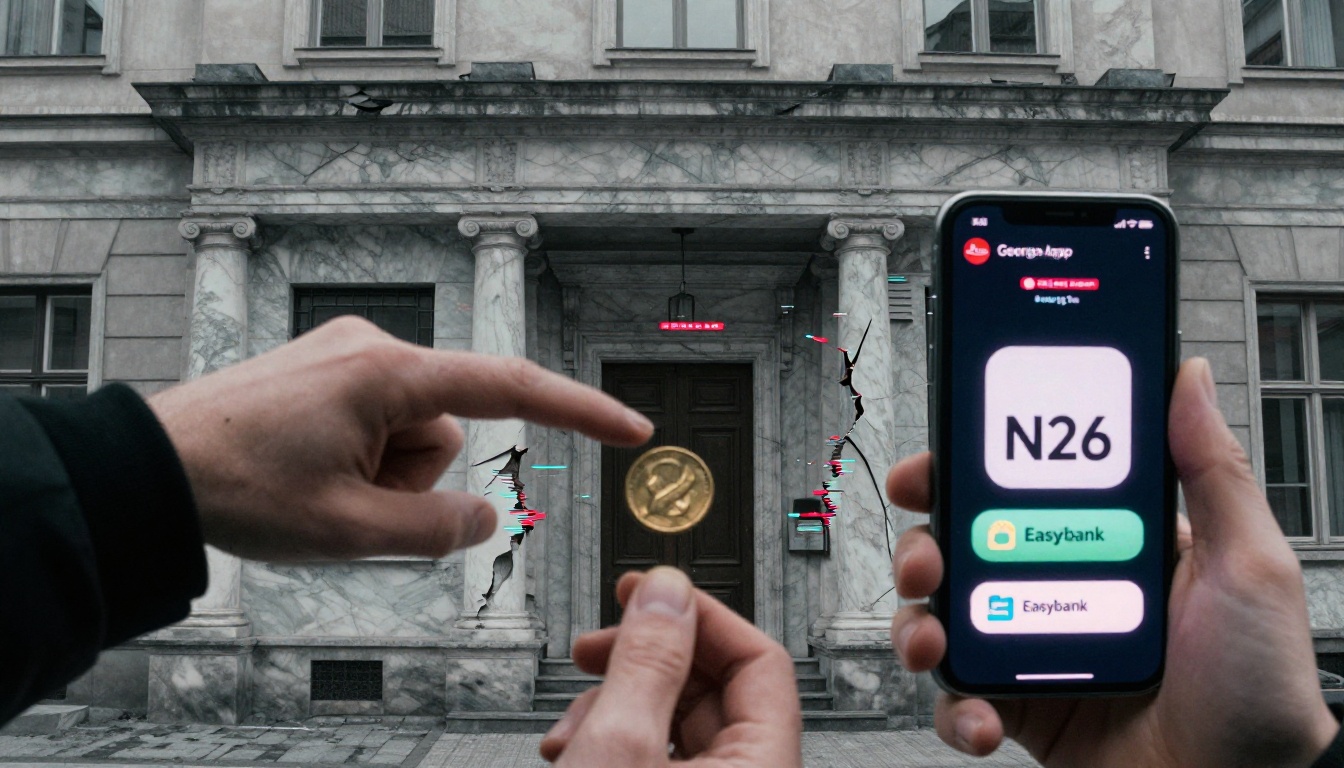
A 20-year customer walks into a Bank Austria branch to buy gold coins and asks a simple question about his €15,000 savings account interest calculation. The advisor gives him curt answers, then shuts down the conversation with: “I can’t help you further, if you think it’s incorrect, contact the Ombudsstelle (ombudsman’s office).” This isn’t a sketch about Austrian banking, it’s a real story from Vienna that perfectly captures why the sacred concept of the Hausbank (house bank) is crumbling.
The loyalty that Austrian banks have taken for granted for generations is evaporating. Not because of one bad interaction, but because the entire foundation of traditional banking, trust, personal service, and reliability, has been replaced by buggy apps, clueless staff, and fees that fund services customers no longer want.
The Hausbank Myth: Why Your Loyalty Means Nothing for Loans
For decades, Austrians believed that staying with one bank for decades guaranteed better treatment, especially for major financial milestones like a Wohnbaukredit (home construction loan). The logic seemed sound: the bank knows your financial history, sees your steady income, and rewards your loyalty with favorable terms.
Reality check: This is now complete nonsense.
Multiple international residents report that when applying for mortgages, their long-term bank offered worse rates than completely new institutions. One customer with 15 years at Bank Austria and consistent income couldn’t even get a credit card limit increase, let alone preferential loan terms. After being denied, they simply switched to N26 and Easybank.
The pattern repeats across Austria. Friends currently shopping for Wohnbaukrediten (home construction loans) consistently find that their Hausbank rarely offers the best deal. The smart strategy? Get multiple quotes and treat your bank like any other service provider. That 20-year relationship might actually work against you, banks know switching costs are high, so they can afford to be less competitive.
Digital Disaster: When Your Bank’s App Becomes the Enemy
Bank Austria’s mobile app has become a running joke among users. Multiple customers describe it as “eine absolute Katastrophe” (an absolute catastrophe). But it’s not just about clunky interfaces, the digital failures run deeper.
Consider the payment processing fiasco documented with UniCredit Bank Austria cards failing to complete 3D Secure transactions for legitimate purchases, even after successful authentication. The bank’s systems show no error, the customer’s account shows no block, yet the payment fails repeatedly. This isn’t a minor inconvenience, it’s a fundamental failure of core banking infrastructure.
Compare this to the George app from Erste Bank, which users praise as “legit eine der besten Banking Apps” (legitimately one of the best banking apps). The contrast is stark: traditional banks either can’t or won’t invest in proper digital infrastructure, while newer players understand that reliable digital service is non-negotiable.

The irony? Even neobanks sometimes struggle to match George’s quality. As one user points out, N26’s app is “alles andere als vertrauenswürdig” (anything but trustworthy) after serious compliance failures. This makes Erste Bank’s digital success even more telling, it’s possible for traditional banks to get it right, but most simply don’t.
The Great Austrian Bank Exodus: Where Everyone’s Going
The Krone article reveals a critical Austrian banking behavior: despite intense competition, Austrians rarely switch their main bank. Instead, they open additional accounts where better interest rates are offered. This half-measure approach is finally breaking down as people realize they’re paying €10 monthly fees for services they can get free elsewhere.
The exodus follows clear patterns:
- To direct banks: Easybank and Bank Direkt attract customers fed up with branch fees. Why pay for a Filiale (branch) you’ll never visit when you can bank from your phone?
- To neobanks: N26 captures younger users with its sleek interface and transparent pricing. The young Austrians shifting from traditional banks to digital-first neobrokers due to cost and usability trend shows no signs of slowing.
- To specialized providers: Some customers maintain a skeleton account at their old bank for cash deposits while moving all daily banking to modern alternatives.
The motivation is simple: “Ich will nicht mehr einen 10er pro Monat zahlen” (I don’t want to pay another tenner per month anymore). When your Sparkasse (savings bank) doesn’t offer a free online option, the decision becomes easy.
The Hidden Costs of Staying Loyal
Traditional banks rely on customer inertia. They count on you finding the Antragsformular (application form) too tedious, the Kontowechsel (account switch) too risky, the unknown too uncomfortable.
But what’s the real cost of this loyalty?
- Monthly fees: €120+ annually for basic accounts that neobanks offer free
- Lost interest: Keeping savings in low-interest Hausbank accounts while better rates exist elsewhere
- Time waste: Visiting branches for tasks that should take seconds in an app
- Missed opportunities: Better loan terms, credit cards, and investment products from competitors
- Stress: Dealing with incompetent staff and broken digital services
One customer described their breaking point: during COVID lockdowns, they were stuck in Asia and asked Erste Bank to increase their credit limit as a precaution. Despite 10 years of income history and €50,000 in their portfolio, the bank refused. The customer immediately closed all accounts. The bank’s loss of a few euros in potential fees cost them a five-figure deposit relationship.
The Loan Loyalty Trap: Why Your History Doesn’t Matter
The original Reddit post’s core question reflects a widespread fear: “Will cancelling my 20-year-old Bank Austria account hurt my chances for a future Wohnbaukredit?”
The unanimous answer from those who’ve gone through it: Absolutely not.
Banks evaluate loans based on current financial metrics, income, existing debt, Schufa (credit score) equivalent, and property value. Your loyalty history might earn you a slightly faster appointment, but it won’t change the interest rate or approval decision.
In fact, the opposite might be true. Banks sometimes offer better deals to new customers to win their business, while taking existing customers for granted. The high long-term costs and lack of transparency in traditional bank loans for home renovation reveal how legacy banks structure products to maximize their profit, not your savings.
When you apply for a mortgage, get quotes from at least three institutions: your current bank, a direct competitor, and a direct bank. The results will surprise you, and likely save you tens of thousands over the loan term.
Switching Made Simple: The Legal Protections You Didn’t Know About
Many Austrians don’t realize that German and Austrian law provides strong protections for bank switching. The Kontowechselhilfe (account switching assistance) requires your new bank to:
- Automatically transfer all Daueraufträge (standing orders) and Lastschriftmandate (direct debits)
- Provide a list of all incoming payments from the last 13 months
- Coordinate the timing of old account closure and balance transfer
The process must be completed within five business days after you authorize it. You can even run both accounts parallel for a month to ensure no payments are missed.
This legal framework removes the main excuse for staying with a bad bank. The challenges with Austrian direct banks’ digital services and hidden traps for salary accounts are real, but they’re minor compared to the ongoing pain of a dysfunctional traditional bank.
The Future: Banks as Utilities, Not Partners
The fundamental shift is philosophical. Austrians are moving from viewing banks as lifelong financial partners to treating them as interchangeable utility providers. You don’t have loyalty to your electricity company, you choose based on price and reliability. Banking is finally entering the same reality.
This shift is accelerated by the increasing friction between traditional banking compliance and fintech user behavior. When your traditional bank reports your Revolut top-ups to authorities while your neobank processes them seamlessly, the choice becomes obvious.
The Hausbank concept made sense when banking was personal, when your father knew the Filialleiter (branch manager), when loans were decided by character assessment. Today, it’s an algorithm, and algorithms don’t care about loyalty.
Practical Steps to Break Free
Ready to quit your Hausbank? Here’s how:
-
Open your new account first: Choose a provider based on your needs, George for best app, N26 for simplicity, Easybank for free basic services.
-
Use the Kontowechselhilfe: Authorize your new bank to handle the transfer. It’s legally required and usually free.
-
Keep both accounts for one month: Manually check that all Daueraufträge and Lastschriften have transferred correctly.
-
Move your emergency fund last: Keep a small buffer in the old account until you’re 100% certain everything works.
-
Don’t close your oldest credit card immediately: This can temporarily affect your credit score. Keep it active with a small monthly payment.
-
Document everything: Save PDFs of your last statements and confirmation of account closure.
The hardest part isn’t logistical, it’s psychological. You’re breaking a decades-long habit and defying the Austrian instinct to avoid change. But as one former Bank Austria customer put it: “Ich habe eigentlich keine Lust größere Finanztransaktionen in so einer Atmosphäre zu tätigen” (I really have no desire to conduct larger financial transactions in such an atmosphere).
That sentiment says it all. When your bank makes you dread basic financial tasks, it’s time to go. The alternatives aren’t just better, they’re waiting with open arms and working apps.