When a ZIB crypto analyst recently declared that Bitcoin’s price follows a “4-year cycle”, Austrian financial forums lit up with skepticism. The claim, that after three years of gains, a fourth year of decline was simply “due”, sounds too simple to be true. And in Austria’s evolving regulatory environment, where the Finanzamt (Tax Office) now has unprecedented access to your crypto transactions through the Krypto-MPfG (Crypto Reporting Law), treating such cyclical theories as investment gospel could prove expensive.
The analyst’s statement, broadcast during a February 2026 ZIB report on Bitcoin’s sharp decline, tapped into a deeply held belief among crypto enthusiasts: that Bitcoin’s programmed halving events create predictable boom-and-bust patterns. But is this pattern reliable enough to base your investment strategy on? Or is it the financial equivalent of reading tea leaves, comforting in its simplicity but dangerous in its application?
The Halving Mechanism: Why the 4-Year Theory Exists
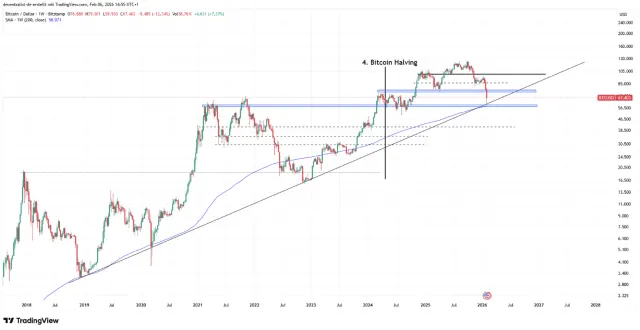
The foundation of the 4-year cycle narrative rests on Bitcoin’s halving events, which occur approximately every four years when the reward for mining new blocks is cut in half. The most recent halving in April 2024 reduced the block reward from 6.25 to 3.125 Bitcoin. Historically, these events have coincided with dramatic price movements:
- 2012-2013: After the first halving, Bitcoin rose from under $13 to over $1,200
- 2016-2017: Following the second halving, the price exploded from around $650 to nearly $20,000
- 2020-2021: Post-third halving, Bitcoin climbed from about $8,000 to almost $69,000
These patterns seem to validate the cycle theory. Many Austrian crypto investors have ridden these waves, with some reporting gains of 100% or more even after the recent downturn. The logic appears straightforward: reduced supply plus steady demand equals higher prices. But this simplicity masks growing complexity.
The Self-Fulfilling Prophecy Problem
What makes the cycle theory particularly sticky is its psychological dimension. As one experienced Austrian crypto investor noted, “It’s my third cycle, and it has paid off again to believe in it.” This sentiment reflects a powerful market dynamic: if enough traders believe in the cycle and act accordingly, buying before the halving and selling after the peak, the pattern becomes a self-fulfilling prophecy.
However, this creates a dangerous feedback loop. The more people who trade based on the cycle, the more volatile the market becomes when reality deviates even slightly from expectations. And deviations are becoming more common. The 2024-2025 cycle has already shown significant differences: the peak occurred later than predicted, the correction has been shallower (around 47% compared to previous drops of 75-84%), and institutional players like BlackRock’s ETF have fundamentally changed market dynamics.
For Austrian investors, this psychological game carries additional risks. The investor psychology around Bitcoin price movements in Austria is shaped by a traditionally conservative investment culture. When crypto narratives clash with Austrian financial pragmatism, the resulting uncertainty can lead to costly emotional decisions, especially when the Finanzamt (Tax Office) is watching every transaction.
Why the Math No Longer Adds Up
Critics of the cycle theory point to a crucial flaw: diminishing returns. Each successive cycle has produced smaller percentage gains:
- First cycle: ~5,200% increase from trough to peak
- Second cycle: ~315% increase
- Third cycle: ~230% increase
This pattern suggests that as Bitcoin’s market capitalization grows, each halving has less impact. The law of large numbers applies: moving a $1 trillion asset requires exponentially more capital than moving a $1 billion asset.
Moreover, the macroeconomic environment has shifted dramatically. Previous cycles benefited from unique conditions: post-financial crisis quantitative easing, ultra-low interest rates, and pandemic stimulus. Today’s Austrian crypto investors face a different reality:
- Aggressive interest rate hikes have reduced risk appetite
- The Krypto-MPfG (Crypto Reporting Law) has eliminated the anonymity that once attracted many investors
- Institutional adoption has increased correlation with traditional markets, reducing Bitcoin’s “uncorrelated asset” appeal
The Austrian Regulatory Wildcard
Perhaps the most compelling reason for Austrian investors to be skeptical of cyclical theories is the regulatory revolution happening at home. Since January 1, 2026, the Austrian tax authorities’ access to crypto transaction data has been complete. Every trade, every profit, every loss is now transparent to the Finanzamt (Tax Office).
This changes the calculation entirely. Previously, Austrian crypto investors might have ridden the cycle waves with relative freedom, reporting profits as they saw fit. Today, the Finanzamt (Tax Office) receives automatic reports from exchanges. A profitable cycle trade now means guaranteed taxation. A losing trade following the cycle theory means real, documented losses.
The tax reporting obligations for Bitcoin investors in Austria have become so comprehensive that short-term cyclical trading strategies face a significant tax drag. Each profitable trade triggers a 27.5% Kest (capital gains tax), making frequent trading far less attractive than the “buy and hold” strategies that dominated previous cycles.
What the Data Actually Shows
Recent analysis from MARES Media, examining Bitcoin’s historical patterns, reveals that while cycles exist, they’re far from clockwork. The timing varies: peaks have occurred anywhere from 12 to 18 months post-halving. The magnitude fluctuates: corrections range from 47% to 85%. The duration shifts: some bear markets last months, others drag on for over a year.
The current cycle illustrates this unpredictability. Bitcoin reached a new all-time high of approximately $126,000 in October 2025, later than many cycle theorists predicted, and the subsequent correction, while sharp, has been less severe than historical patterns suggest. This could indicate growing market maturity or simply that the old patterns are breaking down.
For Austrian investors, this means that betting on a “sure thing” based on cycle timing is increasingly risky. The Austrian financial regulator, FMA (Financial Market Authority), has repeatedly warned that crypto assets are highly speculative and unsuitable for most retail investors. Following simplistic cycle theories without understanding the underlying market evolution could be viewed as exactly the kind of uninformed speculation regulators are concerned about.
Practical Implications for Austrian Crypto Investors
So how should Austrian residents approach Bitcoin investment in light of these uncertainties?
1. Think Long-Term, Not Cyclical
Rather than trying to time the 4-year cycle, consider Bitcoin as a long-term portfolio allocation. The Austrian approach to wealth building has always favored patience over speculation. With the Krypto-MPfG (Crypto Reporting Law) making every trade taxable, the tax advantages of long-term holding have increased significantly.
2. Size Your Position Appropriately
Given the volatility and regulatory scrutiny, Bitcoin should represent only a small portion of your overall portfolio. Austrian financial advisors typically recommend no more than 5-10% in high-risk assets. This way, even an 80% drawdown won’t derail your financial plans.
3. Understand the Tax Implications
Before making any crypto trade, calculate the Kest (capital gains tax) impact. A profitable cycle trade that looked good on paper could leave you with a substantial tax bill, even if the price subsequently crashes. The Finanzamt (Tax Office) doesn’t care about your unrealized losses, they tax your realized gains.
4. Diversify Within Crypto
The cycle theory is Bitcoin-specific, but the Austrian crypto market now offers regulated exposure through various instruments. Consider diversifying across different crypto assets rather than concentrating on timing Bitcoin’s cycle.
5. Document Everything
With the Finanzamt (Tax Office) receiving automatic reports, ensure your own records are impeccable. Every transaction needs to be documented with dates, amounts, and EUR equivalents. Austrian tax law requires precise reporting, “I was following the cycle” won’t excuse inaccuracies.
The Verdict: Insight or Pseudoscience?
The Bitcoin 4-year cycle is neither pure insight nor complete pseudoscience, it’s a historical pattern that has worked until it might not. The underlying halving mechanism is real and does affect supply dynamics. The psychological pattern is powerful and self-reinforcing. But the market is evolving, and Austrian regulatory changes have altered the risk-reward calculation fundamentally.
For Austrian investors, the key takeaway is that while historical patterns provide context, they don’t guarantee future results. The combination of diminishing returns, institutional market changes, and comprehensive tax reporting through the Krypto-MPfG (Crypto Reporting Law) means that strategies that worked in previous cycles may no longer be optimal.
The ZIB analyst’s simplified statement, that a fourth year of decline was “due”, represents exactly the kind of dangerous oversimplification that can lead retail investors astray. Austrian financial culture has always valued thorough analysis over catchy narratives. In the case of Bitcoin’s supposed 4-year cycle, that skeptical, detail-oriented approach isn’t just traditional, it’s essential.
The cycle might continue, or it might not. But one cycle is certain: the Austrian regulatory cycle has turned, and investors who ignore the new reality of complete Finanzamt (Tax Office) transparency do so at their peril. In today’s Austria, successful crypto investing requires not just market timing, but impeccable documentation, tax awareness, and a healthy dose of the skepticism that Austrian investors are known for.