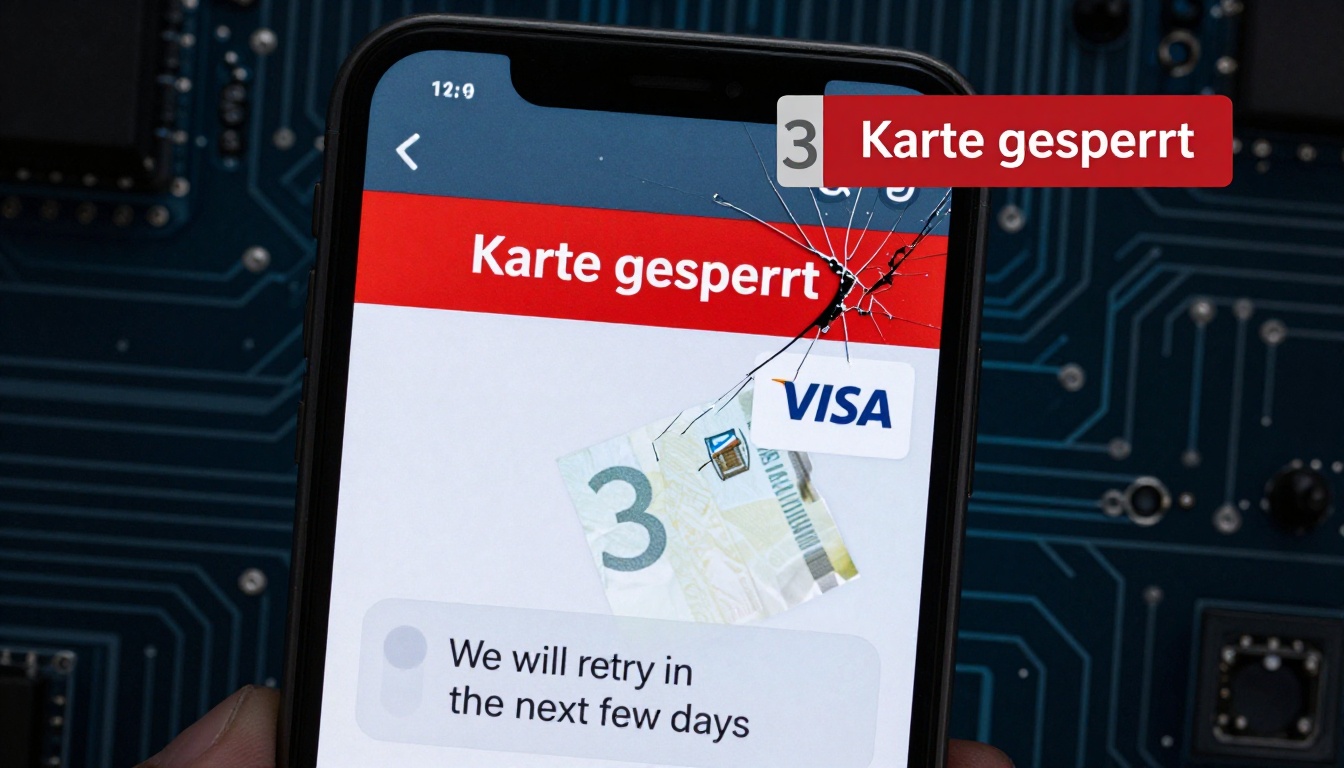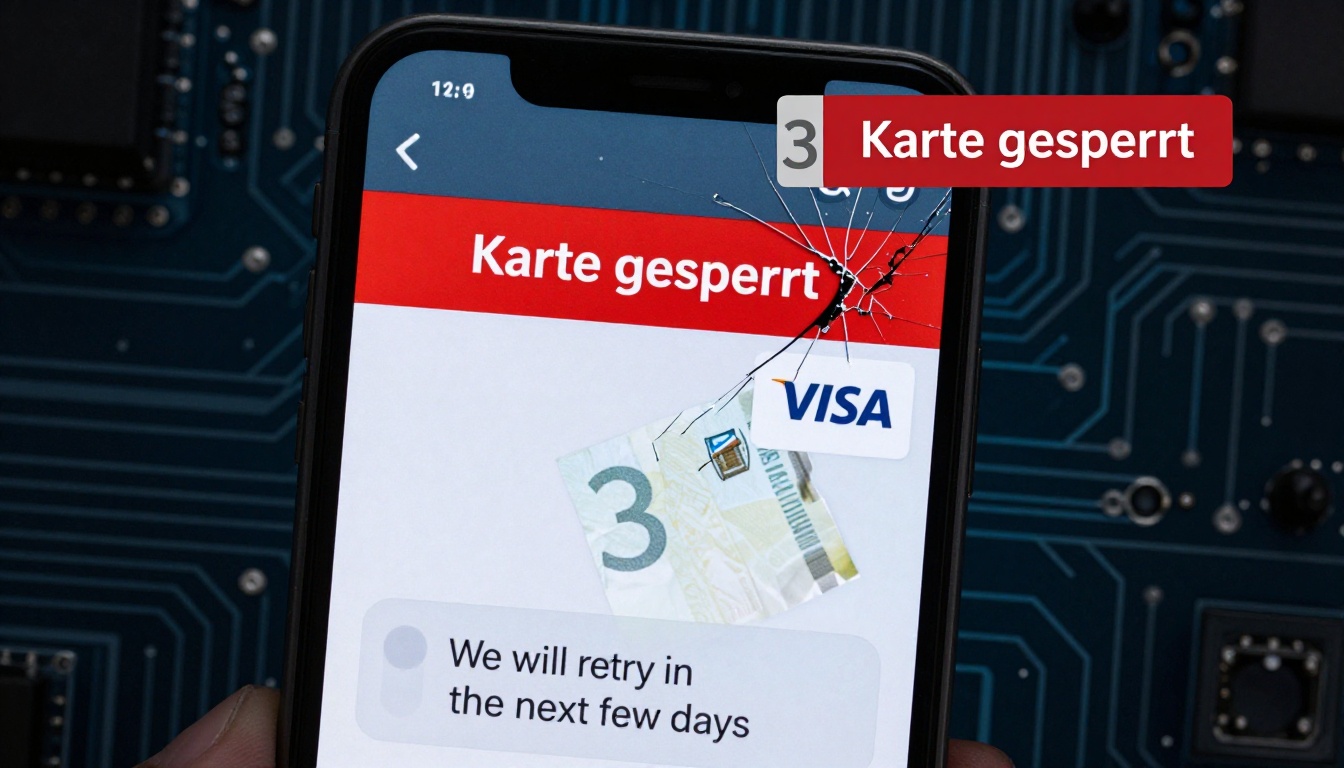
A single failed direct debit shouldn’t ruin your week. But with the Amazon Visa issued by Zinia, it can lock your card within three hours, despite receiving an SMS that explicitly promises a retry in the coming days. This isn’t a glitch, it’s a trap that turns minor cash flow timing issues into full-blown payment chaos.
The Lastschrift (Direct Debit) Lie
You wake up to an SMS: “Your direct debit failed. We will attempt to collect the amount again in the next few days.” Standard stuff. Most Austrian banks and credit issuers actually do this, retry the Lastschrift (direct debit) after 2-3 business days, giving you time to top up your Girokonto (checking account).
But here’s what actually happens with Amazon Visa: no retry occurs. The message is misleading at best, fraudulent at worst. Within hours, not days, your card gets blocked for the missed payment. The promise of a second attempt vanishes into the same void where your available credit just disappeared.
The system is designed this way. Zinia, the financial services provider behind the Amazon Visa in Austria and Germany, apparently prioritizes risk mitigation over customer experience. Their automated systems detect the failed Einzugsauftrag (direct debit mandate) and immediately restrict the card, regardless of what their own SMS communication states.
The Three-Hour Lockout Timeline
Based on user experiences, the timeline is brutally efficient:
- T+0: Monthly Lastschrift fails (insufficient funds, weekend timing issue, etc.)
- T+3 hours: Card is completely blocked
- T+same day: You discover the block while trying to pay for groceries or gas
The only way out? A manual Überweisung (transfer) to your credit card account. But even that isn’t instantaneous. While some users report the payment clears within hours, others wait days for Zinia’s system to recognize the transfer and unlock the card. During that limbo period, every automated payment, your phone bill, Netflix subscription, or that hotel reservation, bounces, creating a cascade of failed transactions.
Zinia’s Reputation Problem
This isn’t an isolated issue. Zinia, a subsidiary of Santander Consumer Finance, has accumulated concerning reviews. Users describe “persistent false payment claims”, cards blocked “twice in one day for transactions I authorized in the app”, and customer service that “refuses to give a plausible explanation.”
The pattern is clear: aggressive automated blocking paired with poor communication. When your Amazon Visa gets frozen, you’re not dealing with a traditional Austrian bank that has local branches and relationship managers. You’re dealing with a fintech-style operation where phone support may tell you they “cannot see your order” and live chat agents terminate sessions without resolution.
This matters because the Amazon Visa is marketed as a seamless shopping tool. The reality? It’s a credit product where minor liquidity hiccups trigger maximum disruption.
The Liquidity Optimization Trap
Here’s where financially savvy users get punished. Many Austrian residents keep minimal balances in their Girokonto (checking account) because it earns zero interest, while parking cash in a Sparkonto (savings account) or investment products. This is standard personal finance optimization.
But Zinia’s system doesn’t care about your overall financial health. It only sees the failed Lastschrift. One user noted this happens “if you optimize too aggressively.” Another countered: “When you manage liquidity correctly, this doesn’t happen, you mean when you manage it incorrectly.”
The truth lies in the middle. Even perfect liquidity management can’t prevent timing mismatches. Your salary arrives on the 1st, but the credit card debit hits on the 30th. A weekend delays a transfer. An unexpected expense drains the buffer. These aren’t failures of planning, they’re normal life.
This connects directly to how Austrians use credit lines. Many treat their credit card as a payment tool to be settled monthly, not as borrowed money. But when your card gets blocked over €50, you suddenly realize how dependent you’ve become on that payment method. For those who also use credit lines and financial overextension risks, a blocked Visa can trigger a domino effect across multiple financial products.
The Hidden Costs Beyond Inconvenience
The immediate pain is obvious: embarrassment at the checkout, failed subscriptions, time wasted on customer service. But the secondary costs bite deeper:
-
Credit Score Risk: While Zinia doesn’t report to SCHUFA (German credit agency) for a single missed payment, repeated issues or manual transfers marked as late could affect your record. One user reported SCHUFA damage from multiple failed application attempts with Zinia.
-
Late Fees Elsewhere: When your Spotify or phone bill auto-payment fails because your Visa is blocked, those companies may charge late fees. You’re penalized for Zinia’s policy.
-
Mental Load: Constant monitoring, anxiety about timing, and the feeling that your financial tools work against you. This isn’t trivial, financial strain due to mental health challenges is a documented issue, and unpredictable banking behavior exacerbates it.
-
Opportunity Cost: Time spent on hold with Zinia support, transferring funds manually, and updating payment methods across services is time you don’t get back.
Prevention Strategies That Actually Work
You can’t change Zinia’s system, but you can build armor against it:
1. Maintain a Buffer of at Least 2x Your Monthly Payment
Keep this in your Girokonto, not your Sparkonto. Yes, it earns nothing. Consider it insurance against lockout. For a €500 monthly Visa payment, maintain €1,000 buffer.
2. Enable Instant Transfer Notifications
Most Austrian banks offer push notifications for failed payments. Set alerts for any Lastschrift attempt, not just failures. This gives you a tiny window to act before the block.
3. Use Echtzeitüberweisung (Instant Transfer) for Top-Ups
If you get a failure notice, immediately transfer funds using SEPA Instant. While Zinia’s SMS lies about retry timing, a manual instant transfer can restore your balance before the 3-hour lockout triggers. Test this: send €1 instantly to verify Zinia processes it within minutes.
4. Set Your Debit Date Strategically
If possible, schedule the Lastschrift for 2-3 days after your salary arrives. This creates a buffer for weekend delays or bank holidays.
5. Have a Backup Payment Method
Never rely solely on your Amazon Visa for critical subscriptions. Keep a secondary credit card or use direct debit from your bank account for essentials like phone and internet.
6. Document Everything
Screenshot the misleading SMS. If your card gets blocked despite the promised retry, file a complaint with the Finanzmarktaufsicht (Financial Market Authority). Regulatory pressure is the only language that might force Zinia to fix its communication.
The Bigger Picture: Digital Banking’s Accountability Gap
This issue highlights a broader problem in Austria’s evolving financial landscape. Traditional banks like Erste Bank or Raiffeisen have decades of established processes and local accountability. New entrants like Zinia operate under the same regulations but with Silicon Valley-style “move fast and break things” attitudes, except they’re breaking your payment flow, not their own systems.
The SMS message promising a retry that never comes isn’t just poor communication, it’s potentially a violation of consumer protection standards. Austrian law requires clear, accurate information about financial products. When a company states they will retry a Lastschrift “in the next few days”, consumers have a right to rely on that timeline.
Yet regulatory action moves slowly, and individual complaints rarely change corporate behavior. The practical solution remains defensive: treat the Amazon Visa as a high-maintenance product that requires constant supervision, not a set-it-and-forget-it tool.
Final Verdict: Should You Cancel?
The Amazon Visa offers decent cashback on Amazon purchases and has no annual fee, which makes it attractive. But that value proposition collapses if you experience even one lockout.
Keep it if: You maintain large cash buffers, rarely approach your credit limit, and primarily use it for Amazon purchases where payment failure isn’t catastrophic.
Cancel it if: You actively manage liquidity across multiple accounts, depend on the card for critical recurring payments, or value predictable banking behavior over marginal rewards.
For most Austrians, the peace of mind from a traditional bank credit card, where failed payments actually trigger retries and human review, outweighs the €50-100 in annual Amazon credits. Your time and sanity have value too.
The real trap isn’t the failed Lastschrift. It’s believing the promise printed in that SMS, when the system is designed to punish you for trusting it.