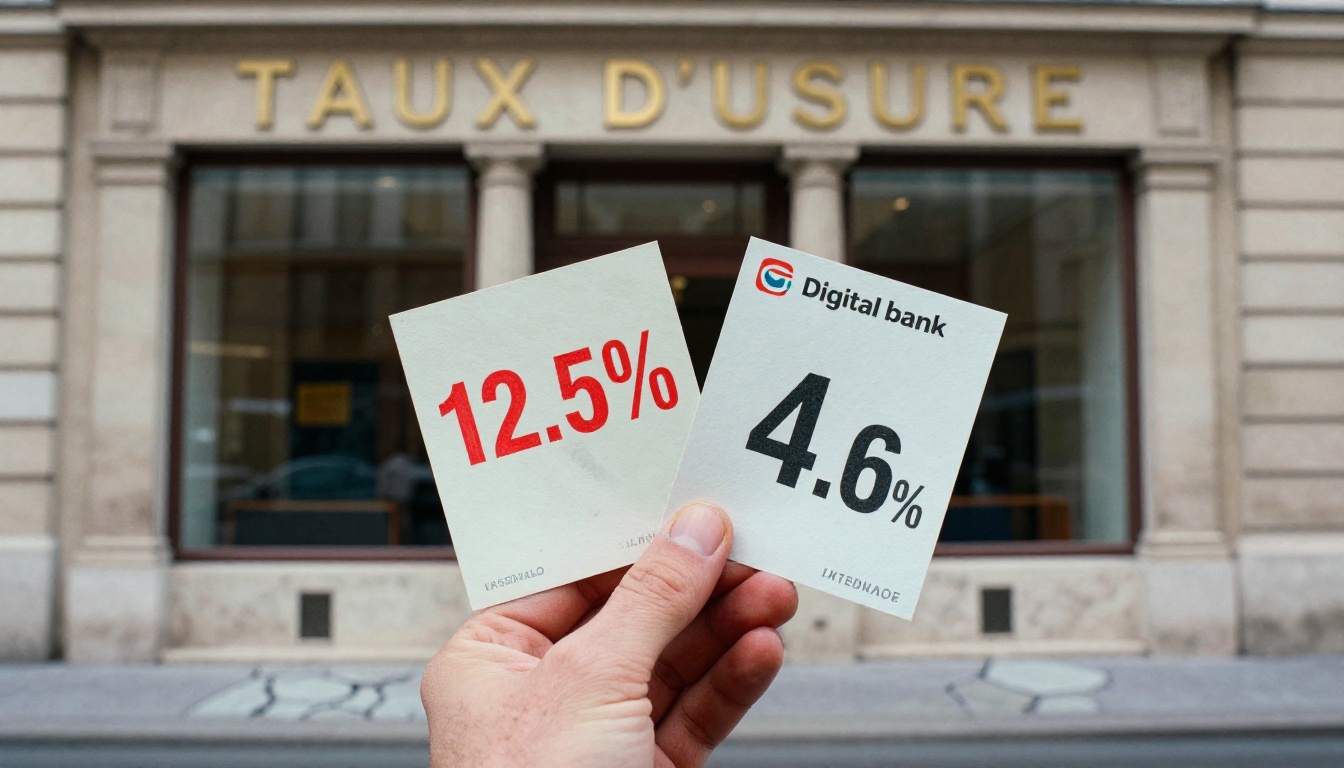
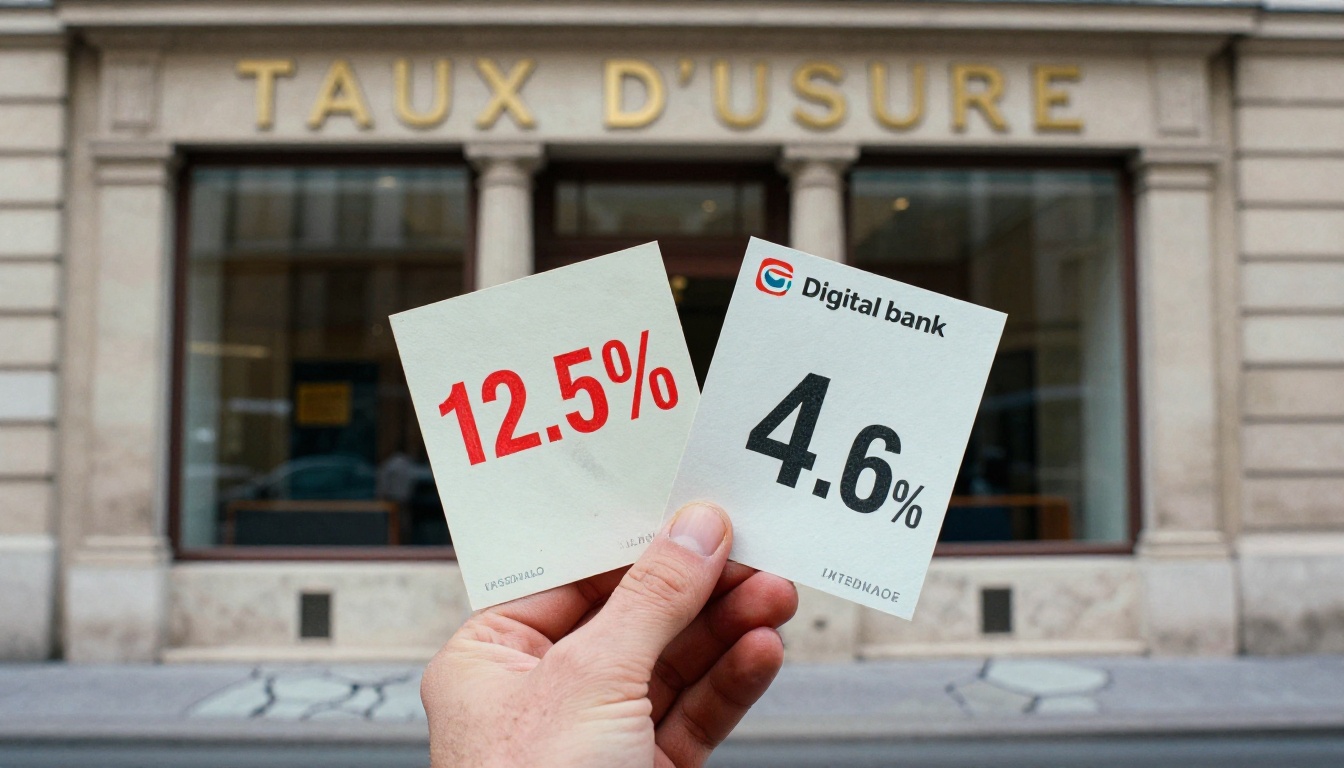
One consumer’s story sums up the brutal math: a €4,000 loan for a used car that would have cost 1.1% interest five years ago now comes with a 12.5% rate tag from a major French bank. That’s not a typo. That’s a eleven-point-four-percentage-point jump that turns a €90 interest bill into a €500 one. When questioned, the bank advisor shrugged: “Times have changed.”
If you think that sounds like a lazy excuse wrapped in a fleecing, you’re not alone. French consumer credit markets have fractured into two distinct realities: digital banks offering rates around 4-6%, and traditional brick-and-mortar institutions apparently testing how much pain borrowers will swallow before walking.
The Great Rate Divorce: Why Your Branch Bank Quotes 12% While Bourso Charges 4.6%
The gap isn’t random. It’s structural. A consumer seeking a €30,000 used car loan over 48 months recently found Société Générale quoting 12.5% while Boursorama, ironically owned by the same SG group, offered 4.60% TAEG (annual percentage rate). For a €4,000 loan over 12 months, Bourso’s calculator showed roughly 3%, while SG demanded triple that.
This isn’t about risk assessment. It’s about business models. Traditional banks operate with massive overhead: physical branches, relationship managers, legacy IT systems that run on code older than most borrowers. When the European Central Bank hiked rates to combat inflation, these institutions didn’t just pass through the increase, they added a fat margin to protect profitability in an era where deposit flight and digital competition are eating their lunch.
Online banks like Boursorama, Fortuneo, or Hello bank! have lean cost structures and use competitive rates as customer acquisition tools. They’re not necessarily more generous, they’re just playing a different game. For them, a 4.6% loan still delivers healthy margins when their cost of funds is managed efficiently.
The Legal Ceiling: When 12.5% Becomes Criminal
Here’s where it gets legally spicy. France maintains strict taux d’usure (usury rates) that cap how much banks can charge. For Q1 2026, the Banque de France set the maximum at:
- 10.8% TAEG for loans above €6,000
- 15.5% TAEG for loans between €3,000-€6,000
- 21% TAEG for loans under €3,000
A 12.5% rate on a €4,000 used car loan sits uncomfortably close to the legal maximum for that category. On amounts above €6,000, it’s outright illegal. Yet banks seem willing to flirt with these boundaries, counting on consumer ignorance or desperation to push through rates that would make a pawnshop blush.
The enforcement mechanism is blunt: any loan exceeding the usury rate is automatically null and void, with criminal penalties for the lender. But detection relies on borrowers knowing their rights and filing complaints, something most French consumers, let alone international residents, rarely do.
The Household Debt Time Bomb
This rate explosion doesn’t exist in a vacuum. It lands squarely on families already stretched thin. The Banque de France reported a surge in household over-indebtedness amid rising borrowing costs, a 9.8% jump in 2025, nearly triple their forecast.
The math is merciless. A family borrowing €15,000 for a car at 12% instead of 4% pays an extra €1,200 in interest. That’s money not spent on groceries, not saved for retirement, not invested in a PEA (stock savings plan). Multiply this across millions of households, and you see why consumer confidence is cratering.
Traditional banks justify high rates by citing increased default risk in a slowing economy. But there’s a circular logic at play: by charging punitive rates, they actually create the financial stress that leads to defaults. It’s a self-fulfilling prophecy that benefits no one except short-term quarterly earnings reports.
How to Dodge the Bullet: Practical Workarounds
You have options, but they require abandoning loyalty to your childhood bank.
1. Digital Banks First, Always
Before stepping into a branch, simulate every loan on Boursorama, Fortuneo, and Hello bank!. The difference routinely hits 5-8 percentage points. The application process takes 15 minutes online versus a 3-week wait for a branch appointment.
2. Check the Usury Rate Before You Sign
Bookmark the Banque de France’s quarterly publication. If your quote exceeds the limit for your loan amount, walk away and file a complaint with the ACPR (Autorité de Contrôle Prudentiel et de Résolution). Banks know the law, they’re betting you don’t.
3. Consider Alternative Financing Structures
For larger purchases, investigate using secured loans like Lombard loans to avoid selling assets or the using borrowing against assets instead of selling them approach. While complex, these strategies can deliver rates below 2% for those with investment portfolios.
4. Negotiate Through Dealerships
Car dealers often have captive finance arms offering promotional rates, especially for electric vehicles. A Renault or Peugeot dealership might beat your bank’s quote by half, particularly if they’re clearing inventory.
5. The Nuclear Option: Threaten to Leave
Banks hate losing customers. If you have a clean payment history and multiple products, threaten to move everything to a competitor unless they match digital rates. It works more often than you’d think, especially in Q1 when banks chase volume targets.
The New Normal? Only If You Accept It
The ECB’s base rate hikes from -0.5% to 4% between 2022 and 2024 fundamentally reset lending economics. Money isn’t free anymore, and it won’t be for years. But there’s a vast difference between a 4% risk-adjusted rate and a 12.5% predatory one.
Traditional banks are using this transition period to rebuild margins they destroyed during the negative-rate era. They’re counting on inertia, brand loyalty, and bureaucratic friction to keep customers from shopping around. It’s a calculated bet that enough people will grumble but ultimately accept the bad deal.
The real new normal should be this: never accept your first quote. French consumer credit has become a bazaar where opening offers are insults. Your bank’s 12.5% rate isn’t a reflection of market reality, it’s a test of your financial literacy. Fail it, and you’ll pay thousands extra for the privilege of staying with a brand you recognize.
The Bottom Line
That 12.5% quote isn’t normal. It’s not justified by risk. It’s not even legal for many loan amounts. It’s a margin-grab by institutions that lost their monopoly on your wallet and are desperate to claw back profits.
Your move is simple: treat every loan like you’re buying a car. Get three quotes minimum. Start with digital banks. Know the usury ceiling. And remember, the bank advising you has sales targets, not your best interests at heart. The days of trusting your childhood branch manager are over. The new relationship is transactional, adversarial, and requires you to be armed with data before you walk through the door.
Times have changed, indeed. But that doesn’t mean you have to get fleeced.