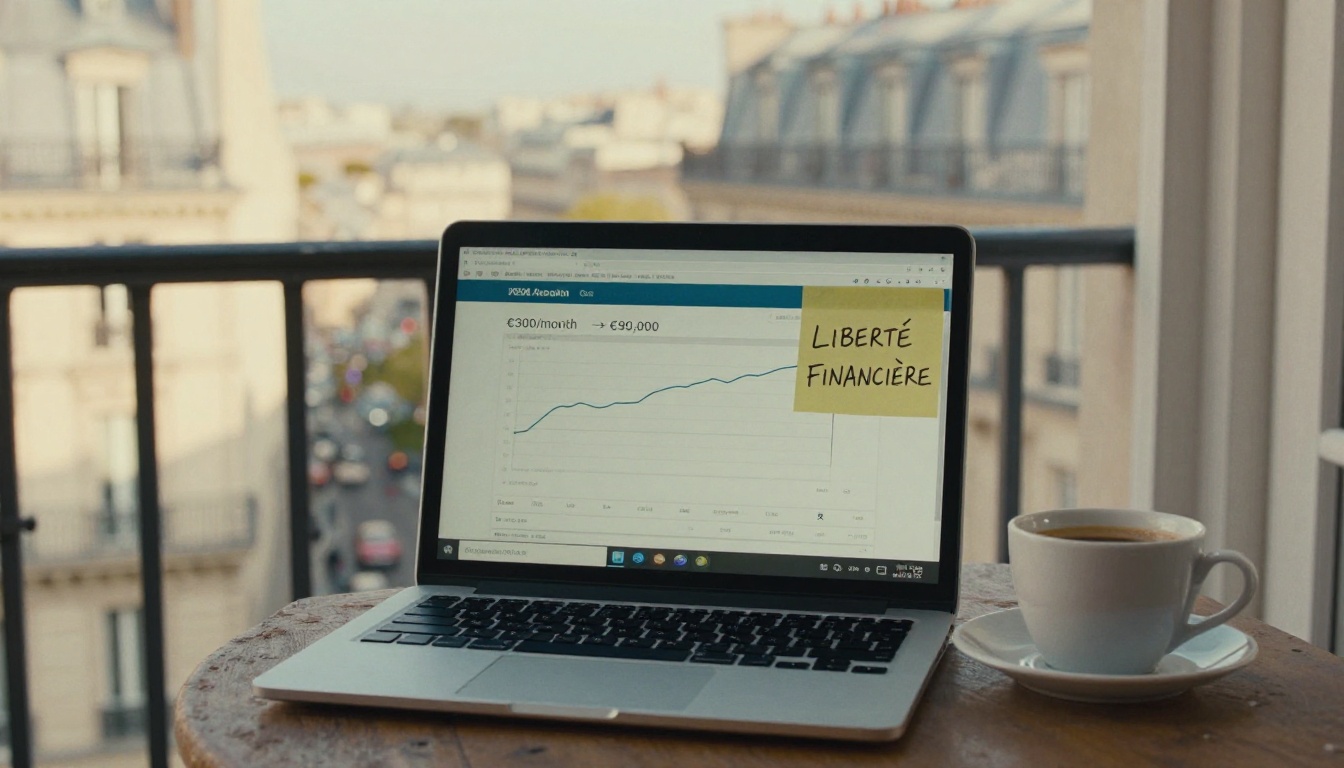
Can disciplined monthly investing in a French PEA (Plan d’Épargne en Actions, the French stock savings plan) really replace a family inheritance? That’s the question keeping many young French professionals awake at night. While financial influencers preach the gospel of DCA (dollar-cost averaging) into ETFs, the math often feels abstract when you’re staring at a €300 monthly investment and wondering if it will ever amount to anything tangible.
The research data reveals something striking: yes, it works, but not how the simulations suggest, and certainly not without significant psychological and structural advantages that rarely make it into the spreadsheets.
The Spreadsheet Fantasy vs. Parisian Reality
Most DCA calculators show smooth exponential curves. Input €500 monthly for 30 years at 8% returns, and voilà, €700,000 appears. What these tools don’t show is the administrative friction, tax complexity, and raw emotional discipline required in the French system.
One investor started at 22 with a modest €32,000 salary, living at home to maximize savings. By 30, their PEA was maxed out at €150,000, entirely in CW8 (the Amundi MSCI World UCITS ETF, a popular French-listed global equity tracker). At 38, another investor’s portfolio reached three years of net salary, around €90,000, through religious €300 monthly contributions. These aren’t FIRE (Financial Independence, Retire Early) numbers, but they represent something more immediate: mental freedom.
When their company announced layoffs last year, that 38-year-old slept soundly while colleagues panicked. The portfolio wasn’t for early retirement, it was a buffer that allowed them to choose their next role instead of accepting the first offer out of fear. This is the unspoken benefit of DCA in France, it creates optionality in a rigid job market where changing positions often means months of unemployment.
The French Tax Advantage That Changes Everything
The PEA’s fiscal structure fundamentally alters the DCA equation. After five years, gains are exempt from income tax (though prélèvements sociaux, social contributions, still apply at 17.2%). This is not a minor detail, it’s the difference between building wealth and spinning your wheels.
Consider the alternative: a standard compte-titres (general securities account) subjects all gains to the PFU (prélèvement forfaitaire unique, flat-rate withholding tax) of 30% plus social contributions. On a €500,000 portfolio generating €40,000 annual gains, the PEA saves you €12,000 per year in taxes alone. Over two decades, that compounds to over €300,000 in tax efficiency, essentially a small inheritance created by tax optimization.

Yet the PEA has limits. The maximum contribution is €150,000, and you can only hold European securities directly. For global exposure, French investors rely on ETFs like CW8 or EWLD that synthetically track MSCI World indices. This creates a hidden concentration risk: your “global” ETF is likely 71% weighted in US stocks, as discussed in our analysis of risks of US-heavy ETFs like MSCI World for long-term DCA investors.
The Invisible Timeline Nobody Mentions
The research reveals a critical pattern: years 1-5 feel pointless. You invest €300 monthly and your portfolio gains only €800 in year one. You’re sacrificing restaurant meals and weekends away for what looks like coffee money. This is where 90% of people quit.
The breakthrough happens around year 8-10, when monthly gains start exceeding your contributions. That’s when compound interest becomes tangible. One investor noted that at 12 years in, their portfolio represented over three years of salary, not enough to retire, but enough to negotiate a job change or weather a crisis without selling at the bottom.
This timeline clashes brutally with French economic reality. While baby boomers inherited affordable housing and stable pensions, younger generations face a different equation. The economic challenges facing younger generations building wealth from scratch include skyrocketing property prices in Paris, stagnant median wages, and the shift to prélèvement à la source (pay-as-you-earn withholding) that reduces monthly cash flow flexibility.
When DCA Becomes Your “Fuck You Money”
A recurring theme among successful French DCA practitioners is what one investor called “fuck you money”, not enough to retire, but enough to say no. With €500,000 in a PEA, you can consider leaving a high-stress job in Paris for a €2,500 monthly university teaching position. You can’t retire, but you can choose.
This psychological shift appears around the €200,000-300,000 mark. At this level, investors report feeling comfortable confronting management, taking career risks, or simply sleeping better during market volatility. The portfolio becomes a form of self-insurance in a country where unemployment benefits, while generous, don’t cover lifestyle maintenance.
But here’s the catch: reaching this level requires either a high savings rate (often 30-40% of net income) or starting early enough for compound interest to do the heavy lifting. For someone earning the French median salary of €1,800 net monthly, investing €500 means living on €1,300, feasible only with shared housing or a partner’s income.
The Inheritance Question: Still Relevant?
French data shows inheritance flows grew from 5% of national income in 1950 to 15% today. The wealthiest 10% hold 54% of total household wealth, much of it received through succession (inheritance). This creates a legitimate question: can DCA truly compete?
The math suggests it can, but with caveats. A €500 monthly DCA at 8% over 35 years yields roughly €1.1 million. That’s comparable to a modest Parisian apartment inheritance. However, the inherited apartment comes with no capital gains tax if it’s the residence principale (primary residence), while your PEA gains face social contributions.
More importantly, inheritance often includes an apartment that eliminates housing costs, a massive advantage DCA can’t replicate unless you specifically save for property. This is why many French investors diversify into SCPI (Sociétés Civiles de Placement Immobilier, real estate investment trusts) or buy rental properties alongside their PEA.
The Discipline Tax
Perhaps the biggest hidden cost of DCA is psychological. One investor’s comment captures it perfectly: “The hardest part isn’t the crash. It’s the colleague who made 10x on crypto while you’re making 8% annually.”
French investors face constant temptation to deviate. The rise of retail investing in France means everyone at the dinner table has a stock tip. When OpenAI’s IPO looms, promising AI revolution returns, disciplined DCA feels like watching paint dry. Our analysis of why chasing high-profile IPOs often underperforms disciplined DCA shows how these deviations destroy wealth.
The data is clear: investors who started DCA in the early 2000s and continued through 2008, 2020, and 2022 are now sitting on portfolios worth 5-10x their total contributions. Those who paused, sold, or switched strategies are not.
The Parisian Case Study: 20 Years of DCA
One of the most detailed accounts comes from an investor who started at 26 with €300 monthly into an MSCI World ETF. Twelve years later, at 38, the portfolio holds roughly €90,000, three years of net salary. The investor emphasizes that the first five years felt like “throwing money into a void”, but the discipline created a habit that became automatic.
They note a crucial French-specific advantage: automatisation du prélèvement (automatic debit). By setting up a monthly transfer on payday, the money disappears before you can spend it. This works seamlessly with the French prélèvement à la source system, where taxes are withheld automatically. You learn to live on what’s left.
Another investor, now in their 30s, invests €800-€1,000 monthly (including mortgage payments) on a median salary. Their father-in-law, who built a €350,000 portfolio from €40,000 in contributions over 20 years, taught them the strategy. The key lesson wasn’t just investing, it was never spending an euro without purpose, a mindset shift that French culture, with its appreciation for quality over quantity, can accommodate.
When DCA Fails: The French Tax Trap
For all its benefits, DCA in France has a critical failure point: taxes on exit. The PEA exempts income tax but not social contributions. More importantly, if you’re aiming for FIRE, the French tax system makes early withdrawals painful.
Our analysis of France’s FIRE tax trap shows that a €1 million portfolio generating €40,000 annually faces effective tax rates of 30-40% when you include social contributions and potential CSG (contribution sociale généralisée, general social contribution) on rental income. Your €40,000 becomes €24,000, barely above poverty level in Paris.
This means DCA alone isn’t enough for early retirement in France. You need either:
– A much larger portfolio (€1.5-2 million)
– Supplemental income (rental properties, consulting)
– Geographic arbitrage (moving to a lower-cost region)
The Verdict: Yes, But Not How You Think
DCA builds wealth in France, but it’s not a magic formula. It requires:
1. Starting early: The difference between starting at 23 vs. 33 is €300,000+ on the same monthly contribution
2. Maximizing the PEA: Tax efficiency is your biggest advantage
3. Maintaining discipline through boredom: 8% annual returns feel pathetic during crypto bull runs
4. Accepting that it’s not for spending: That €500,000 is for retirement, not a Porsche
5. Combining strategies: DCA alone won’t buy you a Paris apartment
The investors who succeed share two traits: they automate everything and they don’t talk about their portfolio. In a culture where discussing money remains taboo, this silence is both a social norm and a competitive advantage. You’re not tempted to keep up with the Joneses because you don’t know what the Joneses are doing.
For the 23-year-old who asked the original question, the answer is clear: start now, automate, and forget about it for a decade. The wealth you build won’t let you retire at 40, but it will give you something more valuable in France’s rigid system, choice.
Your next step: Open a PEA with a low-cost broker like Boursorama or Fortuneo, set up a monthly €300 automatic investment in a MSCI World ETF, and don’t check it until 2036. The rest is noise.