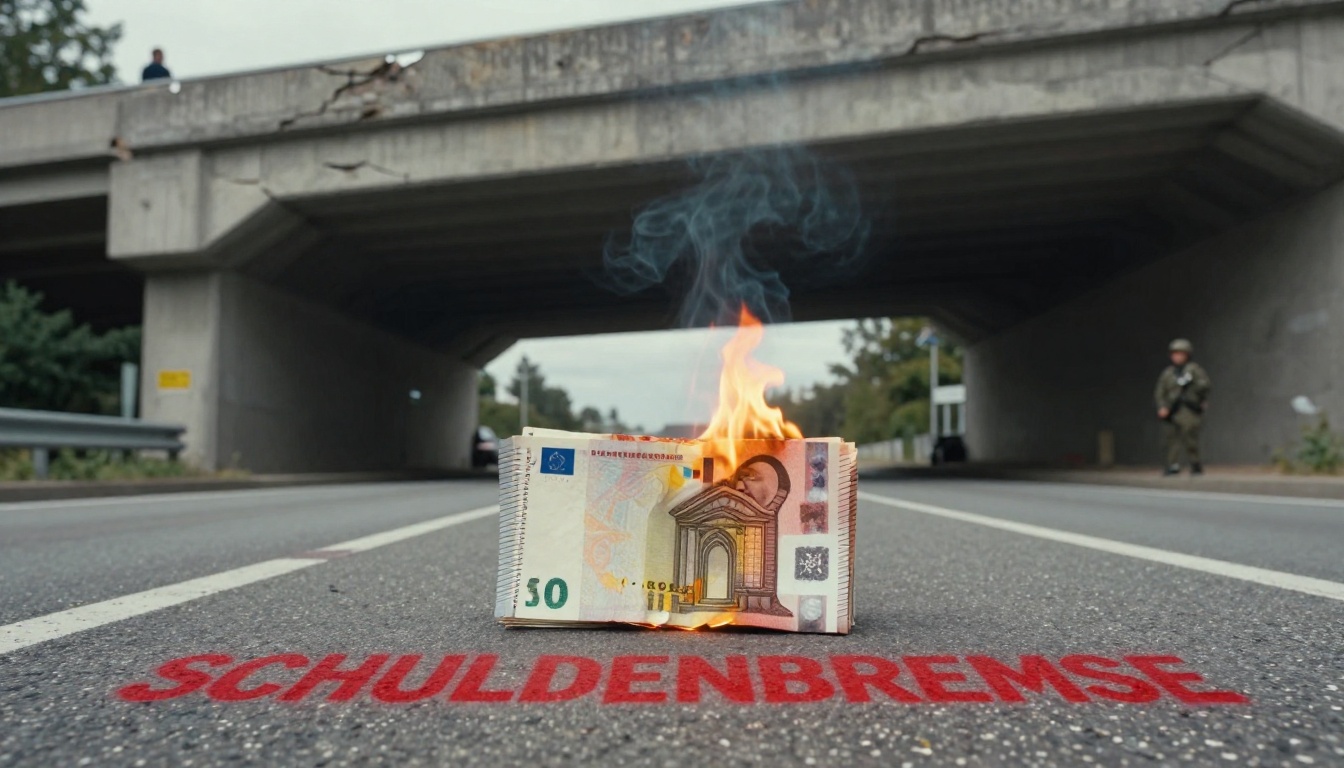
Germany’s fiscal house is on fire, and the firefighters are debating whether to use gasoline or diesel. The Bundesbank (Federal Bank) projects the budget deficit will hit 4.5% of GDP by 2027, a figure that already looks conservative as spending races ahead of revenue. With €119.1 billion in red ink for 2025 alone, the gap between political promises and mathematical reality has never been wider.
The Numbers Don’t Lie (But They Do Evolve)
Remember when Germany’s 2025 deficit was supposed to be 2.4%? The Statistisches Bundesamt (Federal Statistical Office) has revised that to 2.7%, and even that feels like a placeholder. The government managed to stay within the EU’s 3% limit, but that’s like celebrating you haven’t maxed out your credit card while applying for three new ones.
The real story is in the trajectory. While tax revenues grew in the high single digits last year, despite near-zero real economic growth, spending grew faster. Social contributions rose, but so did social outlays, particularly for Renten (pensions) and Pensionen (civil service pensions). Interest payments jumped 8% year-over-year, a taste of what’s coming as rates normalize.
The Infrastructure Promise vs. The Pension Reality
Politicians love to talk about “gewaltige Milliardensummen in Straßen, Schienen und Verteidigung” (massive billions for roads, rails, and defense). It sounds visionary, modernizing crumbling Autobahnen, digitizing the Deutsche Bahn, and finally meeting NATO commitments. The reality? About 25% of the federal budget already goes to pension subsidies, and that share is climbing.
One commenter pointed out the brutal math: pension payments as a share of GDP are actually falling, meaning retirees get less of the pie, yet taxpayers still pay more. The system is simultaneously broke and breaking. Meanwhile, municipalities are drowning in Sozialausgaben (social spending) for Eingliederungshilfe (integration assistance), asylum costs, Bürgergeld (citizen’s benefit), and youth services.
The question isn’t whether Germany needs infrastructure investment, it desperately does. The question is whether the money will reach actual construction sites or disappear into administrative quicksand. Recent reporting from DER SPIEGEL suggests the latter: infrastructure special funds are trickling out so slowly that project backlogs are growing, not shrinking.
The Schuldenbremse Showdown
Germany’s debt brake (Schuldenbremse) was supposed to be constitutional armor against political spending sprees. Now it’s becoming a political piñata. The CDU’s youth wing demands proof that existing debt is funding investments, not consumption, before any further loosening. The SPD wants more flexibility for Kitas, schools, and climate projects.
The Bundesbank has inserted itself into this family feud with unusual directness: “Without countermeasures, the deficit ratio will head toward 5% in 2028.” That’s central-bank-speak for “you’re losing control of the narrative.”

What This Means for Your Wallet
For residents navigating German financial life, this deficit spiral has concrete consequences:
- 1. Stealth Tax Increases Are Coming
Already, discussions about Sozialabgaben (social contributions) on capital gains and higher health insurance contributions for retirees are circulating. When the state runs out of borrowing capacity, it raids private pockets. The complexities of Germany’s tax and benefit system affecting fiscal sustainability mean middle-income earners face subtle but painful bracket creep. - 2. Infrastructure Stagnation
Despite billions allocated, bottlenecks worsen. The Leverkusen highway bridge, symbol of Germany’s Standortkrise (location crisis), remains a daily reminder that allocated funds don’t equal completed projects. Rising transportation costs and fiscal pressure on households mean commuters continue losing €500-1000 monthly as real costs outpace tax deductions. - 3. Labor Market Distortions
High earners are already voting with their feet. One observer noted four “Nettozahler” (net payers) leaving their circle, heading to Switzerland or beyond. This creates a death spiral: fewer high earners to fund the system, more pressure on those who remain, more incentive to leave. Behavioral responses to tax and labor market incentives under fiscal strain are rational but destabilizing. - 4. Investment Uncertainty
Private investment remains 11% below pre-COVID levels, according to DIHK surveys. Companies hesitate when fiscal policy looks unsustainable. Why build a factory when future tax hikes might erase your returns? This is how public debt crowds out private growth.
The Implementation Black Hole
Here’s where skepticism becomes mandatory. Germany has a 500-billion-euro infrastructure special fund, yet:
– Bureaucratic approval processes delay projects for years
– Local governments lack capacity to spend allocated money
– Construction costs have inflated beyond original estimates
– Much “investment” is actually maintenance deferred for decades
The SPIEGEL investigation into the Sondervermögen Infrastruktur (infrastructure special fund) reveals a pattern: money gets allocated, announced, then trickles out at a fraction of planned speed. Meanwhile, the deficit grows because the spending is authorized regardless of execution.
This is the core of the fiscal risk: Germany is borrowing like it’s investing, but spending like it’s consuming. The difference between a growth-generating asset and a current expenditure is years of implementation delay.
Political Theater vs. Economic Reality
Finance Minister Lars Klingbeil faces the impossible task of reconciling coalition promises with arithmetic. The SPD wants to “weiterentwickeln” (further develop) the debt brake for more investment flexibility. The CDU’s youth wing demands proof of proper spending first.
Both positions miss the point: the market is already pricing in risk. German bond yields may be low, but that’s due to ECB policies and Germany’s historical credibility, not current fiscal prudence. If that credibility cracks, the cost of servicing existing debt will consume the budget faster than any political compromise can fix.
The Bundesbank’s warning about needing “a reliable perspective on how high deficits will be reduced” is diplomatic code: show us your exit strategy, or we’ll become the exit strategy by letting rates rise.
The Personal Finance Playbook
In this environment, residents need to think defensively:
- Diversify beyond German-only assets: If the fiscal situation deteriorates, the euro could face pressure. International ETFs and foreign currency exposure aren’t just for speculators, they’re insurance against policy failure.
- Lock in fixed-rate debt now: If you’re planning property purchases or major loans, current rates may look attractive compared to future risk premiums.
- Optimize aggressively: With public finances shaky, personal tax optimization shifts from optional to essential. Tools for personal financial optimization amid rising public debt are no longer just for the wealthy.
- Track implementation, not announcements: Don’t invest based on government press releases about infrastructure. Watch for actual project approvals and spending data. The gap between the two is where fiscal risk hides.
The Verdict: Boom for Whom?
Germany’s spending surge is undoubtedly a boom, for certain sectors. Defense contractors, construction companies with government connections, and bureaucracies expanding to “manage” new funds are thriving. For the broader economy? Not so much.
Real economic growth has been stagnant since 2019. The 0.2% uptick in 2025 came after massive fiscal stimulus. That’s not a boom, it’s life support.
The controversy isn’t whether Germany should invest in infrastructure or defense, it must. The controversy is whether borrowing billions while implementation capacity atrophies is courage or malpractice. When even the Bundesbank starts sounding like a fiscal hawk, it’s time to question the narrative.
Germany’s fiscal problem isn’t a lack of spending ambition. It’s a lack of spending effectiveness, masked by ever-growing numbers. The 4.5% deficit target? That’s not a ceiling, it’s a floor that might already be cracking.
For residents, the takeaway is simple: hope for the best in public policy, but plan for the worst in your personal finances. The Schuldenbremse might be bendable, but household budgets aren’t.