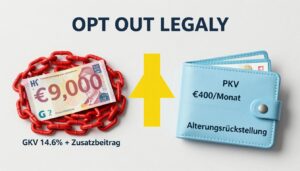
That 16% premium hike notice from your PKV isn’t a typo, it’s the new normal. While Germany debates energy prices and inflation, private health insurance costs are devouring high earners’ paychecks with mathematical precision. A civil servant recently discovered their net income dropped by €110 per month in 2026, with €60 of that directly from PKV increases. That’s €1,320 annually, vanished.
The numbers reveal a system under strain. According to the Verband der privaten Krankenversicherung, average PKV premiums jumped 13% in 2025, with some providers pushing 16% or higher. These aren’t isolated incidents, they’re structural adjustments that expose the fault lines in Germany’s two-tier health insurance system.
The 2026 Squeeze: Higher Thresholds, Higher Costs
Starting January 2026, the income threshold to even qualify for private insurance rises to €77,400 annually (up from €73,800). This 4.9% increase in the Versicherungspflichtgrenze means fewer employees can escape the statutory system, but for those already in the PKV club, the math gets uglier.
Employer subsidies do increase, to €508.59 monthly for health insurance (from €471.32) and €104.63 for nursing care (from €99.23). Sounds generous, until you realize these adjustments lag behind actual premium explosions. The subsidies are capped by law, but PKV providers face no such restraint when calculating your personal risk profile.

The disconnect is intentional. PKV premiums aren’t income-based, they’re risk-based. As Thomas Drabinski, health economist at the Institute for Microdata Analysis in Kiel, explains, the primary driver isn’t medical cost inflation but Alterungsrückstellungen (aging reserves). Younger members essentially pre-fund their future elderly care, creating a compound interest time bomb that detodes in your 50s and 60s.
Why You’re Trapped: The One-Way Door
Here’s where it becomes a financial prison. Once you’re in PKV, returning to gesetzliche Krankenversicherung (GKV) is nearly impossible. The law requires you to be under 55 and earning below the income threshold for at least 12 months, a catch-22 for most established professionals. If your income drops due to career changes, illness, or economic downturns, you’re still on the hook for the full PKV premium.
A Kiel attorney named Ralf Lehmann watched his premium climb from €903 to €938 monthly, €420 more annually. At 30 years in the system, he’s “bound to this insurance until the end of my life.” This sentiment echoes across PKV forums, where members discover that loyalty is a one-way street.
The Praxis ohne Grenzen in Bad Segeberg, literally “Practice Without Borders”, now treats privately insured patients who’ve become “Nullzahler” (zero-payers). These are people who maintain PKV membership but can’t afford premiums, losing all coverage except emergency care. For them, charity clinics become the only option.
The Beamte Blind Spot
Civil servants (Beamte) occupy a unique position. They receive state Beihilfe (assistance) covering 50-70% of medical costs, making PKV seem affordable. But when premiums spike 16%, even their protected status erodes. The Reddit discussion that sparked this investigation came from a Beamte seeing €60 monthly increases on top of tax adjustments.
What makes this particularly galling is the timing. The 2026 changes include a digitalization mandate requiring PKV providers to submit contribution data electronically to the Bundeszentralamt für Steuern (BZSt). When the BZSt’s systems failed in November 2025, many Beamte had excessive tax withholdings in January, a temporary glitch that masked the permanent premium pain underneath.
The Real Income Decline Nobody Talks About
Economists distinguish between nominal and real income. Your nominal brutto salary might rise 3% annually, but if PKV premiums jump 13-16% while employer subsidies increase only 7.9%, your nettolohn suffers a double whammy. Factor in inflation, and you’re experiencing actual purchasing power loss.
The Federal Ministry of Labour and Social Affairs raises income thresholds based on average wage growth, but PKV premium calculations follow different actuarial tables. This divergence creates a scissors effect: as you earn more, you pay more, but your insurance costs accelerate faster than your income.

The real income decline nobody talks about is the hidden tax on your earnings. It’s not just about the 16% increase – it’s about how this affects your overall financial planning and long-term stability.
Career Choices Distorted by Insurance Math
The PKV premium crisis is reshaping German career calculus. High earners approaching the €77,400 threshold face a perverse incentive: stay just below the line to avoid PKV, or leap far above it to make the math work. The worst place to be is barely over the limit with a stagnant income, premium hikes will devour your raises.
Self-employed professionals report delaying retirement, rejecting part-time work, or refusing salary reductions because any income drop makes unaffordable PKV premiums catastrophic. One freelance consultant noted, “I’m working two extra years just to pre-fund my PKV reserves.”
The System’s Structural Rot
The fundamental problem: PKV operates without solidarity. Your premium reflects your individual risk, age, health status, family medical history, while GKV spreads risk across all members. When PKV members age, their premiums must rise to cover their own future costs, creating an exponential curve.
Young, healthy members subsidize this system but receive no permanent benefit. Their “Altersrückstellungen” belong to them individually, but if they switch to GKV, they lose these reserves entirely. It’s a heads-I-win, tails-you-lose structure that benefits only insurance providers.
The Verbraucherzentrale Schleswig-Holstein confirms a surge in consultation requests about premium hikes. Their advice? Tarifwechsel (plan switches) within the same provider often mean Leistungseinschränkungen (benefit reductions), a classic bait-and-switch where you pay more for less.
What You Can Actually Do
If you’re considering PKV:
Run 20-year projections, not just current-year comparisons. Calculate premiums at ages 50, 60, and 70 using provider simulators. If the numbers don’t work at 60, they won’t work at 40.
If you’re locked in PKV:
– Demand transparent Alterungsrückstellungen calculations. German law requires providers to show your individual reserve balance.
– Explore Tarifwechsel options, but scrutinize benefit cuts. Some providers offer “Jungtarife” with lower initial costs but steeper age curves.
– Consider increasing your deductible (Selbstbeteiligung) to reduce premiums, but only if you can afford the risk.
If you’re a Beamte:
Calculate your total cost including Beihilfe reductions. Some Bundesländer offer alternative models. The Bavarian Beamtenkasse, for instance, provides a quasi-public option that avoids PKV’s volatility.
The Political Vacuum
No major party is addressing this. The traffic light coalition fiddles with digitalization mandates while ignoring the core issue: a risk-based insurance model incompatible with demographic reality. The FDP defends PKV as “freedom of choice”, the SPD attacks it as “two-class medicine”, but neither proposes fixes for the 9 million Germans already trapped.
The 2026 reforms are Band-Aids on a hemorrhage. Higher employer subsidies help marginally, but they don’t reform the actuarial math forcing 16% increases. Until Germany confronts whether health insurance should be a solidarity system or a risk market, PKV members will continue funding their own demographic time bomb, one premium notice at a time.
Your paycheck is already smaller than you think. The only question is how much smaller it gets next year.