The numbers don’t lie, but they definitely surprise. After twelve months of tracking every kilowatt-hour through their 9kWp solar system, 10.2 kWh battery, heat pump, and electric vehicle, one German household has crunched the data on whether ditching gas actually pays off. The short answer? Their €40,000 renewable setup saves them €2,900 annually compared to a modern gas system. The longer answer involves a base load that rivals a small server farm, a heat pump working at COP 3.07, and the sobering realization that capital markets might still be the better investment, if you can wait two decades.
The Household Profile: A Perfect Energy Storm
This isn’t a minimalist eco-bunker. It’s a standard German Doppelhaushälfte (semi-detached house) with four occupants, two of whom work permanently from home. The baseline electricity consumption runs between 550-600 watts even at night, roughly equivalent to leaving a vacuum cleaner running 24/7. Add mobile air conditioners in summer, multiple gaming PCs, and the usual array of refrigerators and entertainment systems, and you’re looking at 7,531 kWh of pure household electricity consumption before heating or transportation enter the equation.
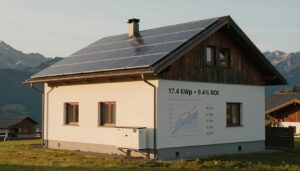
The setup itself reflects a common German retrofit scenario: 9kWp photovoltaic panels spanning south, east, and west orientations, paired with a 10.2 kWh battery. The old gas heating system from 2001 had to go anyway, and the 65% renewable energy mandate meant another gas boiler wasn’t even an option.
The Year in Numbers: Production vs. Reality
The solar production reached 7,506 kWh over the year, not bad for a system of this size. But here’s where German energy economics get interesting. Of those 7,506 kWh generated, the household directly consumed 6,151 kWh (82% self-consumption rate). Only 1,260 kWh fed back into the grid, earning the standard €0.08/kWh feed-in tariff and roughly €100 in annual compensation.
Meanwhile, total electricity consumption hit 15,175 kWh, meaning they still pulled 9,098 kWh from the grid at current consumer prices. The breakdown reveals the real energy hogs:
- Heat pump: 6,687 kWh
- Electric vehicle: 957 kWh
- Everything else: 7,531 kWh
The heat pump alone accounts for 44% of total electricity use, which is where most German households hesitate. At €0.33 per kWh grid electricity, that translates to €2,207 just for heating.
The COP Reality Check: Why 3.07 Changes Everything
The system’s Jahresarbeitszahl (annual coefficient of performance) of 3.07 means the heat pump produced 20,525 kWh of thermal energy from those 6,687 kWh of electricity. In simple terms: for every kilowatt-hour of electricity consumed, you get 3.07 kWh of heat.
To understand the financial impact, compare this to the old gas boiler’s 82% efficiency. Generating the same 20,525 kWh of heat would have required approximately 25,000 kWh of natural gas. At current gas prices around €0.12/kWh, that’s €3,000 annually for heating alone.
The heat pump advantage: €800 saved per year on heating costs alone, despite electricity being nearly three times more expensive per unit than gas. This is the math that many German homeowners miss when they balk at heat pump operating costs.
The Real Magic: Self-Consumption as Financial Lever
The €800 heating savings are just the beginning. The real financial lever is that 82% self-consumption rate. By using their own solar power instead of buying grid electricity at €0.33/kWh, they’re effectively “earning” €0.25 per kWh (the difference between grid price and lost feed-in compensation).
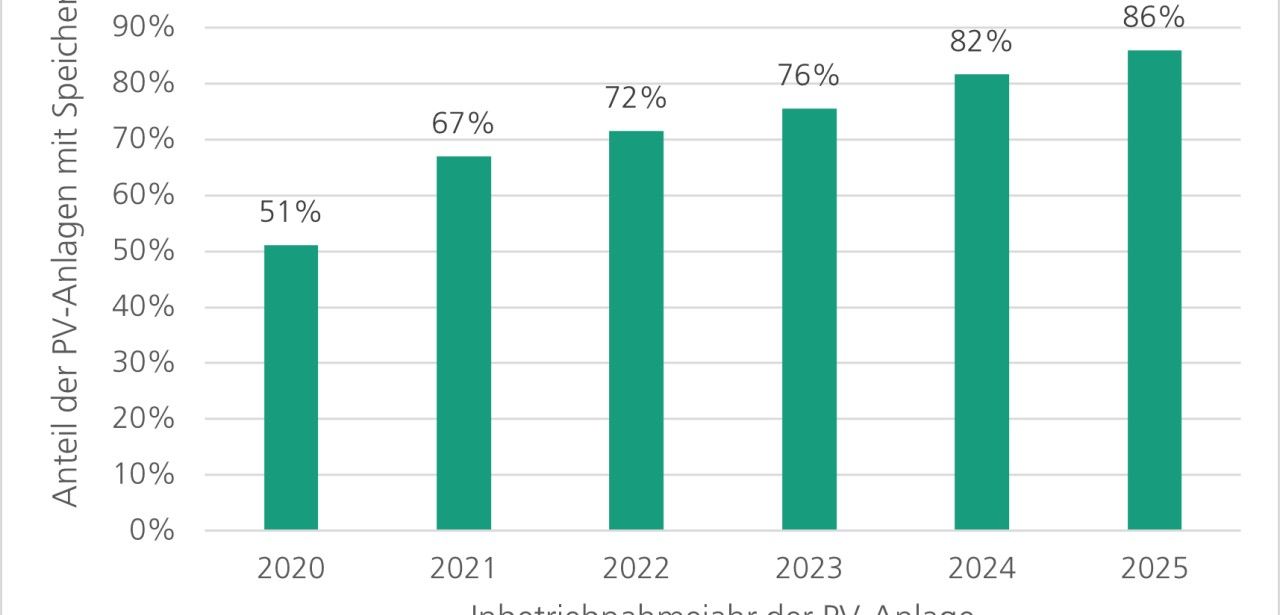
National data supports this strategy. A Fraunhofer ISE study quantified that Germany’s PV self-consumption nearly doubled from 5.57 TWh in 2022 to 12.28 TWh in 2024, now representing 17% of net PV production. Christoph Kost, head of energy systems analysis at Fraunhofer ISE, specifically notes that households with heat pumps and electric vehicles benefit most from this trend. The direct use of self-generated electricity improves grid stability, smooths peak loads, and reduces long-term energy costs and grid dependency.
Total System Economics: €2,900 Annual Advantage
When comparing the entire system against a gas alternative, the numbers become stark:
With heat pump + PV:
– Grid electricity: €3,000
– Feed-in compensation: -€100
– Total: €2,900
With gas heating + no PV:
– Household & EV electricity: €2,800
– Gas heating: €3,000
– Total: €5,800
The renewable system delivers a €2,900 annual advantage. Even accounting for the higher initial investment, €40,000 after subsidies versus roughly €18,000 for a new gas system, the payback period lands at 7-8 years.
But this is where the discussion gets controversial among German finance enthusiasts.
The ETF Counterargument: 19 Years to Break Even
The original analysis didn’t stop at simple payback. The author calculated that if you invested the €22,000 additional cost in an ETF generating 6% annual returns with compound interest, the renewable system only becomes economically advantageous after 19-20 years.
This reframes the entire decision. You’re not just buying a heating system, you’re making a capital allocation choice between energy infrastructure and financial markets. For many German households, especially those without substantial savings, tying up €40,000 in a roof system means missing out on potentially higher market returns.
The counterargument, of course, is energy price volatility. With the EU Emissions Trading System (ETS2) set to increase carbon costs and gas prices historically unstable, the 19-year calculation assumes constant energy prices, an unlikely scenario. If gas prices rise significantly, the payback period shortens dramatically.
The Optimization Frontier: Smarter Tariffs and Timing
Many observers noted that at €0.33/kWh, this household is paying premium grid prices. Comments from other German homeowners suggest optimization potential:
- Separate heat pump tariffs as low as €0.2257/kWh during off-peak hours
- Smart meters enabling variable tariffs from providers like Octopus Energy
- Targeted operation of the heat pump during cheap electricity windows
The catch? Multiple smart meters (one for heat pump, one for household, one for EV) can cost more in rental fees than they save. Some utilities allow dual tariffs on a single meter, requiring only an estimate of heat pump consumption. But the installation and metering costs can eat into savings quickly, making this a marginal improvement rather than a game-changer.
The Bigger Picture: Why Gas Wasn’t Really an Option
Beyond the raw economics, German policy reality matters. The household’s 2001 gas boiler needed replacement, and the 65% renewable energy requirement for new installations means a conventional gas system wouldn’t have passed approval. This policy constraint often gets overlooked in pure financial calculations, the decision wasn’t just “heat pump vs. gas” but “heat pump vs. hybrid system vs. other renewable compliance options.”
Additionally, the comfort factor plays a role. Heat pumps provide consistent temperatures without the cycling on and off of gas boilers, and the integration with solar panels creates a sense of energy independence that many German homeowners value beyond pure euros and cents.
The Hidden Consumption Elephant
The 7,531 kWh household consumption sparked intense discussion. Many German families with similar home office setups report 4,500-6,000 kWh baselines. Gaming PCs running daily can easily add 1,500 kWh annually. Servers, aquariums, waterbeds, and pool pumps push consumption higher.
One commenter’s household of five with servers hits 8,700 kWh without heating. Another with two home office workers and teens with gaming setups lands at 6,000+ kWh. The 550-600W base load, while high, isn’t extraordinary for a tech-heavy, always-occupied German household.
This matters because high baseload actually helps solar economics. It provides a consistent sink for self-generated electricity during the day, improving self-consumption rates. The worst case for solar economics is a low-consumption household that feeds most power back to the grid at low tariffs.
Bottom Line: When Does This Actually Make Sense?
For this household, the renewable system works because:
- High total energy use (15,175 kWh) means savings scale meaningfully
- Occupancy patterns (always home) align with solar production
- Policy constraints made gas non-viable anyway
- Self-consumption rate (82%) is exceptionally good
- Long-term ownership plan makes 7-8 year payback acceptable
The 19-year ETF comparison is intellectually honest but ignores energy price risk and the non-financial value of energy independence. For families planning to stay put and comfortable with illiquid home investments, the system makes solid sense. For renters or frequent movers, it’s capital destruction.
The broader lesson? German energy economics reward households that can maximize self-consumption. Battery storage, while adding cost, becomes the critical enabler that turns solar panels from a feed-in tariff game into genuine utility bill destruction. Without batteries, this household would have fed far more electricity to the grid at €0.08 while buying evening electricity at €0.33, a losing proposition.
Before you copy this setup, audit your actual consumption patterns. A 600W base load isn’t normal for a typical working family that’s out of the house 10 hours daily. Your mileage will vary, and in Germany’s complex energy market, assumptions about savings often prove dangerously optimistic.