The Dutch parliament debate in The Hague last week sent tremors through German investment forums. While Dutch lawmakers wrestled with technical details, German investors saw their financial future flash before their eyes: a 36% tax on unrealized capital gains, applied to investment gains that exist only on paper. The immediate reaction across German financial communities was visceral, some vowed to cut working hours and live off the social safety net, others plotted emigration, and many scrambled to understand whether this could actually happen in Germany.
How the Dutch Ended Up Taxing Paper Profits
The Netherlands’ journey toward taxing unrealized gains didn’t start with a bold policy vision, it began with a court defeat. In 2021, the Dutch Supreme Court ruled that the existing Box 3 system, which taxed fictional yields on assumed investment returns, violated European equality principles because the assumed yields were often higher than actual returns. The government was forced to reform.
The new proposal, slated for 2028, aims to tax actual rather than fictional returns. Here’s the mechanics: on January 1st each year, investors must declare their portfolio values. The calculation is brutally simple, (year-end value) minus (year-start value) minus (contributions) plus (withdrawals) equals taxable gain. Apply a 36% income tax rate, subtract a €3,600 allowance, and pay up. Even if you didn’t sell a single share.
The revenue target is ambitious: €2 billion annually from 2028 onward. The system covers stocks, ETFs, bonds, crypto, and investment properties, though primary residences and startup shares get exemptions. For a German investor with a €50,000 ETF portfolio that grows to €100,000, the Dutch model would demand roughly €16,700 in tax, on gains that could vanish by next year.
German Constitutional Armor: Why Your Portfolio Likely Stays Safe
German investors can breathe easier, but not because politicians are reluctant to tax wealth. The barrier is constitutional concrete. Germany operates on the Zu- und Abflussprinzip (inflow/outflow principle), codified in §12 EStG (Income Tax Act). This principle states that income is only taxable when it actually flows to the taxpayer, when dividends hit your account or when you sell shares for cash.
The Federal Constitutional Court (Bundesverfassungsgericht) reinforced this in a landmark 1995 decision (2 BvL 37/91), ruling that substance taxation is only permissible under extremely restrictive conditions. The core problem with unrealized gains taxation is that it forces investors to sell assets to pay tax on money they never received, directly attacking the substance of the wealth itself.
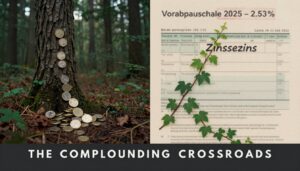
The Vorabpauschale (advance lump sum tax) that Germans already pay on ETFs is fundamentally different. It taxes an assumed minimal return (currently around 1.9% for 2024), and only if your ETF actually generated profit. If your portfolio lost money, you pay nothing. More importantly, the tax amount corresponds to what comparable securities typically distribute as dividends, meaning it doesn’t force you to liquidate holdings. The Dutch model, by contrast, could require selling substantial positions during market downturns just to satisfy tax obligations.
The Behavioral Backlash: From “Zeitmillionär” to Capital Flight
German investors aren’t waiting for constitutional analysis, they’re planning countermeasures. The most dramatic response circulating in investment communities involves becoming a “Zeitmillionär” (time millionaire): liquidate the portfolio, reduce working hours to 20-25 per week, and live off the social safety net. The logic is simple, if the state destroys the incentive to save and invest, why bother hustling at all?
More serious responses include emigration and corporate restructuring. The Netherlands itself offers a loophole: shares in companies where you own more than 5% fall under Box 2 and escape the unrealized gains tax. This has already prompted wealthy Dutch investors to shift portfolios into holding companies. Germans are discussing similar strategies, with vermögensverwaltende GmbH (asset management LLC) structures gaining renewed attention.
But emigration triggers another German tax trap: the Wegzugssteuer (exit tax). Germany already taxes unrealized gains when you leave the country, treating it as a deemed sale. For someone with substantial ETF holdings, emigrating to avoid a hypothetical future tax would trigger a very real immediate tax bill of up to 26.375% on all gains.
Political Reality Check: Why Berlin Is Watching But Not Acting
The Dutch reform stems from a specific legal vulnerability, their Box 3 system was built on fictional yields that courts rejected. Germany’s Abgeltungsteuer (capital gains tax) system, for all its flaws, taxes real events: actual dividends and actual sales. There’s no court pressure forcing reform.
Moreover, the political math doesn’t work. The current German coalition faces enough backlash over existing tax proposals. The SPD’s push to extend social contributions to capital income, while distinct from unrealized gains taxation, already faces fierce resistance from the FDP and business community. Adding a tax on phantom profits would be political suicide.
The revenue argument also fails. Germany’s capital gains tax already generates substantial revenue, and the administrative complexity of valuing millions of private portfolios annually would be enormous. The Dutch system requires detailed annual declarations of all transactions and valuations, imagine the Finanzamt (Tax Office) processing 20 million additional complex tax returns each year.
The Real Danger: Death by a Thousand Cuts
While a direct copy of the Dutch model faces constitutional and political barriers, German investors shouldn’t get complacent. The real risk is incremental erosion. The Vorabpauschale could be increased. The Abgeltungsteuer rate, currently 25%, could rise. Social contributions could be extended to investment income, as the SPD proposes. Each change chips away at returns, but none triggers the constitutional alarm bells that unrealized gains taxation would.
The Dutch precedent serves as a useful warning. It shows what happens when governments need revenue and courts force their hand. German policymakers are undoubtedly taking notes, but they’re more likely to pursue less constitutionally risky paths to the same destination. The SPD’s broader tax plans on capital and earned income already hint at this direction, while Germany’s 2026 tax cut proposals create a confusing push-pull dynamic.
What German Investors Should Actually Do
Panic is premature, but preparation is wise. First, understand that your current strategy remains legally sound. Germany’s constitutional framework protects against the most extreme Dutch-style scenarios. Second, diversify not just across assets, but across jurisdictions. Consider whether a portion of your wealth belongs in structures or locations with different risk profiles.
Third, monitor the Vorabpauschale carefully. This is the likely battlefield for future reforms. If politicians want to tax “phantom” returns without triggering constitutional challenges, they’ll expand this existing mechanism rather than create new ones. The tax optimization strategies for ETF investors in Germany become more valuable as these pressures increase.
Finally, engage politically. The Dutch reform happened partly because the system’s inequality became legally indefensible. German investors who want to preserve the current system need to articulate why it works, not just for the wealthy, but for middle-class retirement savers who’ve spent decades building ETF portfolios for their Altersvorsorge (retirement planning).
The Dutch experiment with taxing unrealized gains is less a blueprint for Germany than a cautionary tale. Constitutional barriers, political realities, and administrative practicalities make direct adoption unlikely. But the underlying pressure, aging populations, rising social costs, and the need for tax revenue, won’t disappear. German investors should watch Amsterdam closely, not because Berlin will copy the policy, but because it reveals how quickly investment incentives can change when governments get desperate.