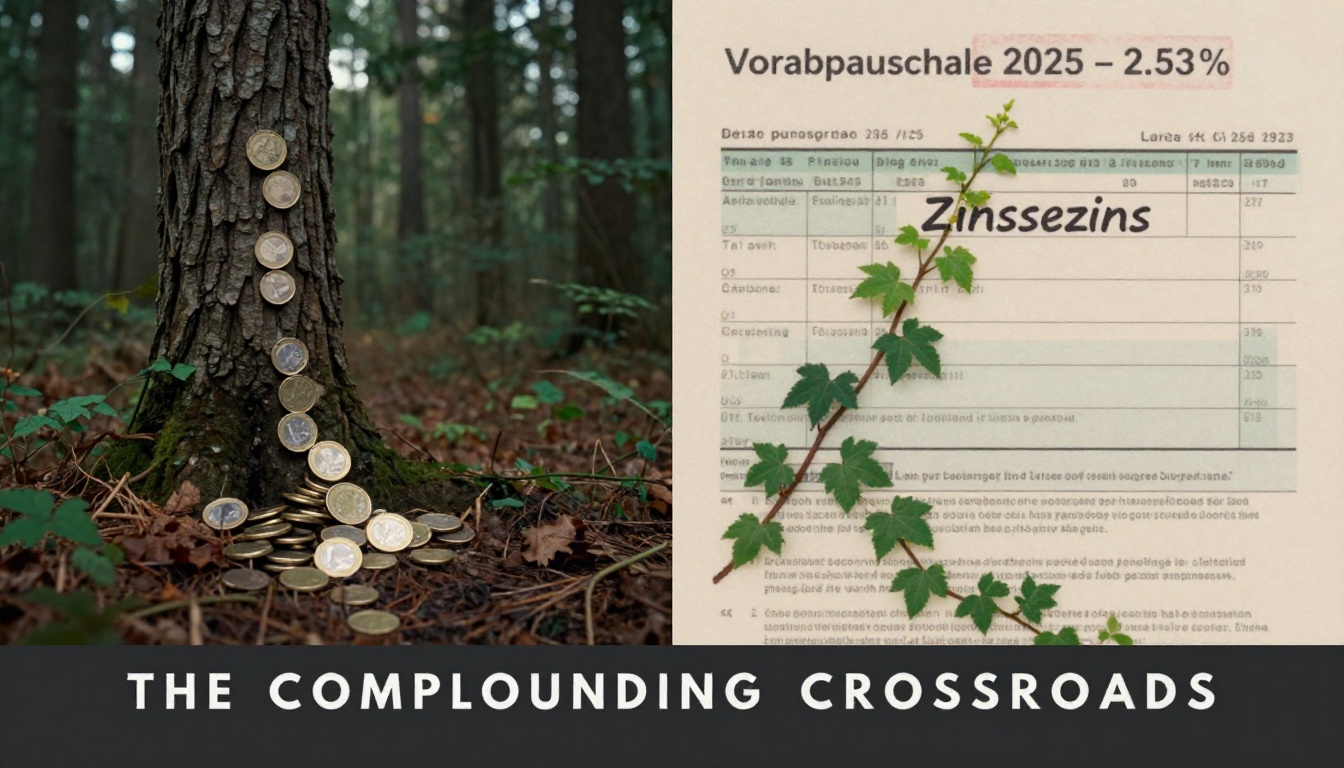
You’ve spent years diligently filling your Sparer-Pauschbetrag (tax-free allowance) with distributing ETFs, watching those dividends roll in tax-free. Now the dreaded moment arrives: your Freibetrag is exhausted. The Finanzamt (tax office) will take its cut of every additional Euro in capital gains. This is the point where German DIY investors face a decision that splits the community into passionate camps.
The question seems simple: Should you keep buying distributing ETFs or switch to accumulating ones? The answer involves compound interest mechanics, the infamous Vorabpauschale (advance tax payment), and execution details that actually matter more than most realize.
The Crossroads: Distributing vs. Accumulating After Freibetrag
Most German investors start with distributing ETFs for one clear reason: they want to use their tax-free allowance. It makes perfect sense. A distributing MSCI World ETF yields roughly 2% annually. On a €50,000 portfolio, that’s €1,000 in dividends, exactly the current allowance. You reinvest manually, stay tax-free, and life is simple.
But once your portfolio grows beyond that threshold, the math changes. Many investors assume it’s “Jacke wie Hose” (six of one, half a dozen of the other) whether you pay taxes now on dividends or later on capital gains. This assumption is technically correct but practically incomplete.
The core argument for accumulating ETFs rests on Zinseszins (compound interest). Every Euro you don’t pay in taxes today keeps working for you. A €100 tax bill deferred for 20 years at 7% annual returns becomes €386 in foregone gains. This effect is real but often overstated in online discussions. The actual advantage depends heavily on the Basiszins (base interest rate) that drives the Vorabpauschale.
The Vorabpauschale Reality Check
Before 2018, accumulating ETFs were a no-brainer. You deferred all taxes until sale, and the compound interest advantage was pure. The Vorabpauschale changed this dramatically.
Here’s how it works: Each January, your broker calculates a fictional dividend based on your ETF’s value at year-start and the official Basiszins. For 2025, this rate is 2.53%. On a €100,000 position, you might owe tax on a €2,530 “gain” even if you received zero cash. The tax is due, and your broker will deduct it from your cash balance or sell shares if necessary.
This makes the accumulating vs. distributing debate much tighter. As one investor calculated, even with €1 million in a MSCI World ETF in 2019 (when the Basiszins was negative), you would have paid no taxes on €300,000 in gains with an accumulating ETF. With a distributing version, you would have owed €3,400 in taxes. The difference is measurable but not life-changing.
The key insight: the Vorabpauschale reduces but doesn’t eliminate the accumulating ETF advantage. You still get tax deferral on the bulk of your actual gains, just not on the fictional dividend portion.
The Automatic Reinvestment Trap
Scalable Capital recently introduced automatic dividend reinvestment, a feature many investors celebrated. The broker automatically buys more shares with your net dividends. Sounds perfect for the “set and forget” crowd.
But there’s a critical catch: the tax is still due. As the broker confirms, “auch bei aktivierter automatischer Wiederanlage wird die Kapitalertragsteuer automatisch abgeführt, sofern dein Freibetrag ausgeschöpft ist.” Only the after-tax amount gets reinvested.
This creates a cash drag problem. If you receive €1,000 in dividends but owe €263 in taxes (26.375% after Solidaritätszuschlag), only €737 gets reinvested. That €263 tax payment is gone from your compounding engine forever.
With accumulating ETFs, you never face this forced liquidation. The entire gross dividend stays invested within the fund structure. Yes, you’ll pay some Vorabpauschale tax, but it’s typically smaller than the full dividend tax, especially in low-interest environments.
What Actually Moves the Needle
The research shows something surprising: your choice between accumulating and distributing ETFs matters less than execution quality. The Laudlab analysis found that optimizing your Sparplan execution time yields more measurable benefits than the tax strategy itself.
Many investors set their savings plan to execute at market open (9:00 AM). This is often the worst time. Spreads are wider, volatility is higher, and you get fewer shares for your money. Switching to midday execution, say 12:20 PM, on a liquid exchange like Xetra can result in measurably better fill prices.
Over a decade, this “midday advantage” compounds. It’s not dramatic, maybe 0.1% more shares per purchase, but it’s consistent and free. Unlike tax optimization, which involves trade-offs, better execution is pure upside.
The formula for effective returns looks like this:
Effective Return ≈ Market Return + Dividends, TER, Tracking Difference, (Spread + Fees), Tax Drag + DCA Effect
Your choice between accumulating and distributing mainly affects the “Tax Drag” component. Your execution timing affects “Spread + Fees.” Both matter, but the latter is more controllable.
The Practical Strategy for Post-Freibetrag Investing
Based on the data, here’s a concrete approach:
1. Don’t convert existing positions. The difference is too marginal to justify selling and rebuying. You’ll trigger capital gains taxes and pay spreads. Let your distributing ETFs run.
2. For new money, favor accumulating ETFs. The compound interest advantage still exists, even with Vorabpauschale. The tax deferral on your actual gains outweighs the annual prepayment.
3. Optimize execution timing. Set your Sparplan to execute between 12:00 and 13:00 on Xetra. Avoid market open and close. This costs nothing and reliably improves results.
4. Use the automatic reinvestment feature selectively. For distributing ETFs in a separate dividend strategy portfolio, automatic reinvestment at Scalable Capital makes sense. For your core wealth-building ETF, accumulating is cleaner.
5. Track your Vorabpauschale impact. Use a calculator like the one at d-mueller.de/etf-tax-calculator to estimate your annual tax drag. This helps you make informed decisions about whether to prioritize tax-advantaged accounts like the Riester-Rente (Riester pension) or Basissparplan (basic savings plan).
The Psychological Factor
One investor in the research mentioned a crucial point: during market crashes, seeing your portfolio deep in red while receiving no cash flow is psychologically brutal. Distributing ETFs provide “something coming back”, which helps many investors stay the course.
This is valid. If you’re the type who might panic-sell during a 30% drawdown, the psychological benefit of distributing ETFs could outweigh the small mathematical advantage of accumulating ones. Personal finance is personal, and your ability to stick with your strategy matters more than optimizing the last basis point.
Internal Link Integration
This decision becomes more critical as your portfolio grows. For context on how this fits into long-term wealth building, see how one investor grew from €29,000 to €200,000 using boring ETFs. The psychological challenges of high savings rates can also impact your ability to stay disciplined during these optimization phases.
As you approach key net worth milestones, your mindset may shift. Many investors report feeling fundamentally different after crossing €50,000 in liquid assets, viewing their job as optional rather than existential. This mindset change affects how aggressively you optimize taxes versus how much you prioritize simplicity.
For those still building their first €10,000, these nuances might seem remote. But establishing good habits early, like choosing the right ETF type and execution timing, compounds dramatically over decades.
The Clear Answer (With Caveats)
Should you switch from distributing to accumulating ETFs after filling your Freibetrag? Yes, for new investments, but don’t convert existing holdings.
The compound interest advantage is real but modest. The Vorabpauschale has reduced the gap, not eliminated it. Execution quality matters as much as tax strategy. And your personal psychology matters most of all.
The path of least resistance: Keep your distributing ETFs running. Direct new savings to accumulating versions of similar indices. Set execution times for midday. Enable automatic reinvestment only for dedicated dividend strategies, not your core portfolio.
This isn’t the exciting answer. It won’t make you rich overnight. But it’s the strategy that works consistently for German investors who’ve actually crossed this threshold, not just theorized about it.
The real optimization isn’t in the accumulating vs. distributing debate. It’s in the boring details: execution timing, fee minimization, and staying invested for decades. Master those, and the tax differences become rounding errors on your path to financial independence.