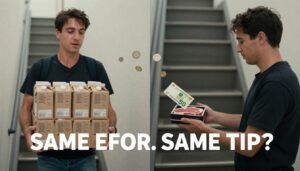
Starting January 1, 2026, German restaurants get a massive tax break: the Mehrwertsteuer on food drops from 19% to 7%. Simple math suggests your Schnitzel should cost roughly 10% less. But the industry has already announced, loudly and clearly, that you won’t see those savings on your bill. This is where things get interesting, and where German consumers are reaching for their most powerful weapon: the threat of killing off Trinkgeld entirely.
The Tax Gift That Isn’t for You
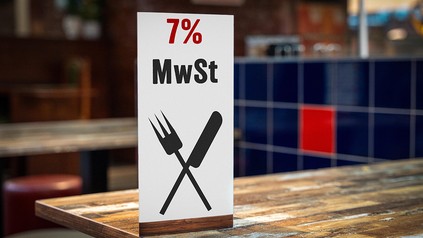
The Bundesrat’s December 2025 decision permanently reduces VAT on restaurant meals, a move the DEHOGA hospitality association calls an “überlebenswichtige Entscheidung” (existential decision). The industry cheered, claiming this will stabilize businesses, protect jobs, and preserve Germany’s gastronomic diversity. What they didn’t say: you’ll benefit indirectly at best.
Lars Schwarz, DEHOGA president in Mecklenburg-Vorpommern, told press explicitly that the reduction “won’t be passed on one-to-one” to customers. His reasoning? Rising minimum wages (jumping to €13.90 in 2026, then €14.50 in 2027), energy costs, and general inflation have squeezed margins. The tax cut, in their view, merely prevents prices from rising further.
This admission has sparked a consumer revolt. If restaurants won’t voluntarily lower prices, why should customers voluntarily supplement wages through tips?
The Trinkgeld Boycott: A Consumer Counter-Attack
The logic is brutally simple: if the 12-percentage-point tax cut isn’t reaching your wallet, stop leaving the customary 10% tip. This consumer advocacy idea has gained traction because it reframes tipping not as generosity, but as complicity in a broken wage model.
Many international residents already question why Germany maintains a tipping culture when the Mindestlohn theoretically guarantees fair base pay. As one service worker noted, with tips and minimum wage, unskilled gastro staff can net over €25 per hour, making it “significantly overpaid relative to other professions.”
The boycott argument goes further: tipping is a regressive social norm that arbitrarily rewards some workers while ignoring others. Why tip your server but not the Müllabfuhr worker who hauls away your trash in freezing weather? Why not tip medical assistants, educators, or postal workers? The inconsistency reveals tipping as a cultural relic, not a rational economic system.
Who Really Gets Hurt? The Wage Structure Reality
Here’s where the debate gets messy. German service staff do earn at least minimum wage (€12.82 in 2025, rising to €13.90 in 2026), unlike their American counterparts. But many establishments structure pay expecting tip income to supplement base wages.
Critics argue this is precisely the problem: employers should pay proper wages rather than offloading compensation onto customers’ goodwill. The VAT cut could theoretically fund wage increases, but only if owners redirect the savings internally rather than pocketing them.

Tax treatment complicates matters further. Small tips are tax-free up to certain thresholds, making them attractive for workers. But larger gratuities must be declared, and employers face scrutiny if they systematically underpay expecting tips to fill the gap. The system exists in a gray zone between undeclared cash and regulated income.
The Retaliation Fear: When Not Tipping Gets Personal
Some consumers report skipping tips not out of principle, but fear of consequences. Stories circulate of staff intentionally dropping food or providing poor service to “punish” non-tippers. One former Aral gas station worker described a colleague deliberately dropping a cheese slice because a regular customer always counted his change and never tipped, making him a “geiziges Arschloch.”
This fear factor explains why many Germans continue tipping despite philosophical objections. The social pressure is enormous. Not tipping feels like breaking an unwritten contract, even when the economic logic is questionable.
The Industry’s Defense: Where the Money “Really” Goes
DEHOGA and individual restaurant owners insist the VAT savings are needed for survival, not profit. They point to:
- Minimum wage increases: The €1.08 hourly jump in 2026 alone adds roughly €180 per full-time employee monthly
- Energy costs: Still elevated post-Ukraine crisis, particularly for kitchens
- Supply chain inflation: Food costs remain volatile
- Investment needs: Many establishments deferred maintenance during COVID
They argue that without the VAT cut, menu prices would need to rise 8-12% just to maintain current margins. So in their narrative, you’re already “saving” by not facing higher prices.
The McDonald’s Exception: When Big Chains Break Ranks
Interestingly, McDonald’s Germany announced it will pass on some savings. Starting January 2026, they’re cutting prices on five popular menu items by over 15%, targeting families and low-income customers. This move, likely calculated for PR value, highlights how larger chains with economies of scale can afford to share the tax cut while independent restaurants claim they cannot.
Food Watch estimates McDonald’s alone will save €140 million annually from the VAT reduction. Their partial price cut is a strategic choice, not a necessity, a fact that undermines smaller establishments’ “we can’t afford it” narrative.
The Bigger Picture: Consumer Power vs. Cultural Inertia
The Trinkgeld boycott debate reveals a deeper German economic tension: when should consumer behavior enforce market discipline? Germans generally trust institutions and regulations to set fair prices. The idea of using tipping as a bargaining chip feels both clever and somehow un-German.
Yet the VAT cut situation is objectively unfair. The government intended to help both businesses and consumers. If businesses unilaterally capture all benefits, they undermine public trust in future economic policies. Why support tax reforms if they only pad corporate margins?
Practical Takeaways: What Should You Actually Do?
If you want to pressure restaurants:
– Stop tipping for standard service. Tip only for exceptional experiences
– Ask managers directly: “Are you passing on the VAT reduction?” Make it a conversation
– Support establishments that transparently advertise price cuts
– Choose McDonald’s or other chains that have committed to reductions over independents that haven’t
If you want to support workers:
– Continue tipping, but ask staff about their base pay structure
– Favor restaurants that advertise “fair wages” or “service charge included” models
– Recognize that withholding tips hurts individuals, not corporate structures
If you’re just confused:
– You’re not alone. The system is deliberately opaque
– Tipping is never legally required in Germany. It’s always discretionary
– Focus on value: if a €15 meal feels worth it, pay it. If not, don’t
The Verdict: A Cultural Tipping Point
The 2026 VAT cut won’t make your restaurant meals cheaper. But it might finally kill Germany’s awkward, outdated tipping culture. That could be the real consumer victory, shifting hospitality compensation from uncertain gratuities to transparent wages built into menu prices.
The boycott movement, whether it succeeds or fails, forces an important question: why do we tip some workers but not others? Why do we accept a system where employers dodge wage responsibility? And when businesses receive tax windfalls, who deserves the benefit?