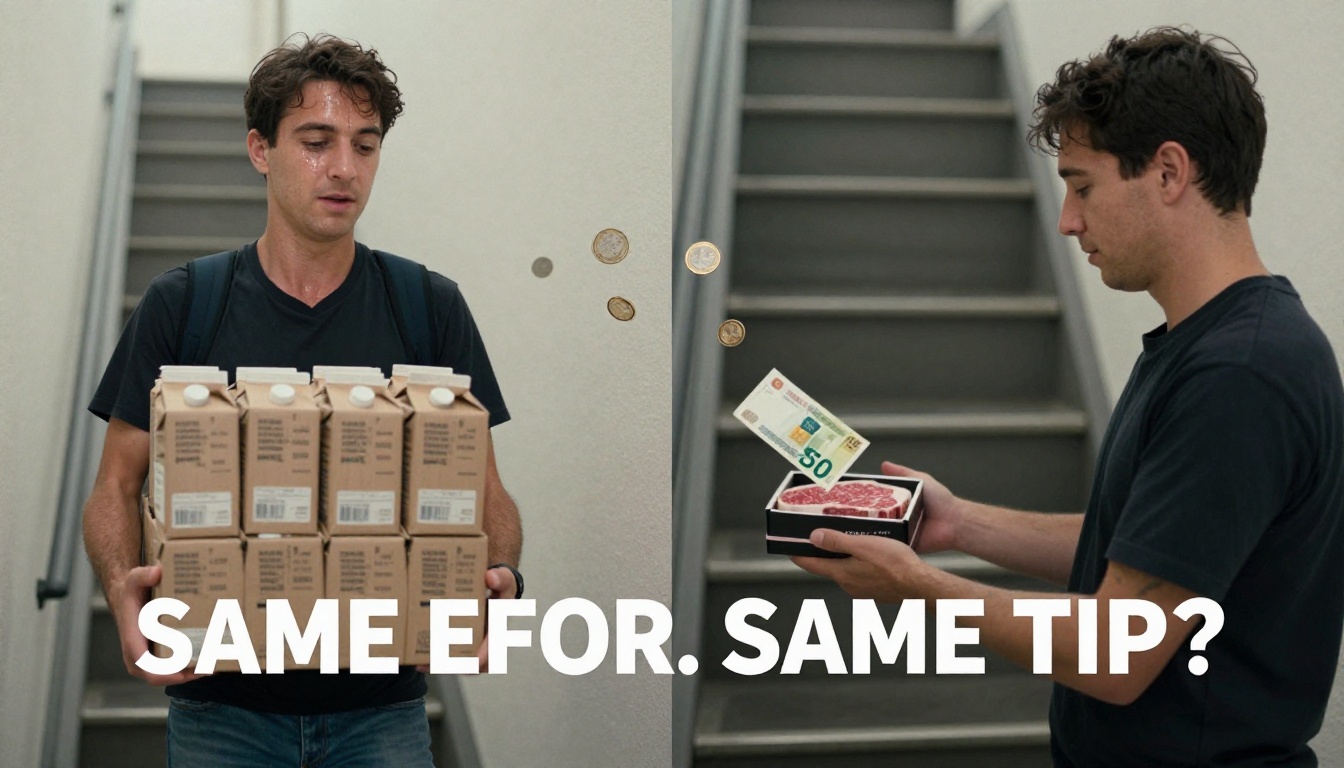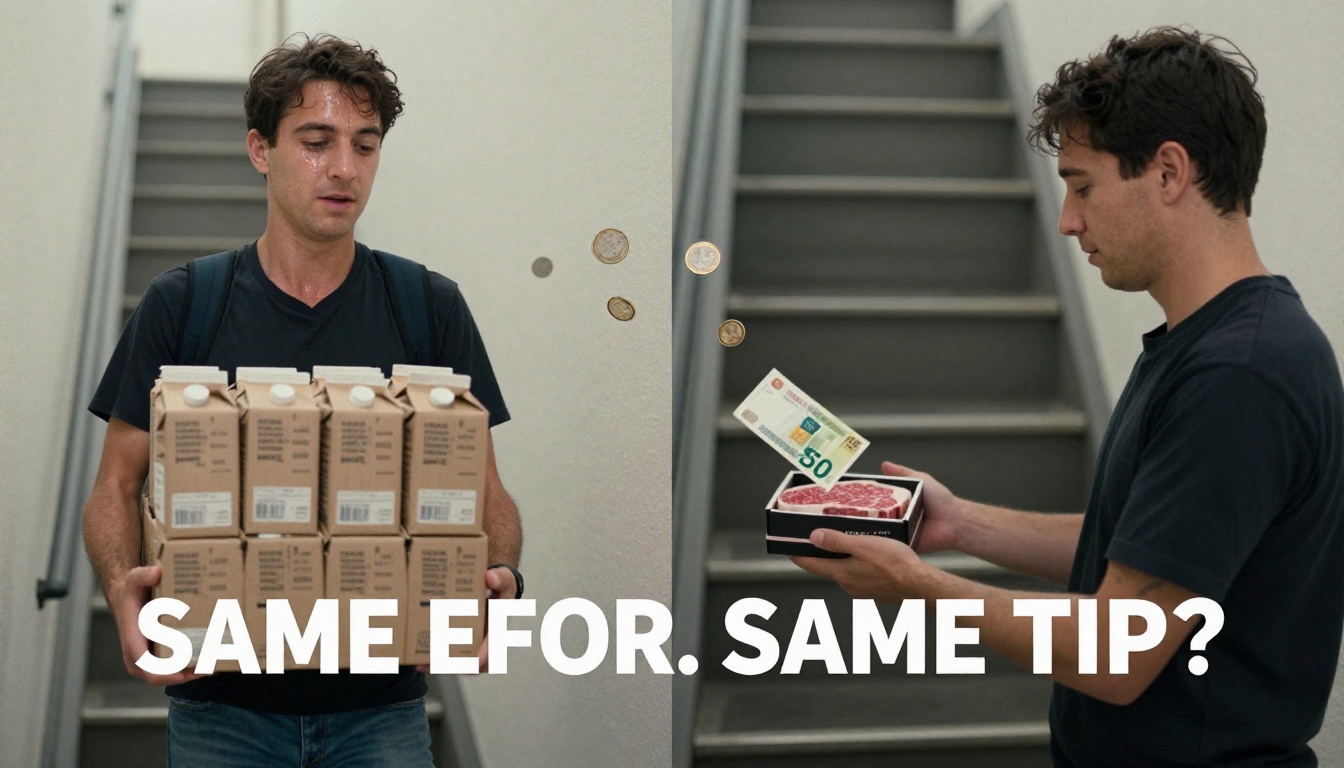
The grocery delivery arrives. You ordered online and the app prompts you for Trinkgeld (tip) before the driver even loads their van. You click 10%, feeling generous. Later, you realize you just tipped €3 for two bags of organic vegetables that took someone 30 seconds to carry to your door. Had you splurged on a single €500 Wagyu steak, that same 10% would have been €50, for identical physical effort. This is the mathematical absurdity haunting Germany’s finance-conscious residents.
The Core Absurdity: Price vs. Effort
The critique emerging from German financial circles cuts through social convention with ruthless precision: percentage-based tipping rewards price, not performance. A delivery driver hauling 100 cartons of milk up five flights of stairs earns less for infinitely more labor than someone handing over a luxury item that fits in a handbag. The distance from kitchen to table doesn’t multiply when a restaurant dish costs €40 instead of €20, yet the expected Trinkgeld (tip) doubles.
This disconnect between labor value and compensation strikes at the heart of rational financial behavior. Germans, who famously scrutinize every cent from their Krankenversicherung (health insurance) contributions to their GEZ fees, are increasingly asking why this logic evaporates at the point of service. The arithmetic simply doesn’t hold. If tipping exists to acknowledge effort, why does the price tag override the actual work performed?
The Maklerprovision: Germany’s Ultimate Percentage Scam
German financial forums point to an even more egregious example: Maklerprovision (real estate commission). The outrage is palpable. Whether a Makler (real estate agent) sells a €400,000 apartment or an €800,000 house, the paperwork remains nearly identical. Yet the commission doubles. This isn’t theoretical, it’s a system where percentage-based compensation reaches its logical conclusion of pure absurdity.
The defense that higher prices require more skill collapses under scrutiny. Many argue that selling expensive properties often requires less effort because demand outstrips supply in Germany’s heated housing markets. The agent doesn’t create the value, the market does. Yet they capture a percentage of that value as if their labor scaled proportionally. This creates a perverse incentive structure where the goal isn’t efficient service, but maximizing transaction size.
Behavioral Economics Meets German Pragmatism
The German approach to money has always been pragmatic. You see it in how residents optimize their Steuererklärung (tax return) to claim every allowable deduction, or how they compare Stromtarife (electricity tariffs) with spreadsheet precision. Percentage tipping violates this cultural DNA. It’s a lazy heuristic that outsources critical thinking to a calculator.
Research shows that preset tip percentages on card readers exploit this cognitive laziness. When confronted with three options, 10%, 15%, 20%, most people select the middle choice, regardless of service quality. This is behavioral economics at its most manipulative. The machine frames the decision, and social pressure does the rest. Many in Germany now report a simple solution: when the card reader flips around with those predetermined percentages, they select “custom tip” and enter zero. Not out of stinginess, but as a conscious rejection of manipulated choice architecture.
The “Americanization” Problem
A cultural shift is underway. Digital payment systems and international platforms are importing American tipping expectations into a society that traditionally viewed Trinkgeld as genuine gratitude, not mandatory compensation. The German model was always different: round up the bill, maybe add 5-10% for exceptional service, but never feel obligated.
This clash creates awkward interactions. Delivery drivers accustomed to app-based prompts for 15% tips meet German customers who still operate on the old system of rounding up to the nearest euro. The friction is real. Some report drivers becoming visibly annoyed when no tip is pre-selected, despite Germany having no legal or cultural expectation of mandatory tipping. The platforms are effectively training customers to override local norms with Silicon Valley-designed prompts.
The Financial Impact on Your Budget
Let’s run actual numbers. If you order groceries twice weekly at €50 per order and tip 10%, that’s €520 annually. For a service where the physical labor component remains constant whether you order €30 or €80. That same €520 could fund your BahnCard (German rail discount card), cover three months of GEZ fees, or boost your ETF-Sparplan (ETF savings plan) by €43 monthly.
The compounding effect matters. In a country where how income changes can lead to disproportionate financial outcomes in Germany creates benefit cliffs, and where how Germany’s tax and contribution system disproportionately affects middle-class earners pushes marginal rates above 50%, every euro of unnecessary spending demands justification. Percentage tipping fails this test.
A Proposal: Effort-Based Tipping
The rational alternative is obvious but socially difficult: tip based on objective effort factors. Number of bags carried. Distance walked. Stairs climbed. Complexity of order. This requires active assessment rather than passive percentage selection, which is precisely why it won’t become mainstream. It demands mental energy that busy consumers won’t expend.
Yet some Germans are pioneering this approach. They keep small bills handy and tip €1-2 per bag for delivery, regardless of order total. In restaurants, they tip a flat €5 for standard table service, increasing only for genuine excellence. This creates predictability for workers and fairness for customers. The tip becomes a recognition of labor, not a tax on consumption.
The Business Model Distortion
Here’s what tipping percentages really subsidize: business models that underpay workers. When restaurants or delivery services build tip expectations into compensation, they shift wage responsibility to customers. This creates information asymmetry. The advertised price isn’t the real price, and the worker’s income becomes variable and unpredictable.
Germany’s strong worker protection laws and relatively high minimum wages should make this model less prevalent. Yet international platforms circumvent this by classifying workers as independent contractors. The tip becomes a wage subsidy disguised as voluntary gratitude. Consumers unwittingly participate in a labor cost transfer that benefits corporations, not workers.
Practical Takeaways for Germany Residents
For delivery services: Consider a flat rate per bag or per stairwell. €1-2 per bag is generous and consistent. Ignore percentage prompts.
For restaurants: The traditional German approach remains valid. Round up to the nearest euro, add 5-10% only for service that exceeds expectations. No tip for poor service is culturally acceptable.
For grocery collection: No tip needed. You’ve saved the business labor costs by picking up yourself.
For taxis: Round up to the nearest euro, or add €1-2 for long rides. The 10-15% rule is American, not German.
Track it: Add a “Trinkgeld” category to your budget tracking for one month. The total will likely shock you into rethinking the system.
The percentage-based tipping model survives not because it’s logical, but because it’s easy. It requires no thought, no assessment of actual service, and no confrontation with the uncomfortable economics of service labor. But in Germany, where financial rationality is a cultural virtue, that excuse wears thin. The math doesn’t add up, the incentives are misaligned, and your budget deserves better.
Next time that card reader flips toward you with three glowing percentage options, remember the Wagyu steak and the milk cartons. The right answer might be zero percent, and 100% rational.