Most German drivers can tell you exactly what they paid for their last tank of fuel. Ask them what their car costs per month, and they’ll likely say around €200. That number feels right. It’s concrete, manageable, and aligns with what they see leaving their bank account for insurance and the occasional repair.
The problem? It’s complete fiction.
Research consistently shows the average German passenger vehicle costs more than €400 monthly, nearly double what drivers estimate. This isn’t a rounding error, it’s a massive blind spot that distorts household budgets, influences major purchase decisions, and leaves countless residents wondering where their money went.
The €200 Delusion: Why Your Brain Lies to You
Behavioral economist Mark Andor identified this pattern in recent studies: drivers systematically ignore or underestimate most vehicle expenses while focusing obsessively on visible costs like fuel. This cognitive bias isn’t unique to Germany, but the country’s high automotive standards and complex cost structures amplify the effect.
When you ask someone about car costs, their mental calculator automatically includes:
– Fuel (€80-120/month)
– Insurance (€60-90/month)
– The last repair bill (amortized to maybe €30/month)
What it doesn’t include:
– Depreciation (€150-300/month for most vehicles)
– Taxes and inspections (€20-40/month)
– Tires and scheduled maintenance (€40-60/month)
– Parking fees and tickets (€20-50/month in cities)
– Financing interest (€50-150/month for financed vehicles)
The result is a financial mirage. Drivers see the oasis of affordable mobility while ignoring the very real costs sinking their budget.

The Depreciation Trap: Your Car’s Silent Money Burn
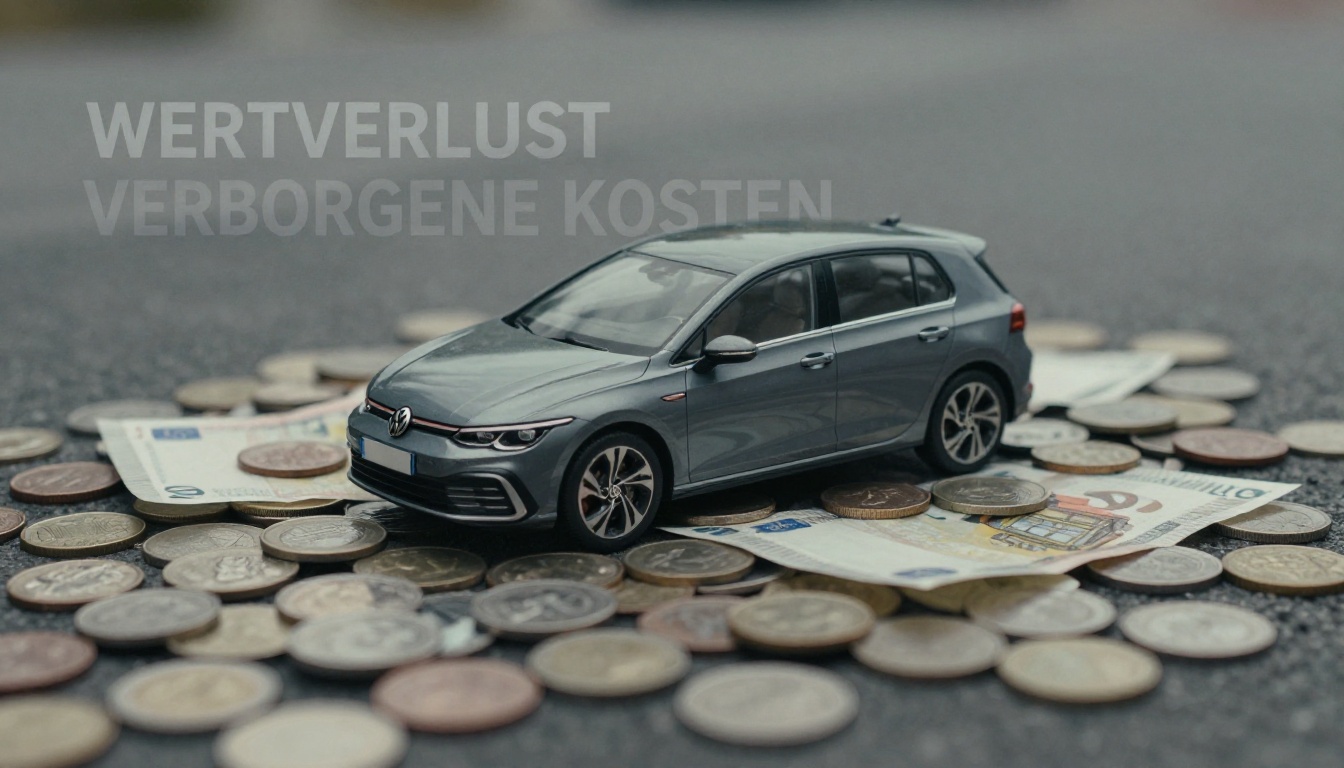
The biggest invisible cost? Wertverlust (depreciation). A new Volkswagen Golf purchased for €32,000 loses approximately €3,500 in value during its first year alone. That’s €291 monthly, more than most Germans estimate for their total vehicle costs.
Even used cars bleed value. A €14,500 vehicle driven for five years still depreciates around €150 monthly. Yet when drivers calculate costs, depreciation rarely enters the equation because it’s not a cash outflow. No money leaves your account, so it doesn’t feel real.
This psychological blind spot explains why many residents continue buying new vehicles despite the financial math working against them. The monthly payment feels manageable at €350, but add depreciation and you’re suddenly at €600+ in real costs.
Official Calculations vs. Reality: The ADAC Controversy
The Allgemeiner Deutscher Automobil-Club (ADAC, General German Automobile Club) publishes detailed cost calculations for hundreds of vehicle models. Their methodology includes depreciation, insurance, taxes, maintenance, and fuel. For a typical compact car, they calculate around €450-550 monthly.
Many drivers reject these figures outright. Online discussions reveal widespread skepticism: “My small car doesn’t cost that much”, or “Those numbers are for people who drive like Mr. Bean.”
This skepticism stems from a statistical truth: ADAC calculates average costs across all drivers, including those with expensive accidents, poor maintenance habits, or high financing rates. Prudent drivers who maintain their vehicles well and avoid crashes can indeed spend less.
One driver reported their Dacia with 180,000 kilometers costs only 23 cents per kilometer all-in, roughly €230 monthly at average mileage. Another calculated their Skoda Fabia at 17 cents per kilometer. These examples prove the ADAC numbers aren’t universal, but they also represent the best-case scenarios, not the typical experience.
The Leasing Illusion: When “Affordable” Becomes Expensive
Leasing seems to solve the cost visibility problem. One fixed monthly payment covers everything, except it doesn’t.
Comparing true costs of leasing versus buying a car reveals how manufacturers structure deals to feel affordable while extracting maximum value. That €270 monthly rate for a new Cupra Born looks attractive compared to a €43,000 purchase price, but mileage limits, mandatory maintenance at authorized dealerships, and end-of-lease fees often push real costs to €400+ monthly.
Worse, leasing locks you into permanent depreciation payments. You never build equity, never reach the point where your vehicle’s value stabilizes, and never escape the highest-cost period of a car’s life.
The Company Car Mirage: Tax Benefits Masking True Costs
For mid- to high-income earners, the Firmenwagen (company car) appears financially optimal. Under the 1%-Regelung (1% rule) for combustion engines or 0.25%-Regelung for electric vehicles, you’re taxed on a percentage of the list price as a monetary benefit.
The math seems absurdly favorable: a €40,000 electric Skoda Elroq costs just €100 in taxable monthly benefit. Even with a 42% tax rate, that’s only €42 net.
Hidden costs of company electric cars in Germany shows how this calculation ignores the embedded cost in your salary package. Employers rarely offer company cars as pure benefits, they’re factored into total compensation, meaning you’re financing the vehicle through lower wages.
Additionally, company car drivers typically cover fuel for private trips, face restrictions on vehicle choice, and lose flexibility. The tax advantage is real, but the total financial picture is more complex than the monthly tax deduction suggests.
The Commuting Cost Delusion: When Time Savings Trump Financial Reality
Many drivers justify vehicle costs through time savings. “I save two hours daily compared to public transport”, they argue, making the expense irrelevant in their calculation.
This perspective reveals another cognitive bias: opportunity cost blindness. While time certainly has value, the financial trade-off remains stark. A driver spending €400 monthly to save 40 hours (€10/hour value) might be better served negotiating remote work or relocating.
Underestimating real commuting costs with personal vehicles demonstrates how the Pendlerpauschale (commuter allowance) fails to bridge this gap. At 38 cents per kilometer for long distances, the tax deduction covers less than half the real cost per kilometer for most vehicles.
The psychological trap: we value time saved today more than money saved tomorrow. This asymmetry drives countless Germans into car ownership that doesn’t withstand rigorous financial analysis.
Breaking the Cycle: How to Calculate Your Real Costs
If you own a car in Germany, stop estimating. Start calculating:
Method 1: The Total Cost Approach
1. Track every euro spent on the vehicle for three months: fuel, insurance, repairs, parking, washing.
2. Add annual costs (taxes, inspections, tires) divided by 12.
3. Check your vehicle’s current market value and compare to purchase price. Divide the difference by months owned.
4. Sum all components. The result will likely shock you.
Method 2: The Per-Kilometer Reality Check
– Fuel: 8-12 cents/km
– Depreciation: 10-20 cents/km (newer vehicles)
– Insurance: 3-5 cents/km
– Maintenance: 3-6 cents/km
– Taxes and other: 1-2 cents/km
Total: 25-45 cents per kilometer
Drive 15,000 km annually? That’s €312-562 monthly. Even at the low end, you’re above the €200 fantasy.
The Bottom Line: Awareness Is the First Step
The problem isn’t that cars are inherently unaffordable, it’s that invisible costs destroy financial planning. German drivers don’t need to give up their vehicles, but they desperately need to understand what those vehicles actually cost.
This awareness changes everything: which car you buy, whether you finance or pay cash, how you weigh cars against other transportation modes, and how you structure your overall budget.
The €200 delusion persists because it’s psychologically comfortable. Reality is less kind, but facing it is the only way to make truly informed decisions about mobility in Germany.
Your car doesn’t cost what you think. The sooner you accept that, the sooner you can take control of the real expenses draining your account.